

Women have always been underrepresented in Ukrainian media. This has been a consistent trend, confirmed by 13 years of monitoring by the Institute of Mass Information: the share of media content about women has fluctuated within 13–30%, while the presence of men in the media has been much larger.
In February 2026, IMI’s monitoring study showed the share of women experts featured in online media to be 21% (the same as the year before), while the share of women as news subjects has grown from 16.5 to 26%. At first glance, this seems like progress. In reality, however, the rise in the number of female subjects in 2026 was mainly due to the increase in the number of news stories about crime and extraordinary events where women mostly appear as victims or perpetrators.
In other words, the visibility of women is growing not because the media have at last begun to consistently seek them out as decision-makers and competent experts, but because they make for a convenient illustration. Women are portrayed as victims, suspects, relatives, beautiful daughters, and social media celebrities. However, only one in five news stories feature women as experts who explain, analyze, and shape the discourse.
Women as experts in Ukrainian online media
IMI’s monitoring study suggests that women are most often featured as experts in news by Suspilne.Novyny (37%). This seems to be a result of the media outlet’s editorial policy and standards rather than random luck with their sources.
Korespondent showed the lowest representation of women experts: 11%. Such a gap usually means that a news outlet is hardly taking any action to expand their pool of female speakers.
Among other media outlets* featured in the study, the representation of women experts varied from 13 to 28%. This range shows that there are quite enough women experts on the market and the problem stems from editorial habits and priorities.
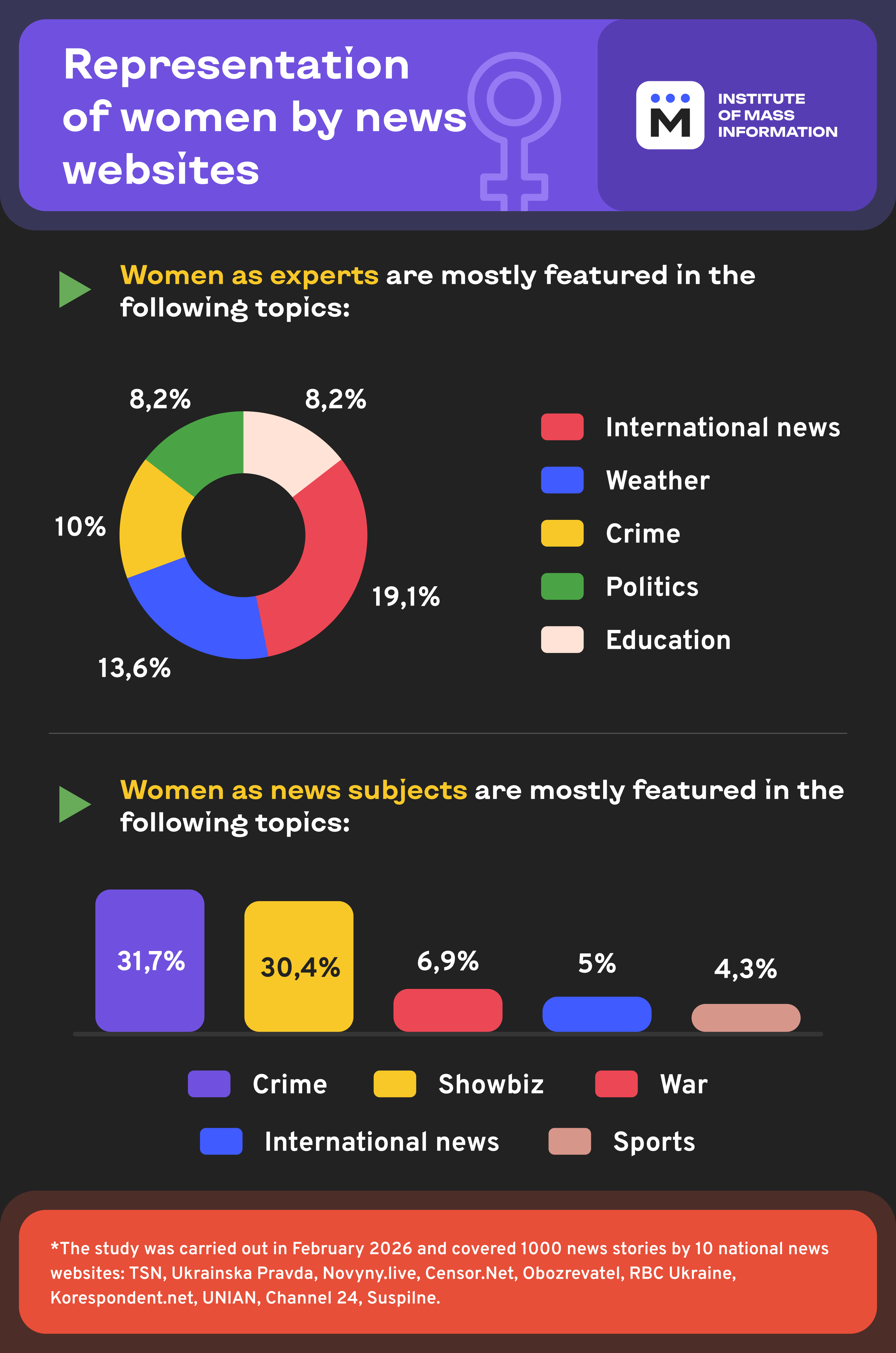
Women were most often invited to comment on international news: 19.1% (of the total number of news featuring women as experts). International news traditionally boost the women visibility score, because the gender balance in European institutions is usually better than in Ukrainian politics or economics. The media quoted international politicians, spokeswomen and speakers from international institutions, including European Commissioner Hadja Lahbib, European Commission Spokesperson Anna-Kaisa Ikonen, and EU Special Envoy for Ukrainian Affairs Ylva Johansson. Female European politicians most often discussed humanitarian aid to Ukraine, the legal status of Ukrainian refugees in the EU, and the EU’s stance on the Druzhba oil pipeline repairs.
- “Is there a risk of Ukraine humanitarian aid cuts: what the EU says” (RBC Ukraine)
- “‘No critical questions’: EU assesses Ukraine’s humanitarian aid spending” (RBC Ukraine)
- “Ukrainians will not get automatic permission to stay in the EU: what awaits refugees in 2027” (Oboz.ua)
- “EU not demanding Ukraine urgently repair Druzhba pipeline, says spokeswoman” (Ukrainska Pravda)
13.6% of expert comments were weather-related, suggesting that a key way for women to be visible as experts is safe, routine topics. In these materials, the media most often quoted the weatherwoman Natalka Didenko, who was close to being the only meteorologist making regular appearances in the news during the monitoring period. Most media were not trying to expand their pool of female weather experts and chose to follow the momentum instead.
- “Anti-cyclonic storm ‘Felix’ to affect Ukraine’s weather: meteorologist Natalka Didenko explains the details” (UNIAN)
- “When true warmth will come to Ukraine: meteorologist makes a hopeful prediction” (Ukrainska Pravda)
Occasional comments by other weatherwomen only occurred in news by Suspilne’s regional branches.
- Chance of rain and wet snow: what the weather in Mykolaiv oblast will be like this week (Suspilne)
Women also provided expert comments on crime and emergencies (10%). A significant share of such news was by Suspilne due to the broadcaster having a network of regional branches: regional journalism automatically expands a news outlet’s range of sources and increases the chances of more female voices being heard, which is why IMI always recommends that national resources look to their regional colleagues.
In these news, correspondents often took exclusive comments from female press officers and spokeswomen of regional law enforcement departments and response services such as the State Emergency Service, the National Police, and the Security Service of Ukraine. On the one hand, this makes women more present in the news. On the other hand, however, it reinforces the “woman as a spokesperson” paradigm while female experts and analysts are much less frequently featured in security-related news.
- “Man’s body found in a river in Zhytomyr: cause of death under investigation” (Suspilne)
- “Plotted terrorist attack in central Kropyvnytskyi: SBU detains man on suspicion of working for FSB” (Suspilne)
- “Deporting Ukrainian children to Russia: 22 people notified of suspicion, 4 cases submitted to court” (Censor)
- “Over 400 persons prosecuted for high treason in 2025” (Ukrainska Pravda)
8.2% of expert comments by women were about politics. This is a fairly low percentage, and a good illustration of men’s monopoly on public expertise in the political field. The woman quoted most often by the media was Prime Minister Yulia Svyrydenko. Her statements recorded during IMI’s monitoring period concerned the government’s decisions and programs to provide internally displaced persons with temporary housing and simplify the state property lease procedure, as well as state energy support programs. It is fairly typical of Ukrainian media to quote women when it comes to social administration issues while leaving topics such as peace talks, strategies, the economy, security, etc. to men.
- “Housing for IDPs for 1 hryvnia per year: government to simplify state property lease procedure, says Svyrydenko” (Suspilne)
- “Government is introducing a simplified mechanism to provide IDPs with temporary housing” (Korespondent)
- “Programs and financial aid: Ukraine launches a comprehensive energy support platform for persons and businesses” (RBC Ukraine)
Female experts also commented on education: such news amounted to 8.2% of recorded material. Education is traditionally a female sphere of public visibility, but this reflects the gender division of labor rather than a real equality of voices in the media. The comments concerned changes in the National Multi-Subject Exam (NME), safety standards for educational institutions, and the use of mobile phones during lessons. Noteworthily, women are more often asked to comment on this topic as practical managers of processes and regulations while strategic discussions about education reforms, funding, or policies are often left to men when it comes to representation in the media.
- “No long answers, no two-day sessions, but with metal detector checks: the Ukrainian Education Quality Assessment Centre explains what the NME 2026 will be like” (Ukrainska Pravda)
- “Metal detector checks upon entrance, video surveillance: new safety measures to be introduced in schools” (RBC Ukraine)
- “Children can not tell time by analogue clocks: what smartphone ban in New York schools revealed” (Oboz.ua)
There were also occasional comments by women experts on topics such as war, human rights, economics, health, and culture.
Women as news subjects in Ukrainian online media
News stories featuring women as subjects amounted to 26%, IMI’s monitoring showed. Compared to 2025, this figure has grown by 9.5%, which may seem as a significant leap forward. In reality, however, the increase in the share of female subjects in 2026 was mainly due to the growing number of news about crime and emergencies, where women mostly appear as either victims or suspects. So, even though there was an increase, it does not indicate any systemic change, because women are still mostly featured to illustrate a news story rather than being portrayed as proactive figures.
The largest share of news stories featuring women as subjects was recorded on TSN (38%) and Channel 24 (32%), while Novyny.live (13%) posted the fewest such news. Such a gap usually means varying editorial approaches, where some media cover personal stories and social issues more actively while others focus on politics, safety, war, sports — the traditionally “male” topics in Ukraine. Among other media outlets included in the monitoring, the representation of women as subjects ranged from 16 to 29%. This once again confirms that the issue is not that there are not enough women in real life, but that journalists gravitate towards men when looking for subjects and are used to considering men more suitable as characters.
Women as subjects were most often featured in news related to crime, emergencies, or traffic accidents — 31.7%. This is an alarming indicator, because women’s visibilty in our media is often associated not with influence or agency but with trauma, danger, or sensation. Women were subjects of news related to crime and emergencies, fraud, kidnapping, accidents, and appeared as accomplices in crimes, recruited agents, or collaborators. Such stories easily reinforce the “woman as victim” and “woman as threat” stereotypes. In both cases, the women’s role is to provide drama, not expertise.
- “Aided Russia’s passportisation effort. Kherson woman convicted of collaborationism” (Suspilne)
- “Kyiv police returns child aged 3 who was kidnapped and taken abroad by father to her mother” (Oboz.ua)
- “Scammed a child into giving her half a million hryvnias: Ivano-Frankivsk woman convicted of fraud” (Ukrainska Pravda)
- “Pregnant woman and underage boy injured in two traffic accidents in Ternopil oblast” (Suspilne)
Show business accounted for 30.4% of news mentioning women as subjects. Meaning, nearly third of women’s visibility is concentrated where the media most often sells “the person” as a curiosity rather than as a subject with a voice and influence. The media mostly wrote about famous women, focusing on their relationships, private life, health, or looks. This is a classic discriminatory lens where men tend to be judged by their actions and achievements while women are evaluated based on their body, age, appearance, behavior, and clothing. A significant portion of such news was based on social media posts and had no informational value. Such content replaces news with gossip and reinforces the idea that women mainly contribute to society by being beautiful. While not thinking too much, preferably.
- “Internet adores new photos of Nikitiuk’s 8 months old son” (UNIAN)
- “Tonia Matviyenko shares reasons for the crisis in her marriage to Mirzoyan and how they overcame it: ‘It’s not easy'” (TSN)
- “Beyoncé radically changes her image, cuts long curls” (Korespondent)
Some showbiz-related news about women were outright discriminatory. Most of these were by TSN, which has been found to violate the standards of non-discrimination against women by IMI’s every monitoring. These are not one-off errors but a consistent editorial practice. Depending on the monitoring period, news about women vary from stereotypical clichés to women being condemned for their clothing choices, age, or lifestyle. Some media outlets seem to assume the authority to judge which women live “the right way” and which deserve condemnation. For instance, TSN decided to highlight a girl’s appearance by calling her a “beautiful daughter.”
- “Masha Yefrosynina shares rare photo of her beautiful 22 year old daughter, addresses her in a post” (TSN)
In this way, the news outlet does nothing but reinforce the classic gender stereotype, where women are described through their appearance or clothing while men are more often characterized by their strength or achievements.
In another news story, the team had fun with sexualising a girl’s body and fantasising about her bust.
- “21 year old daughter of the supermodel Claudia Schiffer shows off lush cleavage in swimwear” (TSN)
IMI has previously reported that 26 out of 50 Ukrainian news outlets produce and share discriminatory, demeaning, or humiliating content about women. IMI’s experts stress that such content has a negative impact on girls’ and women’s quality of life.
6.9% of news featuring women as subjects were about the war. This is a very low percent for a country that lives with war every day. Unfortunately, this goes to show how easily the media narrows the women’s experience of war down to a few familiar perspectives. In these news stories, women were most often depicted as victims of Russian air strikes or as relatives of deceased servicemen. Such a framework reinforces the image of women as bearers of loss and pain while offering little to no space for women as servicemembers, volunteers, medics, administrators, veterans, rescuers, or security experts shaping the reality of war just as much as men do.
- “Russian forces strike major regional center: hospital damaged, people wounded” (TSN)
- “Mother of deceased sergeant from Vinnytsia, Vladyslav Yashyn, receives son’s posthumous award” (Suspilne)
No news stories featuring servicewomen were recorded during the monitoring period. For comparison: last year, IMI researchers found that the media rarely mentioned servicewomen (about 5% of all news about the military), while mentions of servicemen accounted for 95%.
As for international news, 5% of these featured women as subjects. They dealt with international negotiations, security policies, and relations between countries. IMI researchers found that women mostly appeared in such news stories as secondary characters, meaning they were mentioned in relation to events but rarely portrayed as key actors making decisions and setting the agenda.
- “Kallas’s response to Waltz becomes a meme: it shows how Europe feels about the US” (Channel 24)
- “Hungary, Slovakia ask Chroatia to allow transit of Russian oil bypassing Ukraine” (Censor)
- “Fedorov to join meeting of five European defense ministers in Poland” (Censor)
As for sports news, 4.3% of these mentioned women as subjects. Such news reported on female athletes’ participation in international competitions, their achievements, and awards won.
- “Six athletes from Vinnytsia win awards at European MMA championships” (Suspilne)
- “Chernihiv athlete wins bronze in international Olympic taekwondo competition Austria Open 2026” (Suspilne)
There were also some news stories related to politics, society, culture and education, healthcare, and daily life that featured women as subjects.
Feminine forms of job titles
As IMI researchers observed, Ukrainian news outlets still struggle with consistent use of feminine forms of job titles in their news. Some stories used both feminine and masculine job titles to refer to the same woman.
One example is found on the RBCUkraine website, where the same expert was called a “yevrokomisar” as well as “yevrokomisarka” (masculine and feminine forms for “European Commissioner” respectively).
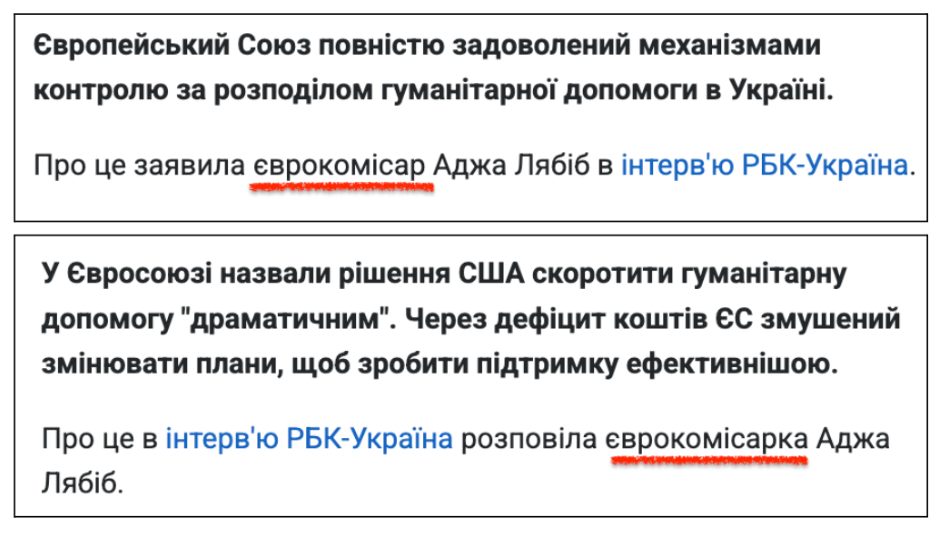
Such occasional cases may suggest either a lack of a thorough editorial policy or careless editing. IMI researchers found no news outlets to deliberately and consistently avoid using feminine forms of job titles. However, the problem remains relevant. Feminine forms are often used inconsistently, varying from contributor to contributor, and not as a rule.
IMI recommends that news outlets establish clear rules for their teams so that editors and journalists adhere to a unified approach to the use of feminine job titles. Consistent use of feminine forms will contribute to greater visibility of women in the media and a more accurate reflection of a reality where women hold positions, make decisions, and bear responsibility just as much as men do.
*The study was carried out in February 2026 and covered 1000 news stories by 10 national news websites: TSN, Ukrainska Pravda, Novyny.live, Censor.Net, Obozrevatel, RBC Ukraine, Korespondent.net, UNIAN, Channel 24, Suspilne.