
The Kremlin has set out to spend 146.3 billion rubles (about $1.6 billion) on propaganda in 2026. This money could have opened approximately 50 hospitals or over 100 schools equipped with modern technology, or it would have been enough to build affordable housing for those in need. Of course, this sum would not have made a significant difference for Russia at large, but it would definitely have improved the quality of life in several regions.
The annual growth in funding for state-affiliated media shows that Russia does not plan to end the war and continues to push hateful narratives targeting whoever is not included in the “Russkiy Mir”.
A thing to note about Russian propaganda is that they hate everyone who is not with them, Ukrainians as well as people of any nation. Russian state media also peddle hostile narratives against their own citizens if they do not fit into the image of “Slavic Russians”. A previous study by the Institute of Mass Information (IMI) showed that Russian media will reliably name the national minority a person belongs to if they are featured as a suspect in a criminal chronicle, but whenever a person from a national minority is commended or awarded, they will always be called “a Russian”.
The Institute of Mass Information has examined the language of hate used by Russia’s top-10 news websites* and found that the vast majority of media outlets included in the study was affiliated with the Russian authorities through receiving funding from the state, having ties to Putin’s entourage, or being part of the state-run propaganda machine.
“Nazis”, “murderers”, and other ways to dehumanise Ukrainians
News containing hate speech against Ukrainians occupy a special place in Russian media feeds. The propaganda outlets consistently work to stir the domestic audience, cement the “Ukrainians — Nazis” association, and dehumanise Ukrainians as a nation. All Ukraine-related narratives that Russia peddles through the media have signs of genocidal rhetoric. The Russian propaganda machine puts extra effort into shaping a negative, satanic image of the Ukrainian Armed Forces and of Volodymyr Zelensky.
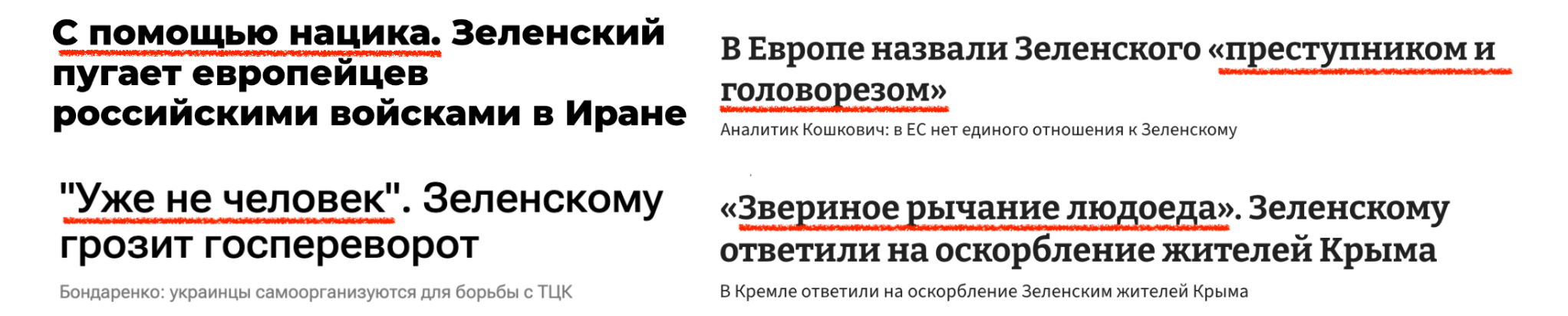
“Zelensky called ‘a criminal and a murderer’ in Europe”;
“‘No longer human’. Zelensky at risk of being overthrown”;
“‘An ogre’s beastly growl’. A response to Zelensky’s insults to Crimeans”.
Screenshots from Rossiyskaya Gazeta, Argumenty i Fakty, and RIA Novosti by IMI
A consistent throughline in Russian news feeds are the “Ukrainians are Nazis” allegations. However, Russian propaganda still has not picked what is better attributed to Ukrainians: Nazism, neo-Nazism, or Satanism.
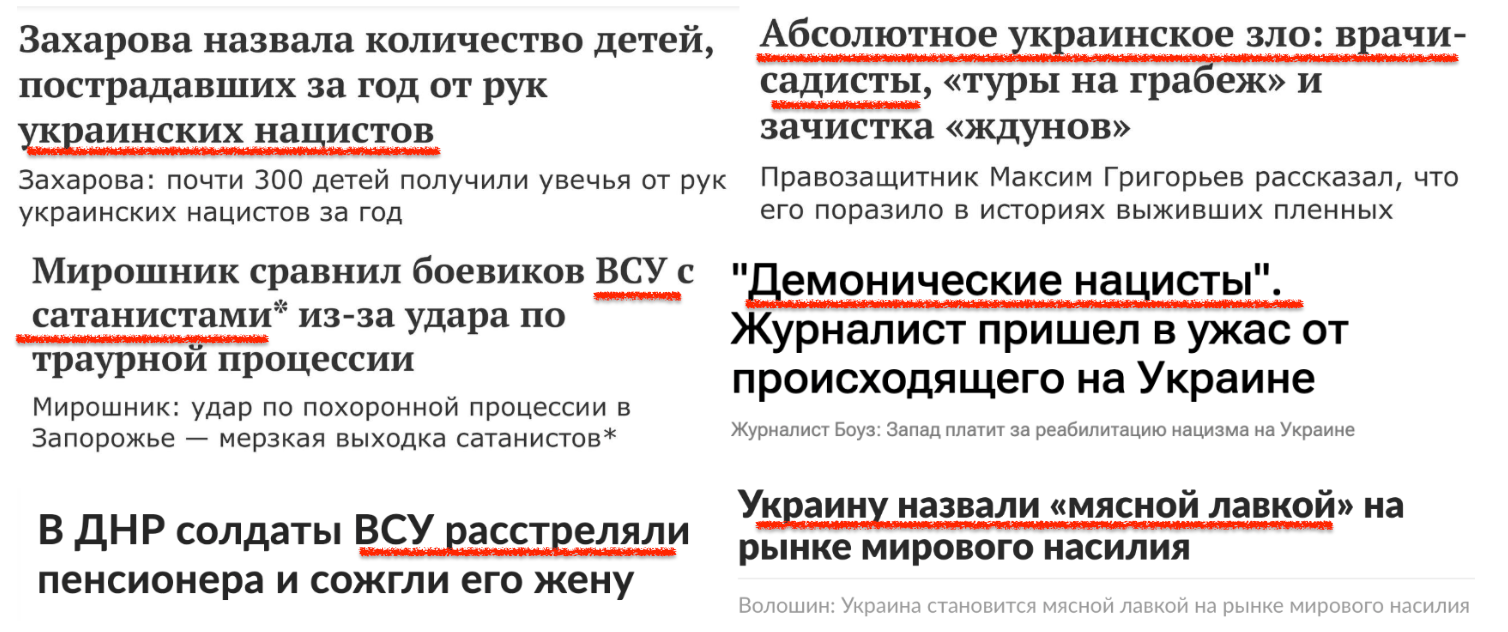
“The absolute Ukrainian evil: sadist doctors, ‘looting tours’, and ‘dissident purges'”;
“Miroshnik compares UAF militants to Satanists following funeral procession strike”;
“‘Demonic Nazis’. Journalist horrified by events in Ukraine”;
“UAF soldiers shoot an elderly DPR resident dead, burn his wife alive”;
“Ukraine named ‘the butcher’s shop’ of the global violence market”.
Screenshots from Rossiyskaya Gazeta, Lenta.ru, Argumenty i Fakty, and MK.ru by IMI
Russian state-affiliated media accuse Ukrainians of each and every sin and never fail to mention victimised children, “civilians”, vulnerable groups — anything that is likely to move the target audience. Repeated constantly, these narratives shape rigid ideas about Ukraine as the enemy, adding another argument in favour of the war.
In addition to genocidal rhetoric, Russian propaganda amplifies the voice of the pro-Russian Ukrainian politician Viktor Medvedchuk, who claims to represent the Ukrainian opposition when he says that in order to survive Ukraine needs to abandon the idea of European integration.
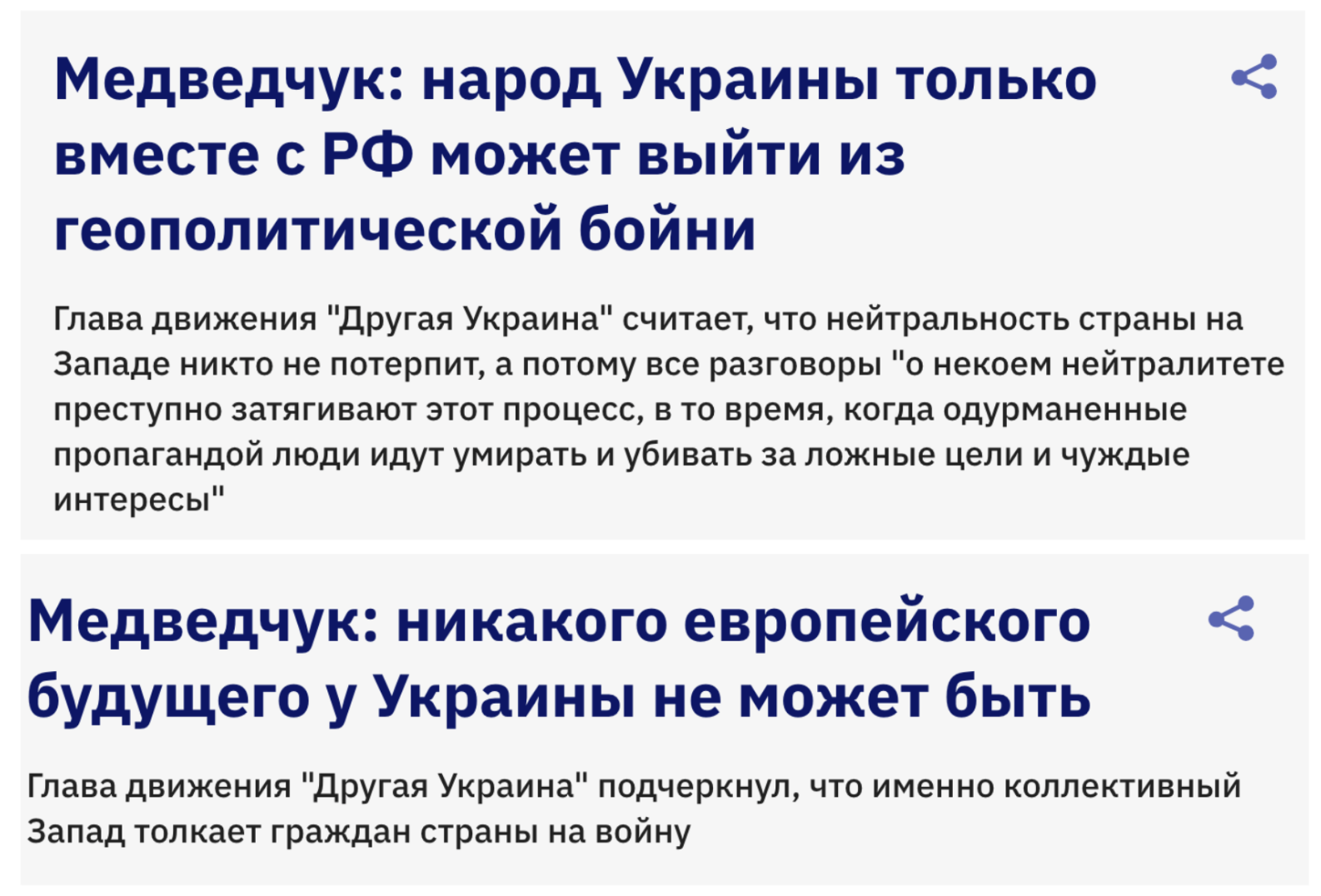
“Medvedchuk: There can be no European future for Ukraine”
Screenshots from TASS by IMI
Medvedchuk’s messaging is that “the collective West is pushing Ukrainian citizens into war, offering no alternative to senseless bloodshed and sacrifice;” he fails to acknowledge that it was Russia that started the war. Medvedchuk’s quotes are often included in Ukraine-related news and are intended to present an alternative, an independent opinion by “the opposition”, which happens to fully align with Russian propaganda narratives.
“The amoral collective West”
Russian state-affiliated media have also been prolific in promoting hate against foreign citizens who have enlisted in the Ukrainian Armed Forces. One should look no further than the headlines of Russian news outlets to understand how Russian state propaganda works. News editors mix together hatred, fear, dehumanisation, and fake ideas about the war.
Russian websites use dehumanising language in their headlines, habitually stripping foreign citizens serving in the UAF of humanity and portraying them as an enemy, thus justifying war and violence against them.
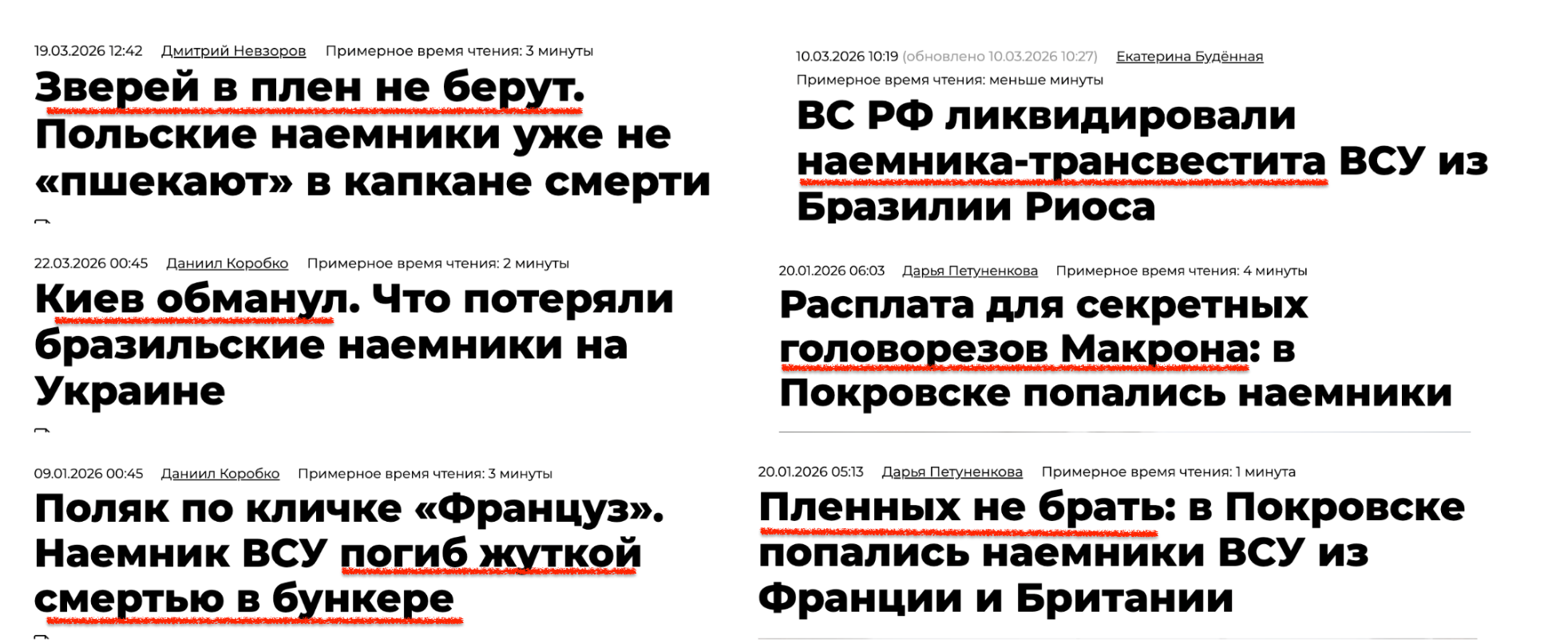
“RFAF eliminate Rios, a UAF mercenary transvestite from Brazil”
“Deceived by Kyiv. What Brazilian mercenaries lost in Ukraine”
“Payback for Macron’s secret thugs: mercenaries caught in Pokrovsk”
“A Pole nicknamed ‘Frenchman’. UAF mercenary dies a horrible death in a bunker“
“Take no prisoners: UAF mercenaries from France and UK caught in Pokrovsk”
Screenshots from Argumenty i Fakty by IMI
Russian media highlights the “enemies'” national diversity in their headlines, fueling the anti-Western sentiment among the domestic audience and reinforcing the idea that “the collective West is against Russia.” At the same time, it is important for Russia to stress that Ukraine is not fighting this war alone but instead recruits “mercenaries”. Such news with pointed headlines act as an emotional trigger for the Russian readers while getting them used to dehumanisation and dulling their sensitivity to violence.
If previously Russian media used to claim that Ukraine was the hotbed of Nazism, now obscure figures and Russian officials alike communicate that it is Europe who is rewriting history and normalising Nazism.
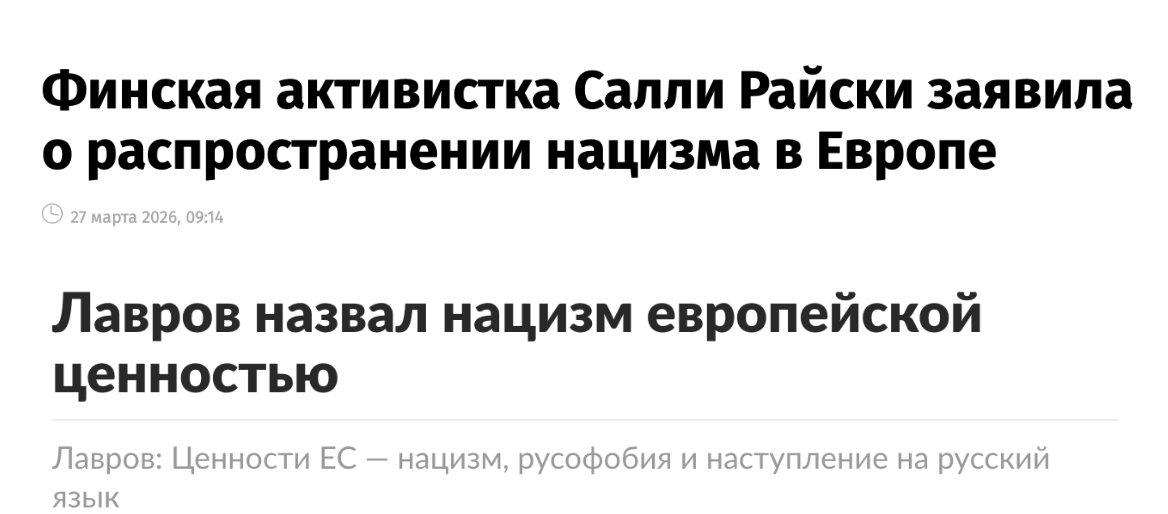
“Lavrov calls Nazism a European value”
Screenshots from Lenta.ru and Izvestiya by IMI
The Baltics do not go unnoticed by Russian media, either. These countries are attributed both Russophobic and Nazi sentiments.
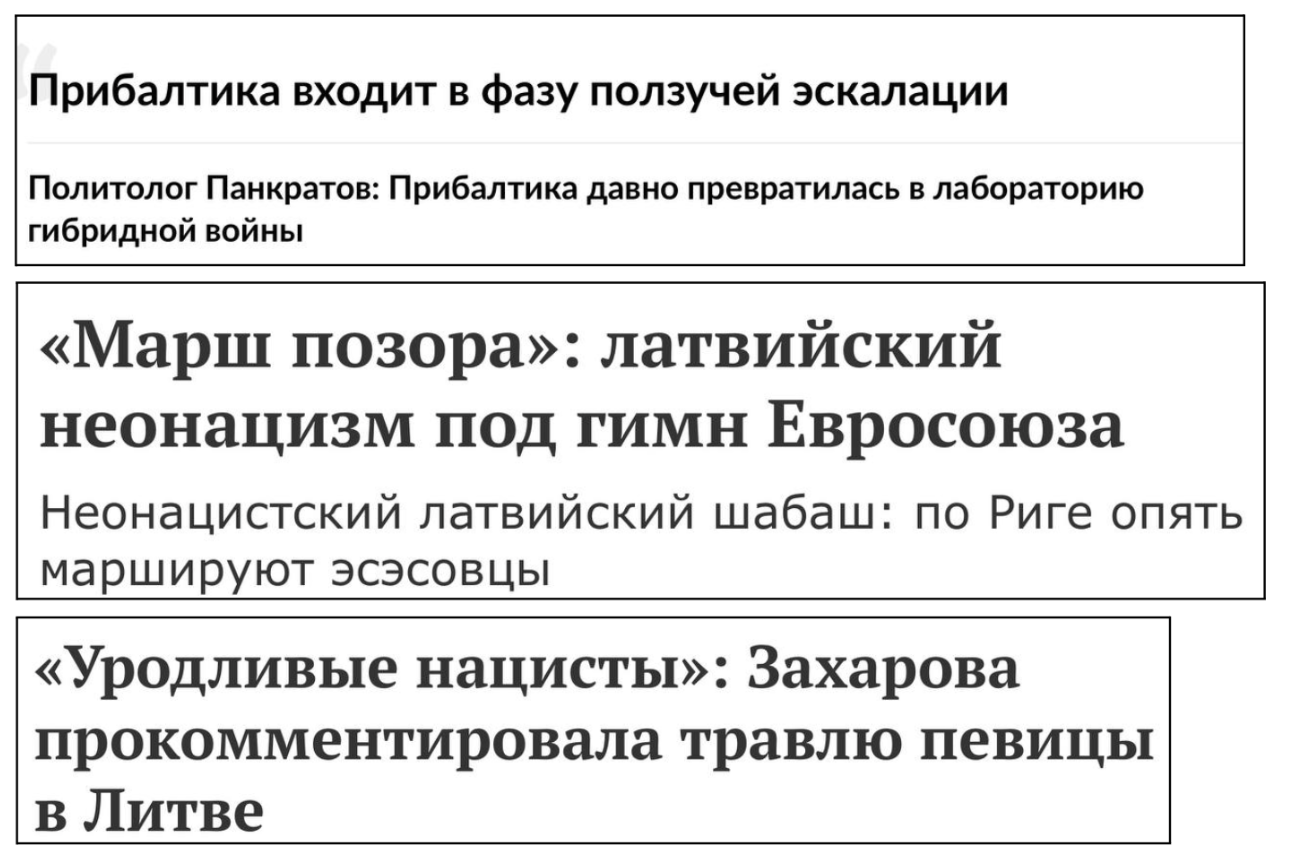
“‘The walk of shame’: Latvian neo-Nazism unfolds to the tune of EU anthem”
“‘Ugly Nazis’: Zakharova comments on the harrassment of a singer in Lithuania”
Screenshots from MK.ru and Rossiyskaya Gazeta by IMI
Obscure “experts” were on it, as well. Occasionally, Russia involved Viktor Medvedchuk, who had promoted and managed the “Russkiy Mir” agenda in Ukraine for years. Since he continues to live in Russia, the media have been calling him “Ukraine’s opposition leader” whose messages are in tune with Russian propaganda.
For instance, in one news article, Medvedchuk compares Friedrich Merz to Adolf Hitler in order to demonise the politician.
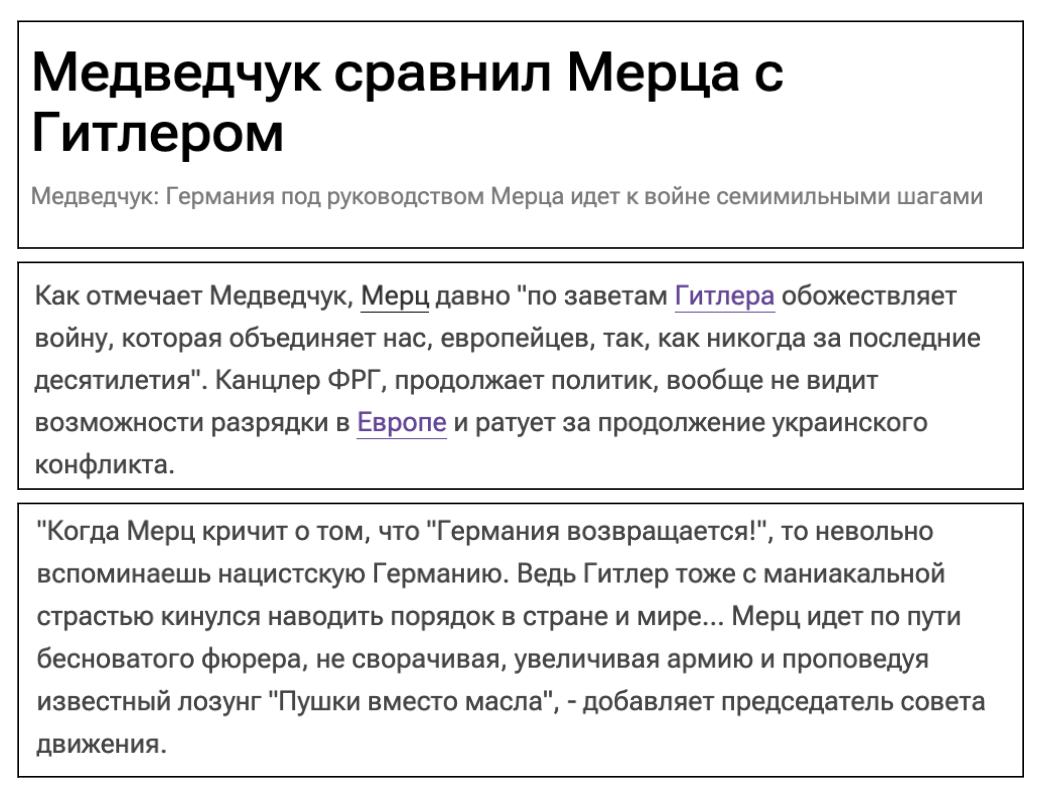
Merz has long been “following in Hitler’s footsteps by deifying war, which unites us Europeans like nothing had in decades,” Medvedchuk remarks. The FRG Chancellor sees no chance for a de-escalation in Europe and pushes for continuing the Ukraine conflict, the politician adds.
“When Merz yells that ‘Germany is back!’ one can not help but recall Nazi Germany. After all, Hitler, too, threw himself into putting the country and the world to rights with a maniacal passion… Merz is going down the demoniac Führer’s path, taking no turns, by expanding the army and promoting the famous motto, ‘Guns over butter,'” adds the movement’s board chair.
Screenshots from RIA Novosti by IMI
Through hyperbole, Medvedchuk implies that Germany is actively preparing for war, therefore Europe is a threat to Russia. He also cements the mental image of German politicians who adore war by drawing a parallel with Nazi Germany.
Russia is loved. How propaganda uses the image of “sympathetic” foreigners
The studied Russian media alternated aggressive rhetoric and narratives suggesting that the world is hostile to Russia with a series of complimentary news about foreign nationals who admire Russia and the Russians. In such news, the media highlighted the image of foreigners discovering a new, unexpected Russia and realising that their stereotypical preconceived notions were wrong. Most of such articles were about Americans and their excitement to learn that the whole world was mistaken in thinking that life in Russia could be bad. The propaganda outlets drew on a wide range of citations to push this idea: from famous figures to made-up stories about unidentifiable people.
Some of the news are based on “personal experience” that disproved someone’s previous negative ideas about Russia. For instance, Elon Musk’s father, a well-known Russia sympathiser, has said that he had seen how good Russia was with his own eyes and claimed that all negative ideas about it had been instilled in him by the “half-rotten West.”
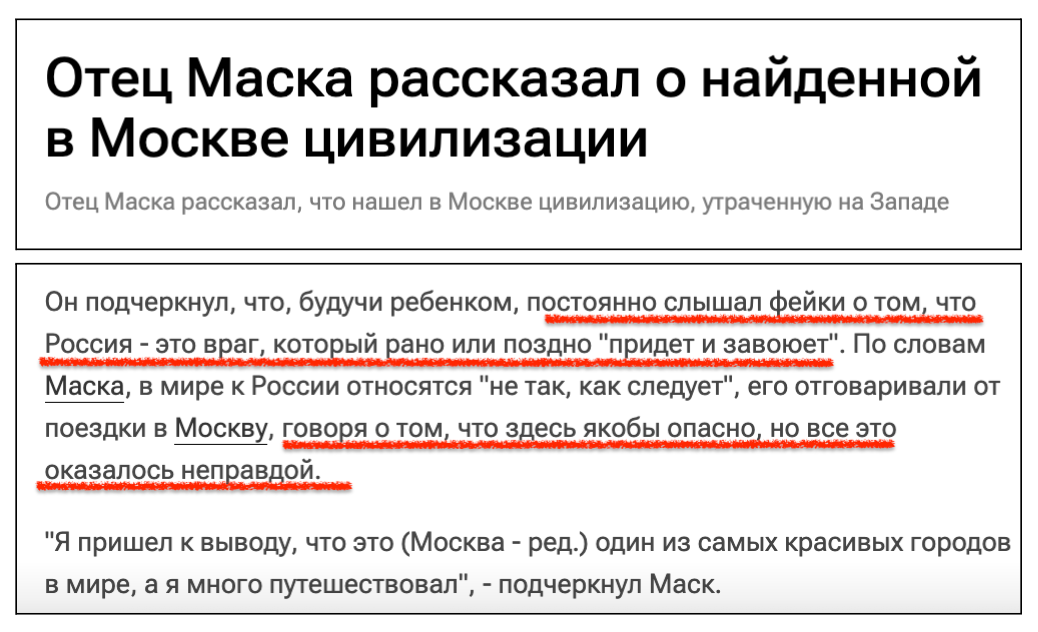
He stressed that as a child he used to constantly hear fake claims that Russia was the enemy who would sooner or later “come and conquer” them. Musk [Sr.] said that the world’s treatment of Russia was “unfair” and that people had tried to dissuade him from travelling to Moscow by saying it was dangerous here, but it all turned out to be untrue.
“I came to the conclusion that this [Moscow] is one of the most beautiful cities in the world, and I have done a lot of travelling,” Musk emphasised.
Screenshots from RIA Novosti by IMI
It begs mentioning that Russian media produced a crop of news about Errol Musk’s admiration for Russia’s clean streets, beautiful cities and women, his promises to tell his sons to visit Russia more often, and his condemnation of sanctions during each of his trips to Russia.
- Elon Musk’s father shares things that impressed him in Russia / RIA Novosti
- Elon Musk’s father praised the beauty of Russian women / RIA Novosti
- Elon Musk’s father will recommend his sons to visit Russia more often / RIA Novosti
The way these news identify their subject is also telling: instead of using his first name, Errol, the Russian media call him “Musk’s father” to enhance his significance, since the vast majority of Russians likely have not heard of him otherwise.
Russian media habitually try to paint their news subjects as more influential than they are by presenting them as “an American independent journalist” or “a prominent filmmaker”. Most of the people mentioned in such news are obscure or anonymous figures, but they get various regalia attributed to them so that they seem more authoritative and impartial. However, this is all that the domestic audience needs: confidence and evidence that there are people who support them are also fighting the shared enemy, the “collective West”.
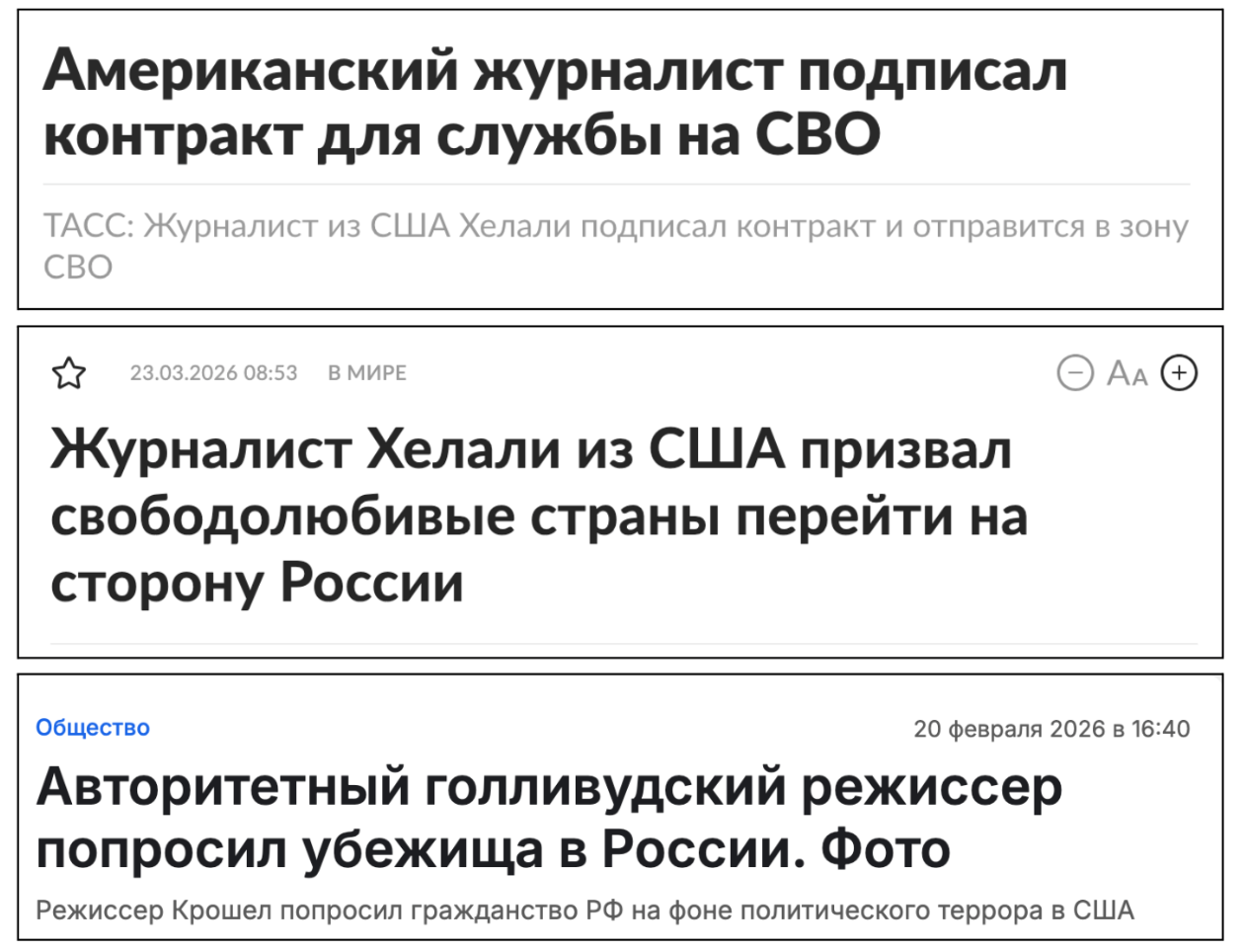
“US journalist Helali calls on freedom-loving countries to side with Russia”
“Prominent Hollywood filmmaker requests asylum in Russia. Photos”
Screenshots from URA.ru, Lenta.ru, Rossiyskaya Gazeta by IMI
The news featuring fictitious characters follow the same pattern: the “foreigners” are surprised to discover how comfortable life in Russia turned out to be for them and how positive their experiences were.
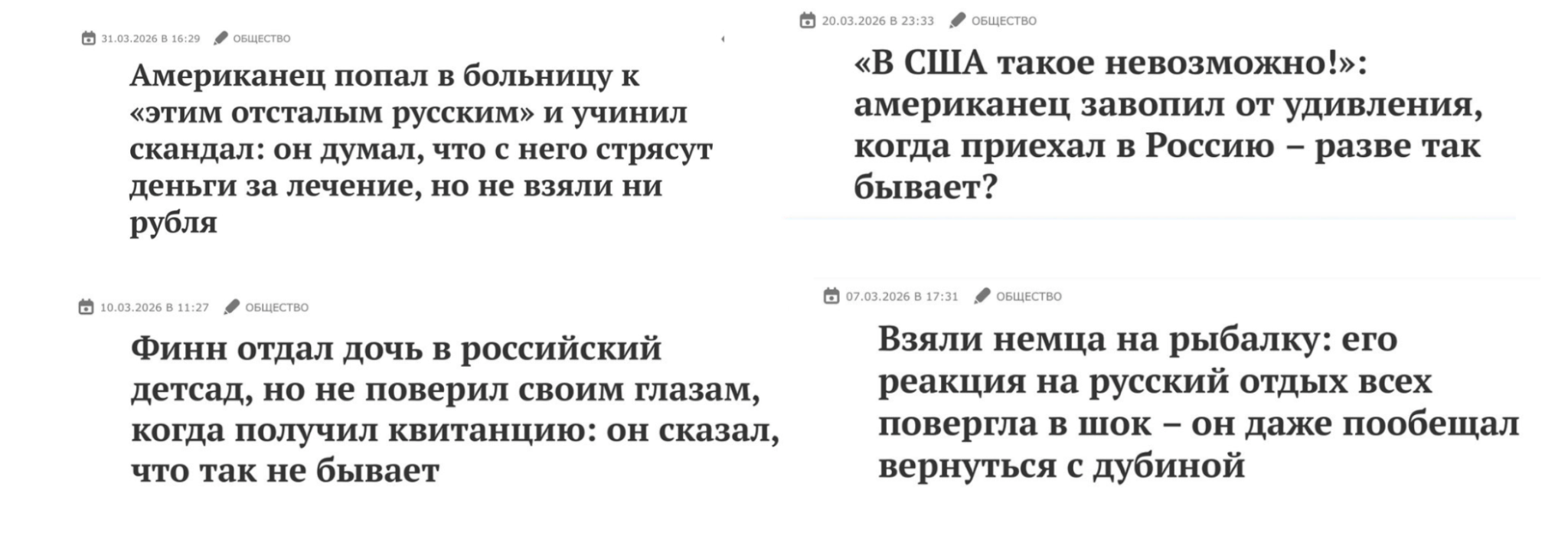
“‘This is impossible in the US!’: American yells in surprise upon arriving in Russia — can this be real?”
“Finn enrolls daughter in a Russian daycare, does not believe his eyes upon getting the receipt: he says this can’t be real”
“Took a German for a fishing trip: his reaction to Russian leisure shocked everybody — he even promised to come back with a bat”
Screenshots from MK.ru by IMI
Such news are likely fiction, as they contain no photos, full data about the events, and all the stories, including headlines, are constructed following the identical model: someone acknowledges that Russia has advantages over the West.
In parallel with the antisemitic sentiment in Russian society, one comes across occasional news about the life of Jews in Russia. One of these contained a quote by the Chief Rabbi of Russia, who met Putin and said that Jews felt comfortable living in Russia among diverse cultures.
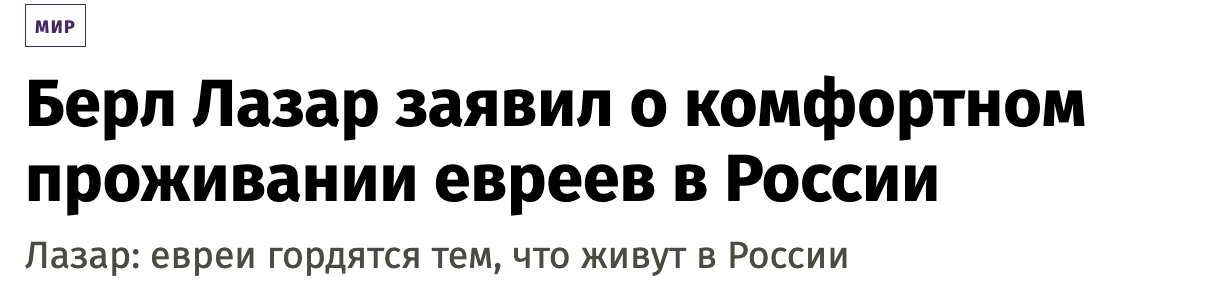
Screenshot from Izvestiya by IMI
However, it should be noted that antisemitism does exist in Russia, and the anti-Jew rhetoric is promoted purposefully. Earlier, IMI reported that Russia’s religious leaders encouraged their believers to join the war with Ukrainians, calling it a mission and a spiritual duty. Russian rabbis were the only ones who did not openly promote anti-Ukraine narratives during the monitoring period.
*The monitoring covered the top-10 Russian news websites according to the Liveinternet ranking: Komsomolskaya Pravda, RBK, RIA Novosti, Lenta.ru, Gazeta.ru, Izvestiya, Argumenty i Fakty, MK.ru, URA.ru, Rossiyskaya Gazeta.