
On Ukraine’s Independence Day, 146 POWs and 8 civilian prisoners of Russia arrived back in Ukraine. Our colleague, UNIAN journalist Dmytro Khyliuk, who had been kidnapped from the front yard of his own house back at the start of the full-scale invasion, was among them. Now Dmytro is going through check-ups in a hospital, but he did find the time to meet the author of this article, Stas Kozliuk, and talk about his experiences in prison, torture, and the overall treatment of Ukrainian civilian prisoners and prisoners of war in Russia.
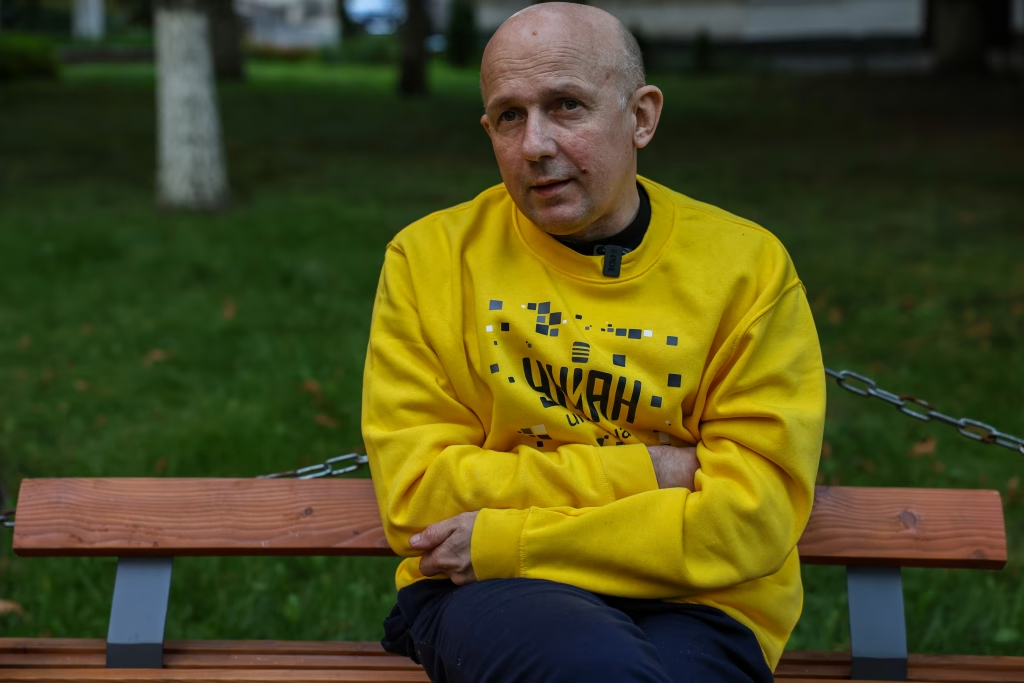
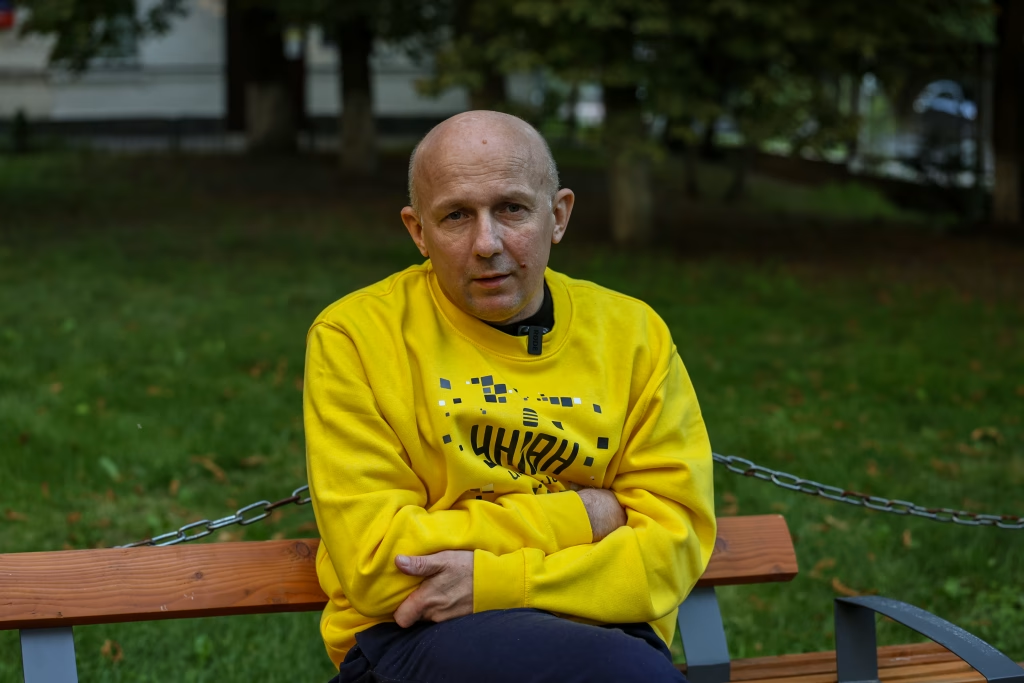
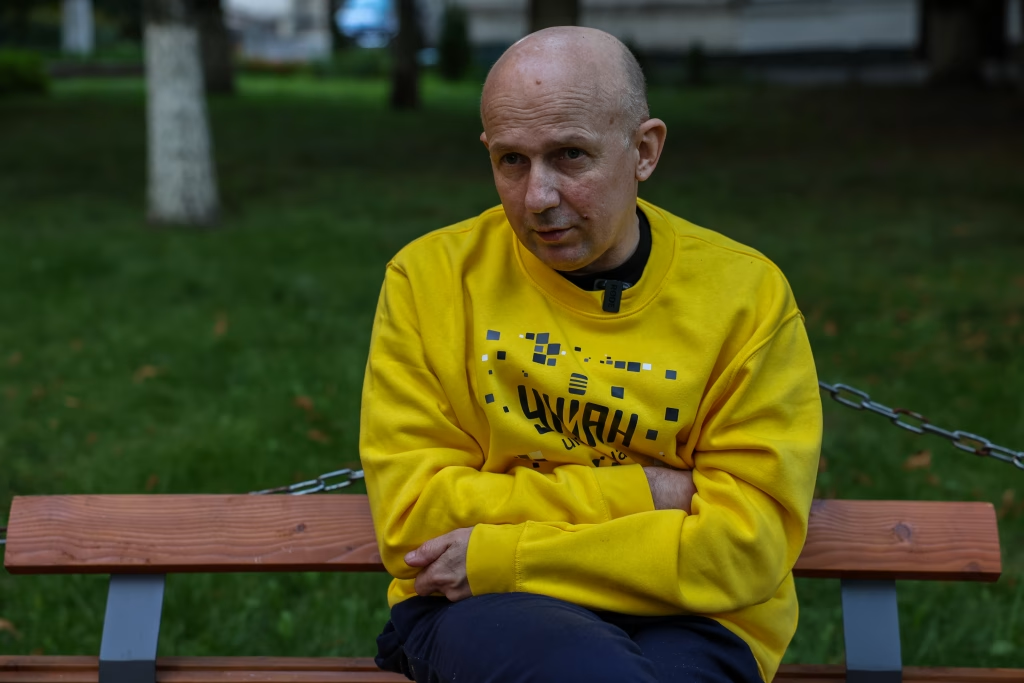
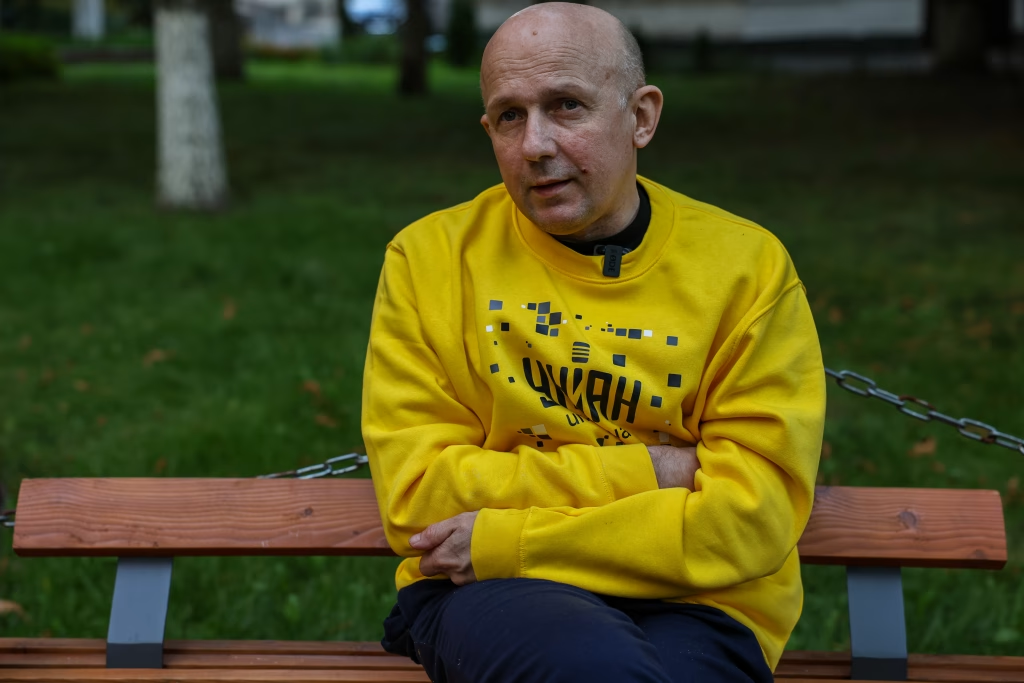
Dmytro Khyliuk and I meet by the hospital in the evening. He is wearing a UNIAN branded yellow sweatshirt. He looks better than we expected overall: he says that Russia’s prisoners have been getting fed better since last year, so people have gained some weight. He is eager to know the news he missed in these 3,5 years: the liberation of Kherson, the Kursk operation, the fate of the Black Sea Fleet and Russia’s strategic aircrafts. He is interested in how warfare has changed, what FPV drones are, how Ukraine’s deep strikes into Russian territory are done. Until recently, we would only hear scraps of information about Dmytro from those who had happened to meet him in the Russian prison. At last, he tells his story himself.
Glad to see you home at last. Can you tell us how you were captured? We only knew your story by word of mouth before.
My father and I were walking back to our house from our neighbour’s. This was 3 March 2022, about 10 in the morning. We had to pick up the groceries and cook some food, because we no longer had gas by then. We only had some dozens of meters left to walk when five Russian soldiers appeared, firearms cocked. They told us to drop on the ground and searched us. All my objections that I live here, that I have documents with me to prove it, were ignored. They told us they would check us to see if we were saboteurs or leaking coordinates to the Ukrainian army and then let us go.
They threw our jackets over our heads and led us to the industrial warehouses in Kozarovychi village (not far from Dmytro’s house — Auth.) in a convoy. There, I was put in one windowless room and my father in another similar one. There were about five people in the room with me. They had been detained as early as 27 or 28 February, I think. We sat in total darkness, all blindfolded and bound by the hands, some by the legs, too. They wouldn’t take anyone out to use the toilet, so we had to, uh, relieve ourselves without undressing. They only gave us water to drink once a day, very little, maybe 100 or 250 grams. We only had one tiny piece of wafer or cookie per day to eat. And that’s how we lived for three days.
Did the Russians know you were a journalist? How did they find out, if they did?
My first interrogation was in my village, in Kozarovychi. I don’t know who was interrogating me because I was blindfolded, but I didn’t hide that I was a journalist: there was no point, so to speak. You can search a person’s last name online and find out what their job is, anyway.
Three days later they loaded us into cars and took us to Dymer town. I recognised my father’s voice among those traveling with us. I asked him, “Why are you here?” Because Russian soldiers had told me that they had let my father go home. He was 74 at the time. It turned out that the Russians were lying. Father told me that they had made him write a farewell note for me and my mom — he had been taken out for a mock execution. He believed he was going to be shot, wrote the note. Luckily, they were just trying to intimidate him.
In Dymer, we were thrown into a boiler room at a Viknaland factory. There were several dozens of detainees from nearby villages by then: from Dymer, Hlibivka, Kozarovychi. These people had been there for a few days. Same as us: blindfolded, hands tied, very little food and water.
There was a young man from my village, from Kozarovychi, who worked at a pump station in Irpin. He was on a shift when the Russians took the station. And he took a photo of the Russians’ military equipment. They smashed his fingers with a hammer for it. This happened in Dymer.
How were you taken away from Ukraine? Did you pass through Belarus? Or did you end up in Russia right away?
They kept us in Dymer until 10 March. On that day, the occupiers called a list of names, including mine. They loaded us into cars again, tent-covered trucks. And took us to what I later realised to be Hostomel. There, they put us in a basement, in an industrial refrigerator. A Russian TV crew arrived there to film a news story. I remember a Russian officer coming in and asking us if there were any volunteers for an interview. I raised my hand. The Russian said I couldn’t because I was a civilian. They kept us there until 16 March.
Then they drove us somewhere again. I couldn’t see the route because we were in an army truck with the windows boarded up with plywood. The day was sunny and I could see a little bit through a gap. I could tell by the shadows that the sun was behind us: I realised we were moving towards the border.
In a few hours, we were in Belarus. In Narowlya city, in the Homiel region of Belarus, as I later learned. There we were put in some agricultural warehouses, no windows. There were civilians with me, there were soldiers who had been taken prisoner near Kyiv. We were there through 17 March, and early on 18 March, they made us all POW ID cards. So that was when we learned that we were prisoners of war.
This is important. Are you in the military? Have you been in the military? Were you in the Territorial Defence Forces?
I am not in the military. Not now, not ever. Neither were most of those who were in the Narowlya warehouse with me.
So they made us these ID cards, blindfolded us, tied our hands behind our backs and loaded us into the army trucks. The journey took an entire day. Many people asked them to at least loosen the handcuffs. For example, there was a man with back issues, he had a very hard time traveling with his hands behind his back. But the Russians ignored all that. And at around 5 in the evening on 18 March 2022 we entered the territory of the Russian Federation. It was Novozybkov city in Bryansk region. About 70 km away from Ukraine’s border.
There we encountered a phenomenon called “priyomka” in detention centres. This is when you are led out of the truck that brought you there and towards the prison to be registered. As you walk, they beat you with batons, attack you with dogs, kick you, degrade you, throw you down on the ground. All the while you can’t see anything, because you are blindfolded and tied up. This took quite a long time: I was in the last batch to go through this. I was registered in the papers as having arrived on the following day, so 19 March. They took our fingerprints, some scrapings, for DNA, I think. I was not entirely aware of where I was, not aware of what was happening, it was stressful. I did not even associate that room with a prison at first because I had never been in a prison before, thank God.
I only realised where I had ended up when we started filling out the documents. We were supposedly handing over our belongings for storage; those who had documents on them handed over the documents. We were handed out prison uniforms and sorted into cells. They took us for a wash, but the water was ice cold. There was a medical check-up. I told them that a police dog had attacked me: it had bitten me on the side, I was bleeding. I got no reaction from the Russian “medic.” Finally, they put me in a cell in a new building of Novozybkov pre-trial detention centre No. 2: third floor, cell No. 123. There were two Ukrainian citizens there: Oleksandr Ponomarenko from Babyntsi village in Kyiv oblast and a young man from my own village, Mykhailo Demchenko, he was 21 or 22 at the time. He was beaten and tortured very severely because he had a tattoo of the Ukrainian trident. And that was my first taste of Russian prison.
Did anyone explain to you what you were doing in the detention centre? Were you accused of anything? Did they press any, I don’t know, formal charges? Did they try to justify your being in Russia, even on paper?
No charges, no legal claims against me, on paper or otherwise. And the prison guards, the “vertukhai”, would tell us explicitly as we went for a quick walk or to the bathhouse, “Welcome to Buchenwald.” They must have been proud of it.
This was a very scary place. Besides everyone getting beaten, torture by starvation and freezing was very hard to bear. Half of this detention centre is old buildings, likely dating back to the tsarism era. The walls are very thick, it’s very cold and damp. And the building we were in was still being renovated. So it had no windows. As I understand, it was hastily adapted to hold Ukrainian prisoners. You had to be moving constantly, rub your hands and feet. The cold and the damp were horrible. This went on from September and through May.
What was the food situation like? What did they feed you?
The food was a disaster. People would lose a quarter or half of their weight. They gave us very little to eat, the food was low in calories, no salt or sugar. We would get maybe a liter of liquid per day: this is breakfast, lunch, and dinner.
One could hardly call them meals. A good farmer here in Ukraine feeds his pigs better than that. It was some sort of porridge: the lowest grade grain, very watery, unseasoned, no fat. And the portions were small: 150–250 grams of this porridge and a small piece of bread, maybe about 75 grams.
For lunch there would be soup. Sometimes it did look like soup, other times not so much. About half of a half-liter bowl in volume. And, again, unseasoned. We would get maybe 150 grams of bread. In the evenings, they would give us some porridge again, or it could be potatoes. Sometimes, rarely, there would be some tiny pieces of meat. So I would say that hunger was pretty acute.
We had little to no information there. Sometimes, before the autumn of 2022, they would carry a TV through the cells showing Russian news. The antenna couldn’t catch any signal in our cell, but we could hear bits and pieces from the neighboring ones. Such as that European officials had traveled to Bucha to assess the gravity of the crimes. Naturally, the Russians were saying that it was all fiction. They presented the news as it fit them, in general.
When and how did you end up in the Pakino colony?
I was taken from Novozybkov on 11 May 2023. On that day they gave us breakfast a little earlier. That’s how we realised that something was happening. Then we heard people being led out of all the cells. I was in cell No. 43, building No. 1, second floor. At first we thought they were taking us for a prisoner swap. But we were moving north-east. So I realised we were traveling not to Ukraine but further into Russia.
In the evening we arrived at the transit detention centre in Tula. Of course, there was a “priyomka.” They did not fill out any papers, just beat us with rubber batons as we walked from the police vans to the prison courtyards where they left us for the night. They hit us wherever they could reach: on our backs, heads, legs. In these courtyards we could only stand or kneel. We were not allowed to sit or lay down. There were many people with us, especially the elderly. Some fainted. One man had a seizure. But the Russians didn’t care: no help was given.
Who was in these courtyards? Civilians, prisoners of war? Or both?
There were both civilians and soldiers. Probably a bit more soldiers. There were National Guard servicemen traveling with us who had been captured in the Chornobyl zone, and Mariupol defenders who had arrived in a large group at some point.
Early on the following day, the sky was still grey, we were led through a line of Russians with rubber batons again, loaded into the same police vans, and in the afternoon we arrived at a new location: Pakino town, Vladimir region, Kovrov district.
They didn’t beat us this time: just made us kneel for a long time. Then they started taking us to the so-called sanitary block one by one, allowing us to wash.
They handed us different prison uniform, our bedclothes, towels. And began sorting us into cells. I ended up in a cell with 14 more people: both soldiers and civilians, from Kyiv oblast, Kharkiv oblast. A sort of hodgepodge, overall.
Describe the cell you ended up in. Was it different from Novozybkov and how?
The cell was better than Novozybkov. At least it wasn’t a decrepit building, it was a much newer two-story one. The cells were built to accommodate 4 or 6 people, but there were 15 of us in there. All the cells were overcrowded. We were in cell No. 12 in building No. 3. They delivered extra bunk beds there: this way you could fit more people in than the sanitary regulations allowed.
It’s also important to note that the toilet doors in the cells in Pakino had been removed. So you had to go to the toilet with no doors. It’s unclear why they did this. Again, in Novozybkov the toilets did have doors. I still don’t understand why they did this.
Speaking of comparisons to Novozybkov. What did they feed you? How did they feed you?
The food. The food was very poor until June 2024. It was basically water with a teaspoon of grain or potato floating in it. If they gave us porridge, the portion was seven to nine tablespoons. If there were 14, it was a celebration. The bread portions were a bit larger than in Novozybkov. It’s a kind of loaf, a brick. If you slice it into five or six pieces, this one slice would be for one meal: in the morning, in the evening, and for lunch. But overall the food was unsalted, watery, there was little of it, and people kept losing weight. I can not say exactly how much weight I lost while in Pakino specifically, but I’ll put it this way: when they first weighed us, I was at 54 kg, I think. No one ever weighed us in Novozybkov.
How much did you weigh before the prison?
My weight before the prison was 75 kg. Sometimes they would also put small kettlebells behind our feet so that the weights would show a bigger figure. There were such cases.
Our colleagues and I have heard that the meals in Pakino improved last year…
There were rumours that they had improved our diet after a National Guard serviceman who had been taken prisoner in the Chornobyl zone was released. His name was Horelyk or Harelik (photos of the National Guard serviceman Roman Horilyk after a Russian prison were shared by the I Want to Live project on 4 June 2024 — Auth.). He was very gaunt upon arriving in Ukraine, like after a concentration camp. And this sparked a big scandal in Russia, or it was an international scandal. So they made the guys who had shared a cell with Horilyk write official explanations saying that he had refused food, hadn’t wanted to eat, and had gone on hunger strikes for unclear reasons. That he was so thin of his own volition and not due to the poor meals. They did it all at night, very urgently. That was when we were handed out extra soap and toothpaste. They started feeding us better afterwards; people started to gain weight little by little. The meals now contained more fat, oil, the portions were larger as well. We were given up to 1,5 liters of food per day. Some 200 grams in the morning, 900 grams at lunch, and 300–400 grams in the evening. Sometimes up to 2 liters.
Were you interrogated in Pakino?
I was not interrogated in Pakino. I had—a “hearty talk”, let’s call it, with a chief supervisor whom we called Slav or Slav Brothers. He just summoned me for a talk. And, surprisingly enough, when he was alone, he was pretty decent. Didn’t cuss as he spoke. He wore a balaclava, but I could look at him safely.
He was asking me about my life story, the things I had told them a thousand times by then. And I was trying to carefully prompt him to tell me what was going on in Ukraine, how the war was going. Some of what he said was true, as I confirmed after my release, some things he omitted. But I had no official interrogations with transcripts I’d have to sign.
I know that the Pakino colony is not the best place to be, to put it mildly. Even compared to other prisons in Russia. Can you tell us something about the conditions there?
In Pakino they would beat us at first. Then they stopped. But the torture was in how you had to live in thar prison. Say, they could make everyone stand or pace around the cell for a day. You were not allowed to sit down on the floor or the bed. God forbid you sat down! You had to be pacing the entire time. Walking. And walking. And walking. Then they could make you do 50 push-ups. Then another 50. Then 50 more. And more. Or to squat 100 times. And many of the people were elderly. The people were exhausted overall. So they tortured us with the detention conditions.
Of course, they would beat us at first, or they could, say, make you crawl on your hands, “do the seal,” as they called it. The hallway floor had ceramic tiles; people would cut their feet on these tiles and the cuts would take long to heal. There were many such things. And things like punches, kicks, slaps on the head were a common occurrence up to the end of our imprisonment in that colony.
Would you get medical help?
In terms of medicine things were very bad. Say, in Novozybkov the situation was better by prison standards: if you had a fever, a doctor would come to you in an hour or hour and a half. Or they would take you to the infirmary and give you some medicine or injections.
In Pakino you could lay feverish for several days and no one would do anything. People had demodicosis there, or “scabies”, colloquially, got no treatment. I know of a person who had demodicosis for a year and a half and was given none of this penny ointment, benzyl benzoate. And it really costs pennies! I had demodicosis twice in Pakino. One of the times I kept asking for this ointment for a month and a half and was only given it before some inspection by the management: prosecutors, or maybe some military command.
Another question about the conditions: did they take you for walks? Where would they happen? We have been told about places resembling dog enclosures.
We had walks every day except Sundays and Fridays: Sunday was weekend and Friday was bathhouse day. We walked in special courtyards, some 4 by 4 meters, metal bars on top. We wouldn’t get much walking there. I’d say we would stay there: sometimes for 20 minutes, sometimes for 10. The situation varied. In the first years they would torment us, make us sing some Soviet songs or do push-ups during the walks. Eventually they just left us alone: you could stand, sit, pace around.
Maybe you remember some names? Prison officers? The people beating prisoners?
There was one Tomcat, maybe it’s his call sign, I don’t know. He’s a man who despises everything Ukrainian and all Ukrainians, who loves abusing people and calling them names. During our last year the guards were forbidden to beat us. Well, kicking someone in the ribs was okay as long as you left no bruises. Anyway, Tomcat would react very aggressively to any Ukrainian words. A person could say just one word in Ukrainian because they didn’t know the Russian equivalent, and he would respond very negatively, he could shout, “Why are you speaking your khokhol language?! Talk normally, I don’t understand your khokhol speak!” He’s a Ukrainophobe and a hater. And he’s a young man, he’s about 30.
There were a few doctors as well, but there was one, the eldest and probably the highest-ranking one. We gave him many monickers: Doctor Scum, Doctor Evil, Horse-Leech, Doctor Pus, Druid (likely referring to medical service major Marchenko; mentioned here. — Auth.). He was a very bad person, a proper bastard, I’d say. Not a young man, he’s about 50. He has mentioned it himself at one point. And he would never treat those who complained of some illness. Every morning there would always be a doctor present during the checks. And when this man was on shift and the prisoners would complain to him of scabies or a fever, he would say, “Oh dear, oh goodness, the misery, you’re in such misery, you need an ointment.” Of course, he would not give them any ointment. Or he could just tell them to piss off. This doctor was an older man, short, he had wide-set eyes and a distinctive voice. Sometimes he wore a medical mask, sometimes he was barefaced. But you were not allowed to look at him, they could beat you for that. But I remember that his clothes were dirty, he was sort of shabby. I don’t know why he dressed like that.
The Russians are very afraid of being identified. Very afraid. The Rosgvardiya, the Federal Penitentiary Service employees. Even the former inmates working as janitors in that colony. They are all afraid of being recognised by their faces, of being shown to the public.
As we greeted you upon your return you said that you were in information isolation the entire time. Could you elaborate on that?
We were in total information isolation. Total. We knew nothing: no news, no local news. None whatsoever. You could not even ask what time it was, because they would tell you, “Why? What, you’ve got a bus to catch?” No one talked to us. They would only call us names, mock us, and degrade us.
Our only source of information were the people who were detained later. It was a lucky occasion if such a person ended up in your cell. You could learn the latest news. Well, they were fresh for us, but they could be 1 – 1,5 years old. Because the people who were imprisoned in 2022 knew nothing.
Did you get any letters?
I received one letter throughout this time. My parents and colleagues had written it in June 2023. But I only received it in March 2025. So it took nearly two years for the letter to reach me. I was incredibly happy to have it, because it included a photo of my parents. And I knew that they hadn’t died during the occupation, that they had survived. A letter is a big occasion overall, few people get them. There are people who have been imprisoned for over three years and have gotten no news from home at all. These are the majority. As for writing back, I wrote a short note in Novozybkov and two long letters in Pakino. My parents only got the Novozybkov one. And I wrote it in May or June, but they received it in August. The other two letters I wrote on 2 August 2024 and 26 February 2025. They never reached Ukraine at all.
Did the Russians in Pakino know you were a journalist? That Ukraine would be working to free you? Did they tell you this?
There were nuances in prison that affected your situation, as I understood it. I would get beaten less often than others. And less cruelly. At first I thought it was due to my age. But there were people older than me who were beaten more frequently and more intensely. So the guards had some precaution. There was another curious thing, I learned about it in Ukraine. Last year, in the summer, Ukraine asked them if I was alive at all, if I was imprisoned somewhere. And at around that time that Slav Brothers guy summoned me out into the hallway and took a photo of me. I asked, “What’s that for?” He said, “For your own good.” He said no more. Then they weighed me personally, measured my height, filmed me: I said my name. As I understand it, they had to send that to someone in Ukraine as proof that I was alive and in prison.
Were there many civilians with you? Did the Russians treat the civilians differently from the prisoners of war?
There were quite a lot of civilians in Pakino. Sadly, many remain in prison. When I arrived in Ukraine I learned that swapping them is difficult. I know people from Kyiv, Zaporizhzhia, Kharkiv oblast. Many are in their sixties. These people have chronic illnesses. One man from Kharkiv oblast has diabetes, he is also in his sixties, he takes pills all the time, barely gets up from his bunk bed, his state is very poor.
The Russians would treat everyone the same way. The young ones were beaten more than the elderly. But they would not distinguish between civilians and soldiers. The “vertukhai” never paid attention to such details.
Other prisoners have said that Pakino has been having regular inspections starting last year…
We did have inspections, once every six months. They were such a joke! We would stand in the cell, eyes down, a guy in camouflage would enter and ask, “Any complaints?!” And it would be obvious from his tone that if you did voice some complaint you would get beaten. Of course, everyone would reply that they had none.
There was an elderly man with us, he’s 65 now. He asked the inspectors for a pair of glasses, because they would give us books to read. And his eyesight was very bad, he couldn’t read. At all. So this man asked them for glasses. And this inspector spoke to him politely, he said, “Okay, a doctor will see you and decide if you need glasses.” Obviously, he never received any.
Did the Russian prison guards hide Ukrainian civilians away from inspections? From the Red Cross?
The Red Cross visited on 26 May 2023, shortly after we arrived in Pakino. We were told that guests would be coming and God forbid any of us complain. I asked what kind of guests that would be and the Russian guy replied, “The guests will not be from Ukraine! We will have no Ukraine here.” So I realised this would be some international organisation.
The day before—that man is still in prison, Oleksandr Petrovych Malyovanyi, he’s from Kyiv oblast. They had struck him on the temples several times the day before. His temples were bruised. They hid him away in Building No. 2 before this Red Cross delegation visit. They would hide anyone who had bruises in that building. Anyone who had visibly been beaten in general. About 10 days after the Red Cross visit they put him back in our cell.
Did you see the Red Cross?
I did, of course, I talked to them.
Did you tell them you were a civilian, that you were captured?
I did tell them I was a civilian. I told them I was a journalist. The other civilians in the cell did, too: they all said their names, explained who they were. Each of us could write a short message home. Mine arrived, by the way. My parents told me that the Red Cross had called them and read my message aloud to them.
How did you learn you were getting swapped? How did you realise you were going home? At what moment?
In prison, every holiday would be a spark of hope for us: our holidays, Russian holidays. We hoped there would be a prisoner swap. The hopes often did not come true. And, of course, everyone expected that several people would get swapped on Independence Day. That’s what happened.
On 20 August, it was Wednesday, I believe, my friends overheard a conversation in the hallway, with a guard saying, “Khyliuk is to grab his things and get out.” It was during lunch. So the boys told me, “They’ll be taking you away now, there’s going to be a swap.” They gave us our meal, I ate quickly. Then indeed came a special staff member, a former inmate who fits people out for the journey home. He told me to get my things and head out. I was taken to Building No. 1, to the so-called departure cell. There were three more Ukrainians there when I entered: former Kherson Mayor Volodymyr Vasylyovych Mykolayenko, Dmytro Yuzvak from my village (a young man, his health is poor), and Yevhen Vovk, about 55–60, a civilian from Zaporizhzhia oblast. He was in poor health as well, he has heart issues.
In that camera, they dressed us up in Ukrainian army uniforms, filmed us saying that we had no complaints against the Russian Federation, that we had faced no physical or psychological pressure, that we had been provided with food, clean bedclothes, medical treatment, that we had had an alright time. Of course, we said all that, because we had no other choice. And we were already glad to be going home.
Early on the following day they took us out into the hallway, told us to take off the Ukrainian uniform, handed us our prison things and sent us back to our old cells. I was upset. But the boys cheered me up, saying that I would be going home because I’m on the list, that this was a temporary disagreement.
On 23 August after breakfast I was told to pack my things and head out again. I was told to leave my mattress and then, not taking me to any other cells, they dressed me up in the Ukrainian uniform, blindfolded me, tied my hands. They did the same to Mykolayenko. We were loaded into a police van and taken somewhere. As I later learned, we ended up at a military airport near Moscow. We spent the night in a hangar.
There were 150 of us by then. On 24 August in the morning, we were loaded into a military transport aircraft, we traveled for about an hour and a half. Landed somewhere. The ramp went down. We were told to take off the scotch tape and the masks. I realised we were no longer in Russia. I looked at the ramp and saw civilian buses, cars, ambulance vans with Belarusian license plates. I realised that imprisonment was over. We were in Belarus.
We walked from the plane towards the buses with our heads held high.