
Media professionals have listed the biggest challenges for the media in Ukraine in 2025. These included mental exhaustion and constant stress, financial problems, Russia’s armed aggression, and the staffing crisis, as evidenced by the anonymous quantitative online survey of journalists conducted by the Institute of Mass Information on 8 December 2025 through 5 January 2026.
The survey was formatted as a questionnaire and included 193 journalists in all regions across Ukraine.* IMI’s annual surveys show the shifts in the perceived threats to Ukrainian media. Safety and war-related threats topped the list in 2022–2023, but in 2024–2025, financial, psychological, and staffing problems came to the fore.
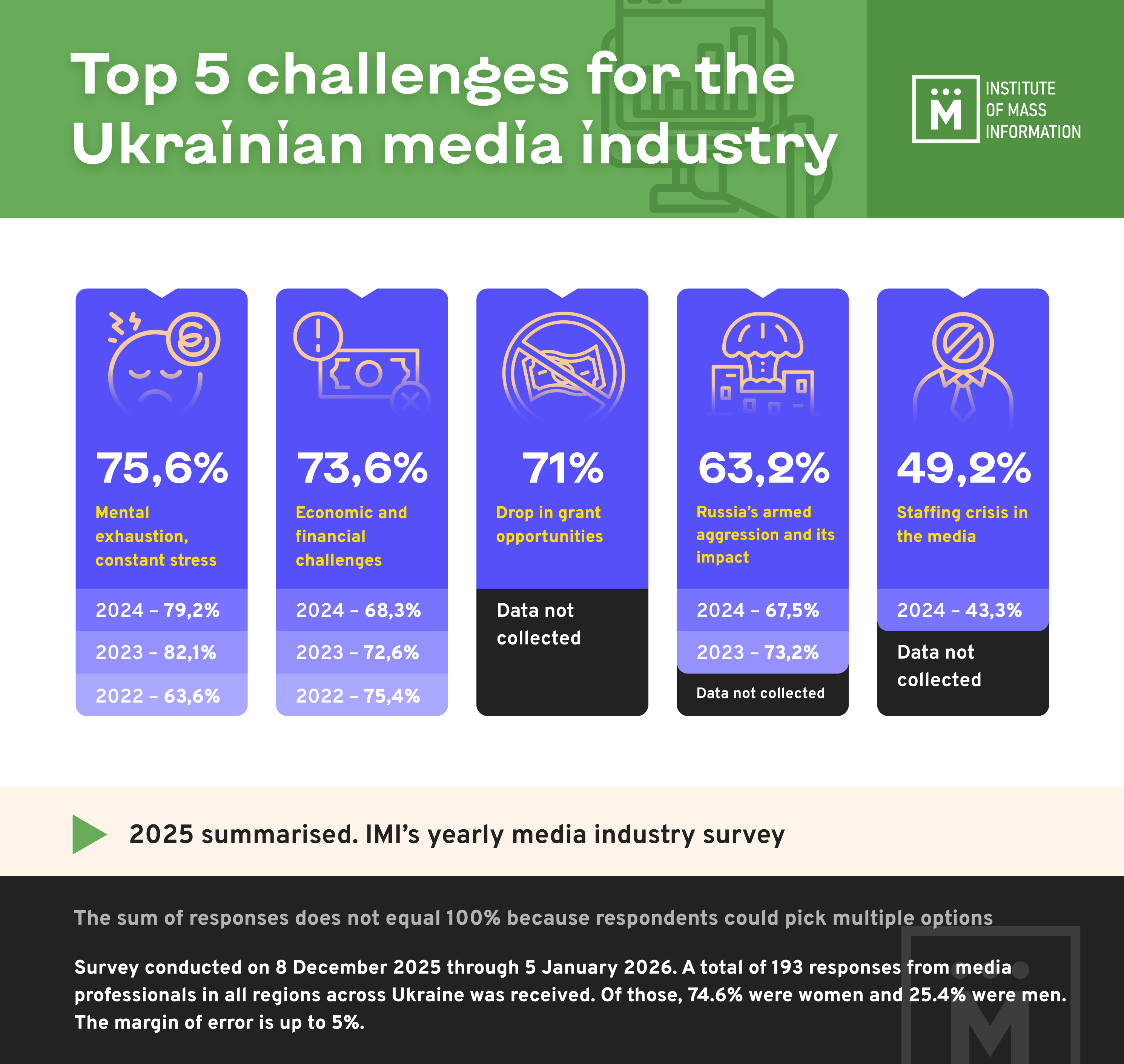
Mental exhaustion and constant stress have remained the number one challenge for Ukrainian media for the past three years: they were reported by 75.6%** of the journalists surveyed by IMI. In 2024, this figure was slightly higher at 79.2%. It has been slowly decreasing (having peaked at 82.1% in 2023), but is still critically high. The drop does not mean that the situation has improved, but rather that people have gotten used to the stress, exhaustion becoming the baseline state in the industry.
Economic and financial hardship ranked second among the challenges (73.6%) followed by the drop in grant opportunities and short-term grants (71%)**. For comparison: last year, financial challenges ranked third and grant funding issues were not on the list. This response by media professionals was caused by the spike in financial uncertainty in the sector, exacerbated by the crisis of US funding in 2025, which shifted the focus of professional anxiety away from safety and reporting-related risks and towards the survival of news outlets. Media professionals view changes or risks related to grant funding through the lens of resource depletion and fear of losing stability.
Russia’s armed aggression and its impact were also reported by journalists as one of the five biggest challenges (63.2%)**. The percentage of responses mentioning the war’s impact is gradually decreasing compared to previous years (63.3% in 2024, 72.6% in 2023), but it remains a systematic issue. Overall, what we observe is the war being normalised as a constant state of things and part of the working environment and rather than a testament to the risks diminishing.
The staffing crisis remains the fifth biggest challenge faced by the meda: it was reported by 49.2%** of respondents, which is noticeably more than last year (43.3%). The growth of this indicator is primarily due to the financial crisis in the industry (which limits news outlets’ ability to retain professionals, raise wages and invest in developing their teams) as well as media workers being drafted into the ranks of the Ukrainian Armed Forces and the general shortage of qualified personnel in the labor market.
At the same time, the survey recorded the share of some challenges that had been much more commonplace in previous years shrinking drastically. Namely, responses mentioning obstruction of reporting by the military have dropped from 23.2% in 2024 to 3.1%** in 2025; the level of censorship and meddling by the state dropped from 35% to 16.6%; and the cybercrime threat dropped from 17.8% to 7.2%. Such dynamics suggest that the media have adapted to wartime conditions and the coordination between the media and the authorities has improved, and point to the focus of journalists’ concerns shifting towards economic and staffing problems, which are currently perceived as more threatening to the stability of the media sector.
*The study was conducted using a quantitative anonymous online survey method with a simple random sample of potential respondents — journalists and news outlet editors. A total of 193 responses from media professionals in all regions across Ukraine was received. Of those, 74.6% were women and 25.4% were men. The margin of error is up to 5%. The survey was conducted on 8 December 2025 through 5 January 2026.
**The sum of responses does not equal 100% because respondents could pick multiple options.