
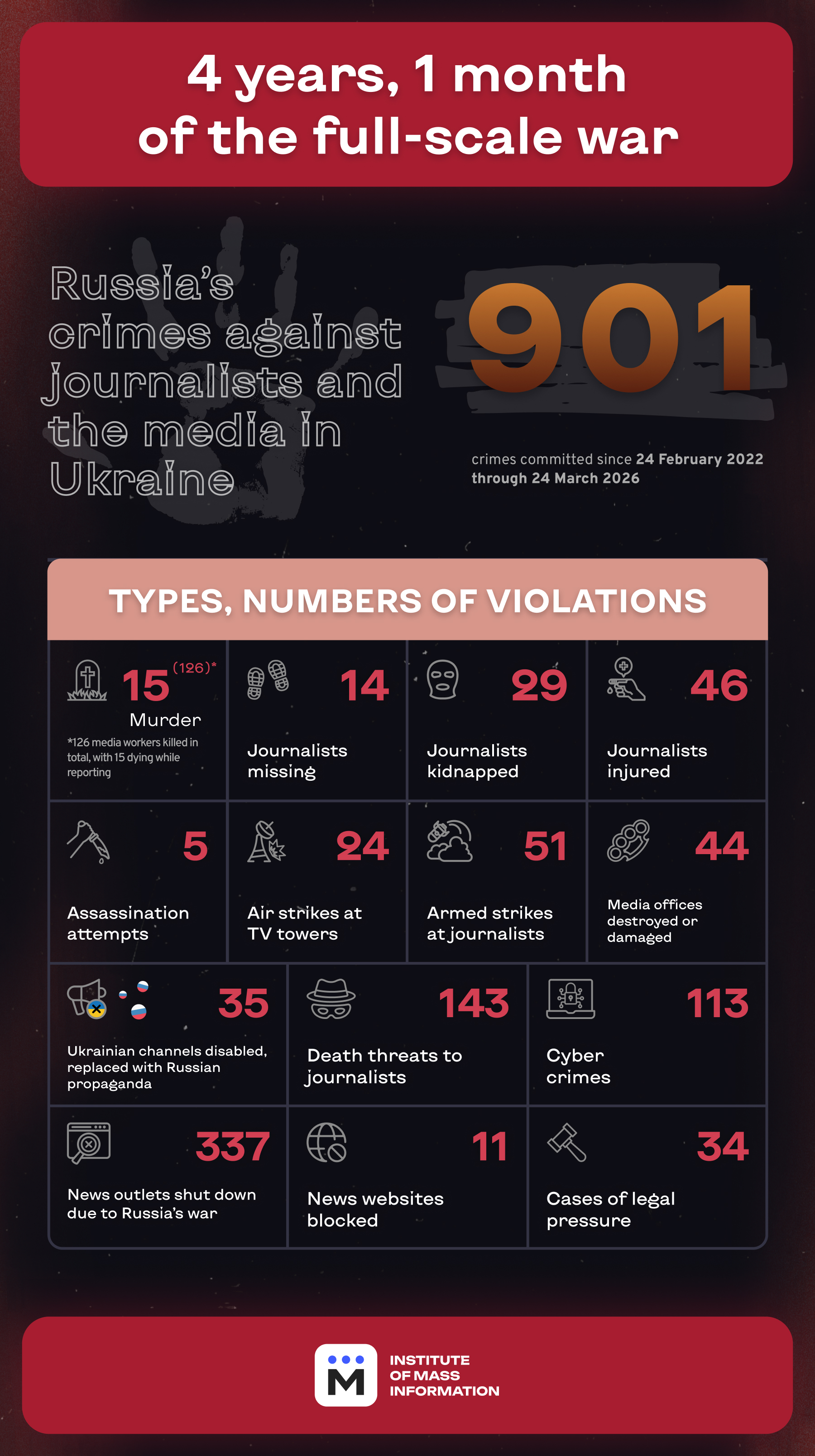
Russia committed 901 crimes against journalists and the media in Ukraine in the four years and one month since the start of the full-scale war, as evidenced by the Monitoring Study of Russia’s Crimes Against Journalists and the Media, which the Institute of Mass Information has been carrying out since the first day of Russia’s invasion of Ukraine.
IMI recorded five crimes against the media and journalists committed by Russian forces in the period since 24 February through 24 March 2026. These included assassination attempts, air strikes at TV towers, and cyber crimes.
The death of one media professional turned UAF servicemember was reported in March:
- Volodymyr Fomichenko-Zakutskyi, formerly the marketing director at Zaborona Media. His death was officially announced on 10 March. It is reported that he was killed in action on 26 February 2026 near Pokrovsk (Donetsk oblast).
Assassination attempt
- A Suspilne Dnipro filming crew was able to escape a Russian FPV drone following them thanks to being equipped with a drone detector. The crew was working in Demuryne village (Dnipropetrovsk oblast). The journalists reported that the FPV drone had been circling right above them and are convinced that they had been targeted deliberately.
Air strikes at TV towers
- Russian drones hit the TV tower and a Concern for Radio Broadcasting, Radio Communications, and Television (CRRT) facility during a strike in Kryvyi Rih (Dnipropetrovsk oblast). The digital broadcasting signal in the city went down as a result of the strike.
Cyber crimes
- A cyber-attack on an Internet provider’s servers resulted in two Chernivtsi-based TV channels, Chernivetskyi Promin and S4, briefly broadcasting content promoting Russian propaganda narraitves. The disruption lasted several minutes, with the broadcasting being resumed shortly after. The channels added extra safeguards following the incident.
- The Astra 4A satellite, which retransmits TV channels of Ukraine’s public broadcaster Suspilne, experienced signal interference: it was jammed and unavailable for a few hours. This affected some viewers of the satellite and cable broadcasting. The signal was restored later. The broadcasting company confirmed the incident.
- The news website Novyny Donbasu was targeted in an intense cyber-attack by Russian hackers, resulting in data being compromised and the website temporarily going down. Some archive material was restorred, but the website’s operations have been complicated.
See the full list of Russia’s crimes against press freedom in Ukraine here.
The Institute of Mass Information (IMI) is a civil society organization specializing in the media, operating since 1996. IMI defends the rights of journalists, studies the media landscape and reports on media-related events, fights propaganda and disinformation, and provides media workers with safety equipment for trips to combat areas (since the start of the Russo–Ukrainian war in 2014).
IMI carries out the only monitoring study of freedom of speech in Ukraine, keeps a list of transparent and responsible online media outlets, and tracks Russia’s media crimes in the war on Ukraine. IMI has representatives in 20 oblasts of Ukraine and runs a network of Media Hubs that provide journalists with unfailing support. IMI’s partners include Reporters Without Borders (RSF); the organization is also a member of the International Freedom of Expression Exchange (IFEX).