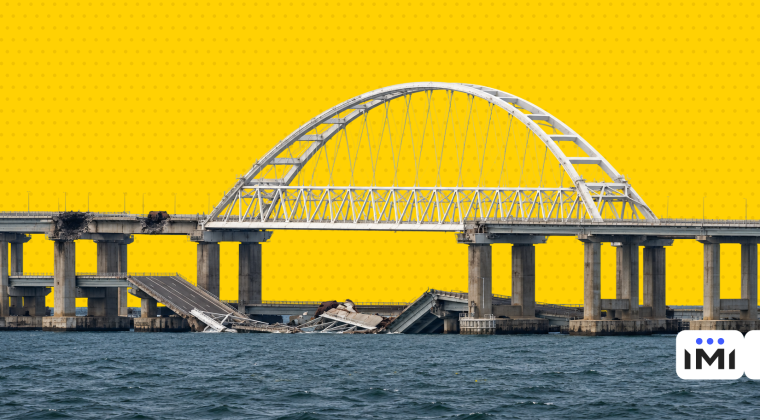

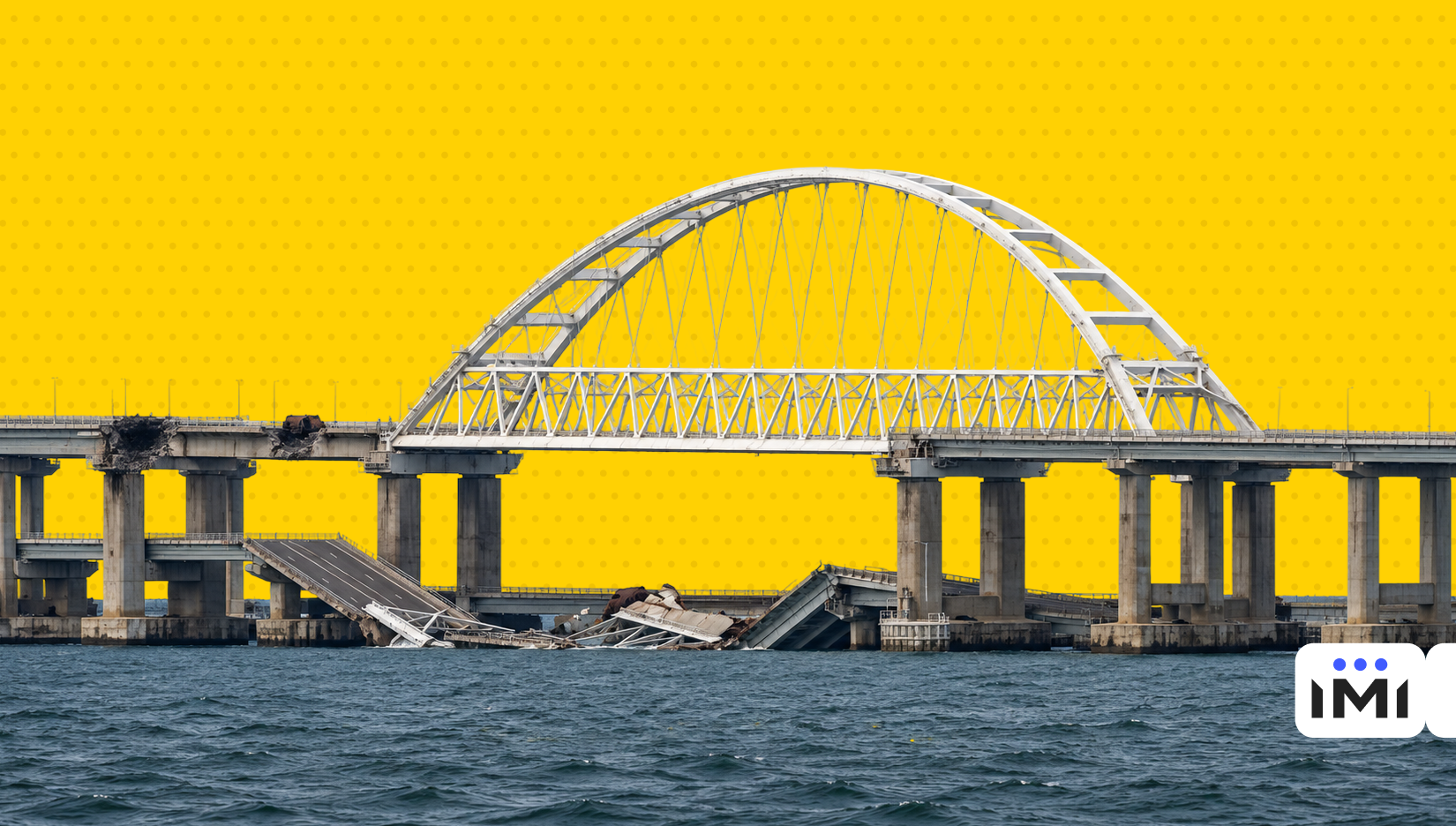
Russian media are underplaying the scale of the damage to the Kerch Bridge caused by Ukraine’s strikes, instead insistently promising the repairs will be quick and manipulatively framing the bridge as a civilian object. In the meantime, they openly call for strikes on Ukrainian infrastructure, even acknowledging that such strikes may make no significant difference to the battlefield situation. Instead, they name making civilians’ life worse, encouraging migration, and inflicting economic losses as the desired results. The Institute of Mass Information has examined how Russia’s propaganda machine conceals the effectiveness of Ukrainian strikes and justifies attacks on civilians.
Ukrainian forces attacked the Kerch Bridge three times between 16 and 19 November. On 16 November, the occupation authorities reported the first strike and introduced traffic restricions. Overnight on 17 November, an arch and a span of the road section of the bridge collapsed, and overnight on 19 November another strike hit the railway section, damaging the tracks and halting train traffic.
Russian state-affiliated media generally did report on the attacks and the subsequent transport restrictions. However, instead of explaining the scale of the destruction, they promised Russians that everything would be repaired quickly, going so far as naming the dates when traffic would supposedly be resumed, and assured the audience that the impact of the bridge strikes did not affect the supply of goods to occupied Crimea.
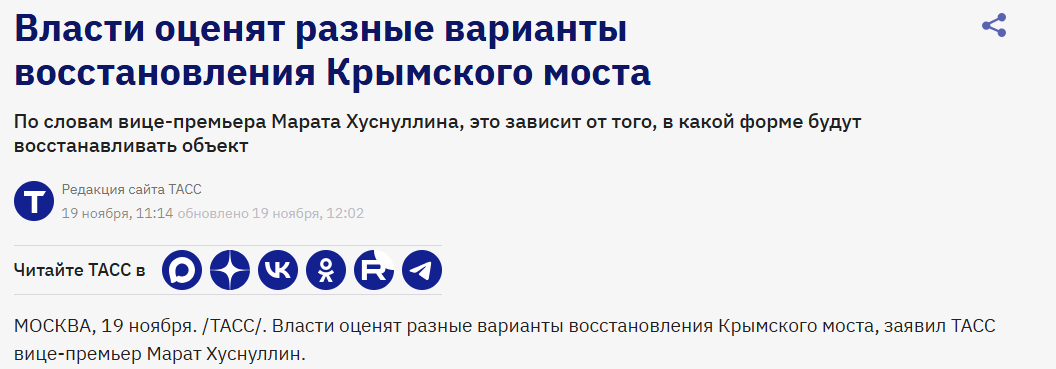
Screenshot from TASS by IMI
For example, on 19 November TASS acknowledged the structure had been damaged and road and rail traffic had been halted, but did not go into detail or explain which parts of the structure had been affected or how serious the destruction was. At the same time, the outlet claimed that the Russian authorities would consider various options for restoring the bridge.
In another news item, TASS quoted Russian Deputy Prime Minister Marat Husnullin, who promised to restore individual elements of the bridge within one to two months. As for the rest of the structure, the official left it at “We’ll see about the rest.”
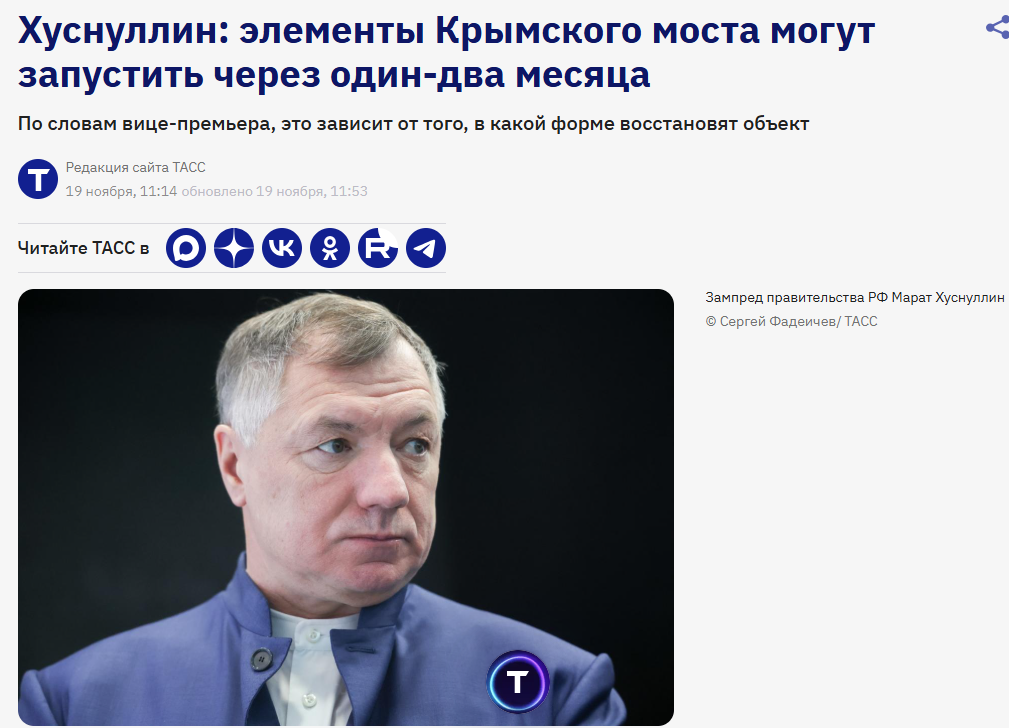
Screenshot from TASS by IMI
Russians are thus invited to discuss coming repairs without being told what exactly needs to be repaired.
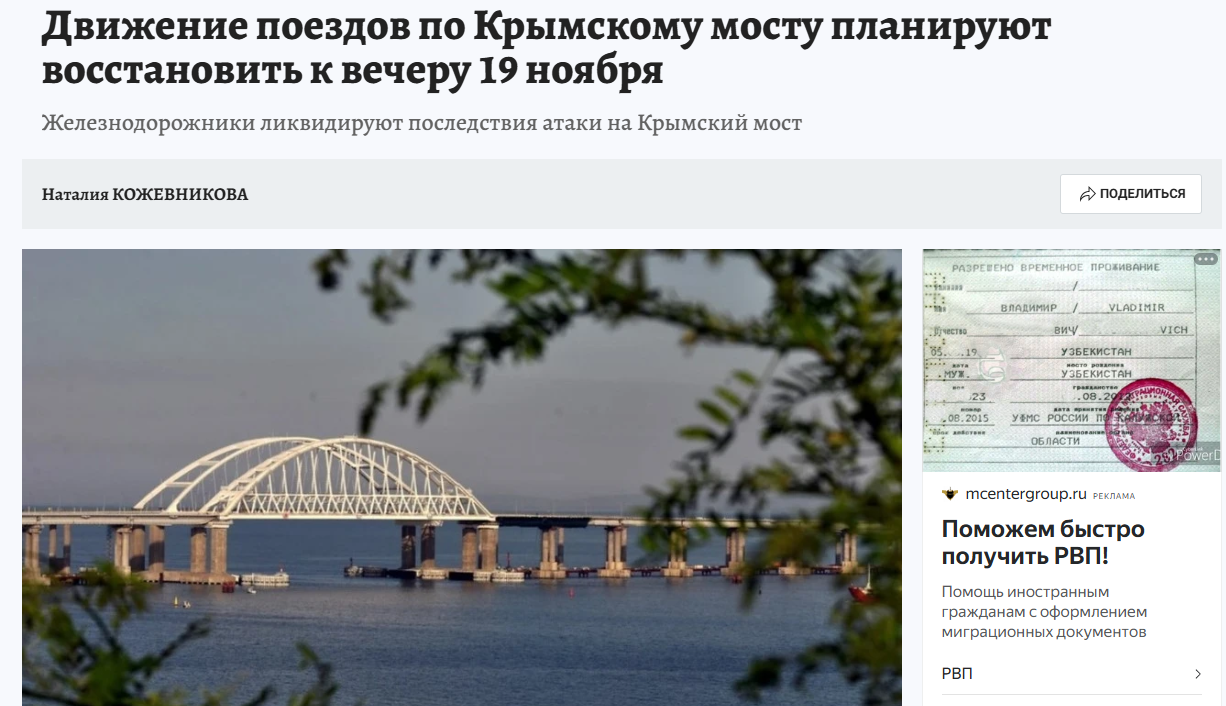
Screenshot from Komsomolskaya Pravda by IMI
Meanwhile, Komsomolskaya Pravda, instead of focusing on the damage to the bridge, emphasised the heroism of railway workers. The outlet promised that rail service would be restored as quickly as possible and quoted the Russian-appointed governor of Crimea, Sergey Aksyonov, who praised the repairers’ “heroic efforts”; assured their readers that the authorities would handle the difficulties, and reminded people to only trust official sources. Not a word was said about the scale of the damage.
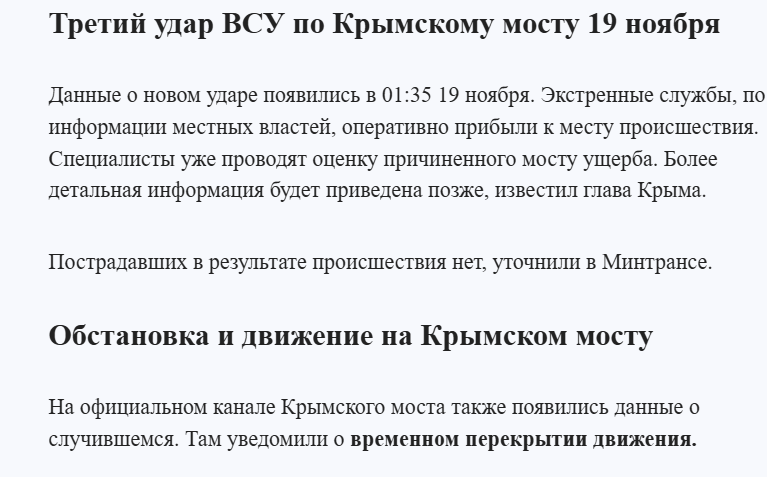
Screenshot from Komsomolskaya Pravda by IMI
In another news story, Komsomolskaya Pravda did admit that road traffic across the bridge had been halted for several days due to damage to the structure. But here, too, Russians were reassured that rail service would be restored quickly, as it had been in the past. The outlet never explained how seriously the bridge had been affected.
Propagandists in search of “good news”
The pro-war Telegram channel Rybar did not pretend that nothing of note had happened. It acknowledged that an arch of the Crimean Bridge’s road section had collapsed along with the carriageway. Moreover, the post called this the most serious damage to the structure since the start of the full-scale invasion. The channel even warned that the threat of repeated Ukrainian strikes made the repairs more difficult and that supply routes to occupied Crimea would have to be changed.
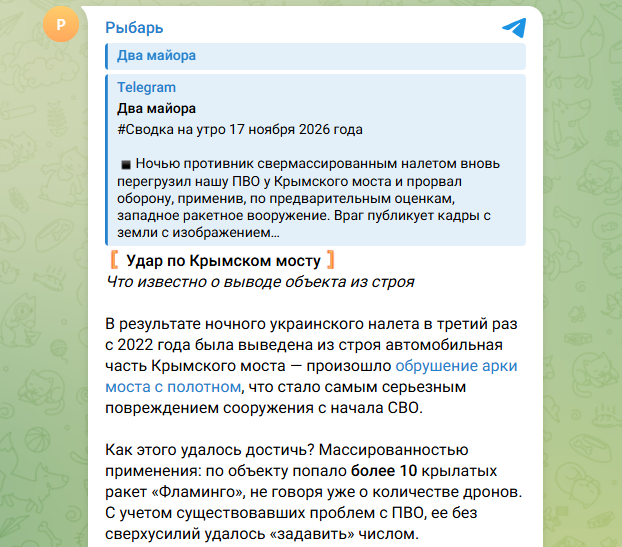
Screenshot from Rybar on Telegram by IMI
However, the channel did not leave its audience with such gloomy news for long, assuring them in the very next post that supplies to the peninsula could be ensured overland.
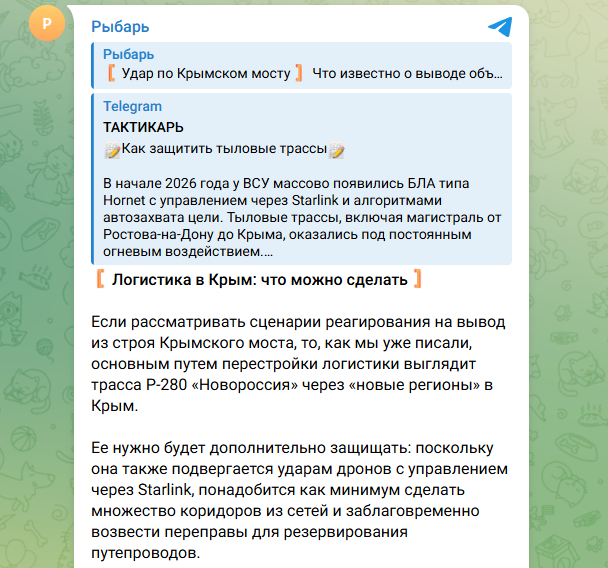
Screenshot from Rybar on Telegram by IMI
“Good news” soon followed: despite the destruction of the road section of the bridge, Russia has managed to temporarily restore train traffic. Rybar praised the efficiency of Russian railway services and recalled earlier repairs.
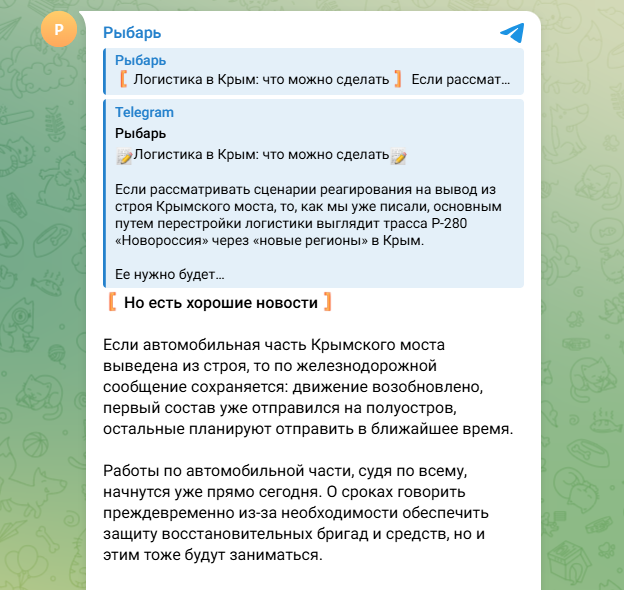
Screenshot from Rybar on Telegram by IMI
Even admitting this is the most severe destruction the bridge has suffered over the course of the full-scale war, the propagandists looked for a reason to reassure Russians and invite them to admire how well their authorities were handling the consequences of Russia’s aggression.
The “civilian” bridge
Still, some propagandists managed to lead their audience to the conclusion that the Kerch Bridge was barely needed at all. The pro-war Telegram channel Dva Mayora (“Two Majors”) shared statements by occupation officials claiming that the bridge had not been used by the military.
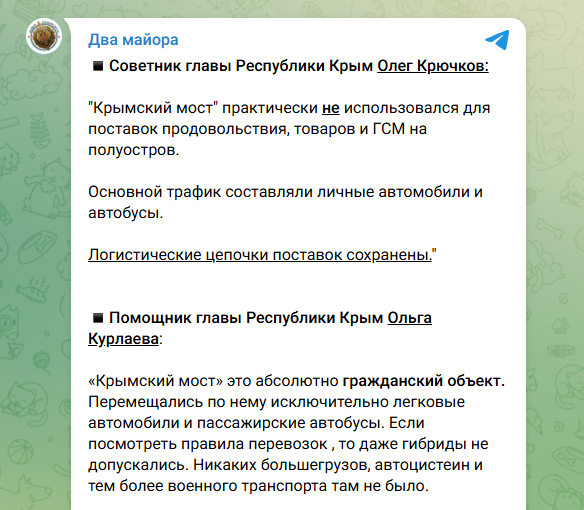
“‘The ‘Crimean Bridge’ is a completely civilian object. Only passenger cars and buses used it. A look at the transportation regulations will show you that even hybrid vehicles were not allowed. There were no heavy-duty trucks, cisterns, or especially military vehicles there,’ says Olga Kurlaeva, aide to the Governor of the Republic of Crimea.”
Screenshot from Dva Mayora on Telegram by IMI
Olga Kurlaeva, an aide to the Russian-installed governor of Crimea, called it “a completely civilian object” and claimed that only passenger cars and buses had been using it. According to her, even military transport did not cross the bridge. Oleg Kriuchkov, an adviser to the Crimean governor, added that the structure had been barely used to supply food, goods, and fuel, and claimed that the supply chains remained intact.
The propagandists’ version of events says that Ukrainian forces targeted a purely civilian object — and one that was hardly used to supply the occupied peninsula at that. Not a word about the bridge’s military significance. All the strikes achieved was inconveniencing civilian passengers.
One would think that the Kerch Bridge was barely used to transport anything and had no particular significance. Although for some reason, Russia had to urgently search for alternative supply routes after it was damaged.
Russian propagandists thirst for retaliation
Russia’s propaganda machine insists that Ukraine’s strikes did no severe damage to the Crimean Bridge, yet it demands revenge as aggressively and hysterically as if the bridge had been razed to the ground. Pro-war Telegram channels are calling for more strikes on Ukraine. Moreover, they propose destroying not just the transport infrastructure but the Ukrainian economy as a whole.
For example, in the post reporting traffic resumption on the bridge, Rybar calls for the destruction of Ukraine’s economic potential, calling this the most effective way to bring a “diplomatic solution” to the war closer. In other words, they propose inflicting as much economic damage on Ukraine as possible first, and then calling it a path to diplomacy.
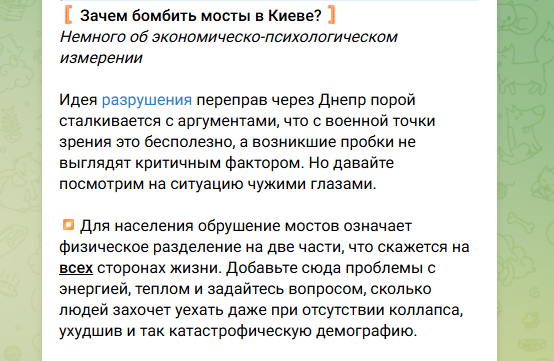
“For the locals, the bridges being destroyed means physical division into two parts, which will affect all aspects of life. Add to this the problems with the power supply and heating and ask yourself how many people will want to leave even if there is no general collapse, making the already disastrous demographic situation even worse.
Screenshot from Rybar on Telegram by IMI
Rybar is even more explicit in explaining why Russia should target the bridges in Kyiv. The channel admits that, from a military standpoint, destroying crossings may not significantly affect the flow of supplies to the UAF. Still, it insists that the living conditions in Kyiv should be ruined.
Russian propagandists are essentially proposing that the Russian military wage war on Ukraine’s civilian population, and they do not even sugarcoat it. According to their twisted logic, bridges must remain untouched, but only Russian ones.
For this review, IMI analysed content published on 16–19 November 2026 by five Russian websites (RIA Novosti, TASS, RT in Russian, Izvestia, and Komsomolskaya Pravda) and five pro-war Telegram channels (Rybar, Dva Mayora, Operatsiya Z: Voenkory Russkoy Vesny, WarGonzo, and Solovyov).