


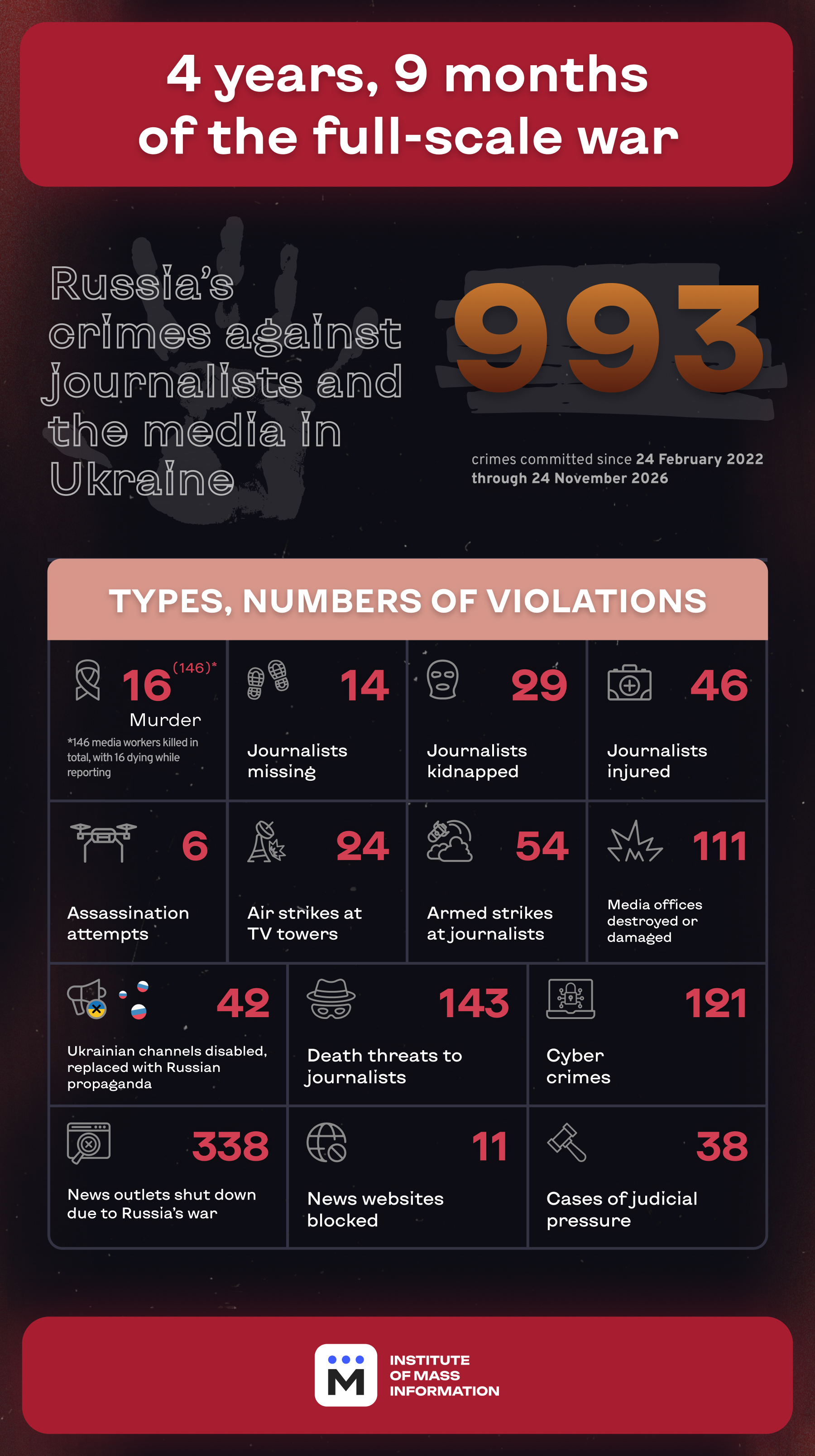
Russia has committed 993 crimes against journalists and the media in Ukraine in the four years and nine months since the start of the full-scale invasion, killing a total of 146 media professionals, 16 of whom died in the course of performing their professional duties. These include the civilian media worker Khrystyna Lysenko, who died in the Russian strike on Odesa on 18 November 2026.
The above is evidenced by the Monitoring Study of Russia’s Crimes Against Journalists and the Media, which the Institute of Mass Information has been carrying out since the first day of Russia’s invasion of Ukraine.
IMI recorded four new instances of Russia’s war negatively affecting Ukrainian media in the period from 24 October to 24 November 2026, including deaths of media professionals, a film crew coming under drone fire, and cyberattacks targeting Ukrainian news outlets.
The death of Khrystyna Lysenko
Khrystyna Lysenko was a coordinator, administrator, and producer at the Odesa-based TV channel Pershyi Miskyi. She died in a Russian attack on the city on 18 November. She was walking along Yevropeyska St., headed to work, at the moment of the strike.
A total of 146 media professionals have been killed since the start of Russia’s full-scale invasion into Ukraine. Of these, 16 died in the course of performing their work.
Media professionals killed in action
The deaths of two media workers serving in the army were reported in October and November 2026.
- Volodymyr Obertas was a photographer, cameraman, and UAF serviceman. He died in Kherson on 27 October while accompanying a group of war correspondents and filming city streets. He died in an explosion caused by a landmine likely planted in central Kherson by Russian troops on the first day of the ceasefire. Obertas had filmed the drone video that first showed the world the scale of humanitarian disaster in occupied Oleshky.
- Artur Nazarov was a Sumy-based photographer, videographer, and UAF serviceman who died in November of 2026. He worked as a photographer on the Maidan during the Revolution of Dignity and has worked with the local newspaper Panorama as a freelancer at one time.
Air strikes on journalists
- A film crew with the TV channel Kyiv 24 came under fire by a Russian jet-powered drone while working in Kyiv’s Podil district on 19 November. Journalist Dasha Riabchun reported that they had been filming on the street when a jet drone passed over them, and the team then heard several big explosions. The media workers ran for shelter to escape danger, leaving some of their equipment behind.
Cyberattacks on Ukrainian news outlets
Two Ukrainian media outlets were targeted in cyberattacks during the latest reporting period.
- Hackers attacked the English-language news outlet The Kyiv Independent on 4 November. Readers received emails with a false message about an upcoming nuclear strike on Kyiv. The hackers also attempted to post similar messages on the news outlet’s website. The newsroom believes Russian actors to be behind the attack and assumes the goal was to sow panic and undermine trust in the outlet.
- The website of Ukraine’s national news agency Ukrinform came under a cyberattack on 11 November. The hackers managed to post a message on the website that read, “Thank God we are Russians” (in Russian), which the team promptly deleted. The outlet’s director Serhiy Cherevatyi has confirmed Russian involvement.
View the full list of Russia’s crimes against the Ukrainian media and journalists here.
The Institute of Mass Information (IMI) is a Ukrainian civil society organization specializing in the media, operating since 1996. IMI defends the rights of journalists, studies the media landscape and reports on media-related events, fights propaganda and disinformation, and provides media workers with safety equipment for trips to combat areas (since the start of the Russo–Ukrainian war in 2014).
IMI carries out the only monitoring study of freedom of speech in Ukraine, keeps a list of transparent and responsible online media outlets, and tracks Russia’s media crimes in the war on Ukraine. IMI has representatives in 20 oblasts of Ukraine and runs a network of Media Hubs that provide journalists with unfailing support. IMI’s partners include Reporters Without Borders (RSF); the organization is also a member of the International Freedom of Expression Exchange (IFEX).