
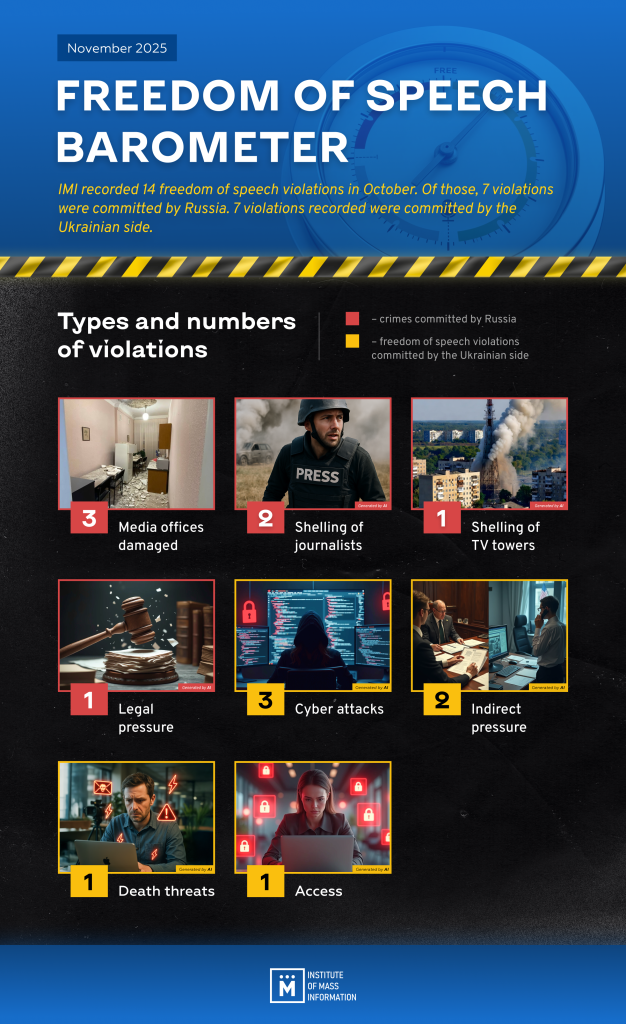
The Institute of Mass Information experts recorded 14 freedom of speech violations in Ukraine in November 2025, with 7 committed by Russia, according to the IMI’s monthly monitoring study Freedom of Speech Barometer.
Russia’s crimes against media and journalists included armed strikes at journalists, media offices, and TV towers, as well as legal pressure.
The death of two media workers turned UAF servicemen was reported in November:
- Kostyantyn Huzenko, photographer, media producer, Ukraïner team member, liaison officer at the Rear Admiral Mykhailo Ostrohradskyi Marine Brigade No. 35. Killed on 2 November 2025.
- Anton Bondarenko, UAF serviceman, Ukrainian fixer for the French TV channels TF1 and LCI. Went missing in action in Kharkiv oblast on 15 September 2025. His death was confirmed by a DNA test.
Armed strikes at journalists
- Russian troops deployed a drone to hit a Proliska Humanitarian Mission car as it was approaching Kostyantynivka (Donetsk oblast) on 8 November. There were four people in the car: two volunteers and two journalists from Spain and Austria. All four survived.
- A Russian FPV drone struck at an evacuation vehicle carrying volunteers and Radio Liberty correspondent Serhiy Horbatenko near Lyman (Donetsk oblast) on 20 November.
Damage to media offices
- The Russian drone strike in Dnipro overnight on 15 November damaged the building where the offices of the newspaper Visti Prydniprovya and the news website Novyny Pidhorodne (founded by Visti Prydniprovya) are located. The blast wave broke the windows, damaged the frames, furniture, and some office equipment.
- The Russian mass drone strike on Dnipro city late on 17 November damaged the building where the office of the regional Suspilne branch was located.
- The Zaporizhzhia office of Ukraine’s public broadcaster Suspilne was damaged in the Russian shelling strike late on 26 November. The team was unharmed: there was no one in the office at the time of the strike. The company reported damage to a part of the building’s wall and broken windows. The team is assessing the damage inflicted by the strike.
Strikes at TV towers
- A TV tower in Dnipro city was damaged in a Russian strike. Local TV channels and radio were off air.
Ukrainian media workers sentenced by Russian courts:
- Vilen Temeryanov, citizen journalist from Russian-occupied Crimea, has been sentenced to 14 years in prison. Temeryanov was detained in his home in Crimea’s Çanköy district in 2022 on false charges of terrorism.
IMI also recorded seven freedom of speech violations unrelated to Russia’s war on Ukraine. These included cyber attacks, indirect pressure, death threats, and denial of access to information.
Death threats
- Kramatorskyi Rayon journalist Andriy Hryn received violent threats from a man featured in his reporting. The police did not enter the data into the URPI at first, so the journalist sued and the court ordered the police to open an investigation. The case was opened under the death threats article.
Access
- The Komyshuvakha Town Council declined 21 information queries by SODA journalist Veronika Khorolska, sending her a non-response without the requested data. IMI’s lawyers confirmed that such a response violates the laws on access to public information.
Indirect pressure
- The suspects in the Midas corruption case were gathering intelligence on journalists, politicians, officials, and NABU detectives. The list included 10 journalists investigating corruption, such as Yuriy Nikolov and Oleksa Shalayskyi
- Slidstvo.Info received a crisis management action plan by the Ruslan Shostak Foundation, intended to neutralise the backlash expected to follow the release of the investigation into the Foundation’s efforts to evacuate children to Türkiye. The plan involved bot farms, controlled influencers, and meetings with news outlet editors. The Slidstvo.Info team expressed concerns for their sources’ safety.
Cyber attacks
- The website of the Kharkiv-based news outlet Nakypilo was targeted by hackers who attempted to crack account passwords on 14 November. The attackers operated from multiple IP addresses located mostly in Kyiv and Odesa. The website’s security system thwarted the attack.
- Unknown individuals tried to access the corporate accounts of journalists with Poltavska Khvylia and Sil Media at the same time. The mass attack resulted in Meta suspending the profile of the media outlets’ founder, which impacted the work of the pages.
- Cherkasy-based news outlet 18000 received several phishing emails mimicking Meta notifications with an offer to receive a “blue check mark” on Facebook. The emails contained a link to a suspicious Google form intended to steal data. The team recodnised it as a scam and did not interact with the suspect links.
See the full list of freedom of speech violations below.
Russia’s crimes
Armed strikes at journalists — 2
1. Russian drone targets car with volunteers, journalists in Donetsk oblast
08.11.2025 Russian troops deployed a drone to hit a Proliska Humanitarian Mission car as it was approaching Kostyantynivka (Donetsk oblast) on 8 November. There were four people in the car: volunteers Yevhen Tkachov and Oleh Tkachenko, as well as two journalists from Spain and Austria. All four survived, reports Suspilne Donbas, which was informed about the incident by Yevhen Tkachov, the Proliska Humanitarian Mission head in Donetsk oblast.
Yevhen Tkachov said that the drone targeted the evacuation mission deliberately and hit the mission’s logo on the car.
“We were on our way to help people evacuate as volunteers, we had four or five addresses, with chaplain Oleh Tkachenko in his armored car. At the entrance to Kostyantynivka, Novoselivka district, we had just turned around, drove around the bend and noticed an optical fiber drone hovering 10 or 15 meters away from us. When we saw it, we stopped the car, and it started moving. We jumped out of the car, and at that moment it attacked,” Tkachov said.
“[They hit] the Proliska logo. It being the engine compartment is one thing, but it was a targeted strike, despite the humanitarian mission sticker,” he said.
The volunteer said that the journalists took everything without undue emotion: “They have a lot of experience. They have been in Donetsk oblast since the start of the invasion, they have seen a lot, so they took everything without undue emotion.”
Yevhen Tkachov believes that the strike at the Proliska car in Kostyantynivka was probably done by an FPV drone on a fiber optic cable with a cumulative projectile from an RPG launcher: it burned the car through. The damaged vehicle has already been pulled out of Kostyantynivka; it is yet unclear whether it can be repaired.
The volunteer said that last week the Russian army had tried to attack the Proliska car twice, but missed.
Austrian journalist Christian Wehrschütz was in the car at the time of the strike, reports ORF. According to ZiB (ORF’s news broadcast), Wehrschütz was in Donetsk oblast with a team from the humanitarian organization Proliska and a Spanish reporter. The team wanted to film the evacuation effort taking place in Kostyantynivka, a city near the front line.
2. Russian drone targets car with RFE/RL correspondent Serhiy Horbatenko
20.11.2025 A Russian FPV drone struck at an evacuation vehicle near Lyman (Donetsk oblast) today, 20 November. The car was carrying by Serhiy Horbatenko, a correspondent with the Radio Free Europe / Radio Liberty project Donbas Realii, RFE/RL reported in a Telegram post.
RFE/RL said that the Russian forces had hit the car as it was on its way to Lyman to evacuate civilians.
The fiber optic FPV drone was lying in wait and targeted the evacuation vehicle. The crew included Devon Masser, a US volunteer with the humanitarian organization Plain Compassion Crisis Response, two police officers from White Angel (Donetsk police’s civilian evacuation unit), and Donbas Realii journalist Serhiy Horbatenko.
The volunteer who was driving was injured: he has shrapnel wounds to his face.
“We were driving when all of a sudden — bang, bang. I don’t really understand what happened. We’re here to evacuate people, I’m from the US. I’m a little confused right now,” volunteer Devon Masser said after he was given first aid.
The car burned down completely.
In a comment to Valentyna Troyan, the Institute of Mass Information representative in Luhansk oblast, Serhiy Horbatenko said that he had been wearing a bulletproof vest and helmet at the moment of the strike.
“My head and ears are ringing a little, but as for the rest, thanks be to God,” said Horbatenko.
He added that the car had the humanitarian mission’s logos.
Damage to media offices — 3
1. Russian strike in Dnipro damages local media offices
15.11.2025 The Russian drone strike in Dnipro overnight on 15 November damaged the building where the offices of the newspaper Visti Prydniprovya and the news website Novyny Pidhorodne are located. The blast wave broke the windows, damaged the frames, furniture, and some office equipment, reports Visti Prydniprovya.
Visti Prydniprovya chief editor Natalia Kovalchuk said that the strike occurred just a few days after the office renovations were completed: the team had created a modern media hub where journalists from relocated media outlets and other media professionals could come to work.
“We had just prepared the rooms for the editorial archives and equipped the working areas for journalists. We hadn’t even had time to set up the chairs — that’s when the attack happened,” the editor said.
She added that the team was assessing the scale of the damage and coordinating to resume work.
This information was confirmed to the Institute of Mass Information journalist by Oleksiy Kovalchuk, the founder of Visti Prydniprovya (which, in turn, founded Novyny Pidhorodne. – Ed.).
“We bounced back, as they say, the easy way. The windows in the room where they were replaced recently are still intact. A window was blasted out in the room where we were building the media hub. The problem is that these are large front windows. In another room, which we use for storage, the windows also shattered,” said Oleksiy Kovalchuk.
2. Suspilne Dnipro office damaged in Russian drone strike (updated)
17.11.2025 The Russian mass drone strike on Dnipro city late on 17 November damaged the building where the offices of the regional Suspilne branch and Ukrainske Radio are located, reports Suspilne Dnipro.
The strike resulted in a fire, blasted out out the windows and doors, damaged the building’s ceilings and the roof.
There were no staff in the office at the moment of the strike.
Suspilne Dnipro chief editor Yevhen Pedashenko says that the first floor of the building, where the large studio is located, was destroyed.
“We cannot access the second floor now and assess the scale of the damage, because there are certain obstacles. The main thing that we stress is that everyone on our team is alive and unharmed. We continue to work, continue to go live on Pershyi TV and work on all our digital platforms, we are trying to fully resume operations as soon as possible,” he said.
Suspilne Dnipro manager Kateryna Lysiuk says that the studio burned down completely and that the attack damaged not just the main building, but also the annex.
“There were up to 15 explosions overall, from what we know. The premises and all our buildings were affected. We are looking into the situation now, trying to understand the scale of the tragedy, but we keep working. Despite everything, we continue to work, continue to make news,” she said.
Head of newsroom Valeria Bovsha says that the staff learned about the office building damage from a colleague who lives nearby.
“Our colleague, a video editor who lives next to the office, wrote that there had been a very powerful and loud explosion, that windows in her house had been blasted out and that she had seen the roof of our building on fire. Several more explosions followed after that. When it was more or less safe, our driver was able to come here and see the impact,” she said.
The strike destroyed parts of the floor barriers and the roof. In some places, the ceiling and walls collapsed. The fire that broke out on the roof quickly spread to the entire building due to the windy weather.
“This morning we managed to come to the office, we saw the aftermath of the destruction. We managed to carry out two laptops and a surviving potted plant, some bulletproof vests. The cameraman and a reporter checked the cameraman’s office, they managed to save several cameras, they are functional as far as we know. Now [the emergency services] have told us again that we can’t go there because of the smoke, because the firefighters are still working,” Valeria Bovsha said.
One of the cars owned by Suspilne Dnipro also burned down. In addition, Bovsha says the building may collapse, so being there is unsafe.
The Suspilne Donbas office, located in the Suspilne Dnipro building, was also damaged.
The strike also affected the premises of the Kontrabas film studio, located in the same building. The co-founder of the film company, Oleksandra Teslenko, said that almost all of their property was destroyed in the Russian strike.
“We have a large filming pavilion with sets, props, costumes, a lot of professional equipment. There is not even anything to record there, everything has burned down. We have invested in all this for more than seven years, out of our own pocket. There is nothing left,” Teslenko said.
The Russian forces attacked the Dnipro with drones late on 17 November. A series of explosions occurred in the city at around 10:30 p.m. The city and the district came under a massive Shahed drone attack. The strikes caused multiple fires.
3. Russian strike damages Suspilne Zaporizhzhia office
26.11.2025 The Zaporizhzhia office of Ukraine’s public broadcaster Suspilne was damaged in the Russian shelling strike late on 26 November. The team was unharmed: there was no one in the office at the time of the strike, Suspilne reports.
The company reported damage to a part of the building’s wall and broken windows. The team is assessing the damage inflicted by the strike. Suspilne did not interrupt their work.
Strikes at TV towers — 1
1. Russian strike in Dnipro damages TV tower
17.11.2025 A TV tower in Dnipro city has been damaged in a Russian strike. Local TV channels and radio are off air, regional National Council for Television and Radio Broadcasting representative Olena Demchenko reports to Detector Media.
“The tower is standing, the TV channels and radio that broadcast from it are not working,” the NCTRB representative said.
These are local broadcasters. The scale of damage to the TV tower is being assessed. Olena Demchenko added that the Suspilne Dnipro office bulding “burned down.”
The Russian mass drone strike on Dnipro city late on 17 November damaged the building where the offices of the regional Suspilne branch and Ukrainske Radio are located. The strike resulted in a fire, blasted out out the windows and doors, damaged the building’s ceilings and the roof.
Legal pressure — 1
1. Citizen journalist Vilen Temeryanov sentenced to 14 years in Russian prison
26.11.2025 Vilen Temeryanov, citizen journalist from Russian-occupied Crimea, and four Crimean Tatar activists targeted in the “first Çanköy Hizb ut-Tahrir group” case have been sentenced to 13 to 19 years in prison, Crimean Solidarity reports.
The verdict was passed by the Southern District Military Court in Rostov-on-Don (Russia) today, 26 November. Activist Enver Krosh was sentenced to 19 years in prison, Edem Bekirov and Rinat Aliyev to 15 years, journalist Vilen Temeryanov to 14 years, and Seyityaga Abbozov to 13 years. The court also ruled that Enver Krosh would serve the first four years in a prison and be later moved to a maximum-security colony. The other defendants were sentenced to three years in prison each.
The prosecutor had requested 17 years in prison for Krosh, 15 years for Edem Bekirov and Rinat Aliyev, 13 years for Temeryanov, and 11 years for Seyityaga Abbozov.
Crimean Solidarity reports that the “first Çanköy Hizb ut-Tahrir group” case against Enver Krosh, citizen journalist Vilen Temeryanov, Rinat Aliyev, Murat Mustafayev, Seyityaga Abbozov and Edem Bekirov was opened in August 2022. The Crimean Tatar men were detained in Çanköy. They were charged with involvement in the Islamic political party Hizb ut-Tahrir, which is outlawed in Russia. Murat Mustafayev was later singled out into a separate case.
The main piece of evidence in the case was an audio recording of a 2015 conversation about prayer and fasting. Defense attorney Kurbedinov is certain that the recording was extracted from the FSB archives eight years later.
The attorney also reported gross violations during the investigation, such as forged evidence, unlawful interrogations of “secret witnesses,” incriminating material being planted in defendants’ homes during searches. The examination showed that on the books “seized” during the searches had fingerprints of ten people, none of them being the defendants; the court did not allow the material evidence to be sent for additional examination.
The Hizb ut-Tahrir party was declared a terrorist organisation in Russia by a Supreme Court decision in 2003, before the adoption of the law “On Combating Terrorism”, which de-facto undermines the decision’s legitimacy. The hearing was held in camera, without the organisation’s representatives present.
Vilen Temeryanov is on the Institute of Mass Information’s list of Ukrainian journalists imprisoned by Russia.
Crimea — 1
1. Russian police in Crimea issues another warning to journalist Lutfiye Zudiyeva
02.11.2025 Russian police in occupied Canköy (Crimea) issued another warning of “unacceptability of violating the law” to journalist and human rights advocate Lutfiye Zudiyeva on 2 November, the journalist reports to Crimean Solidarity.
Zudiyeva said that she had been visited by two policemen who claimed to be from the Canköy department of Russia’s MIA. When asked why they were handing her the document, the officers replied, “To have a talk so that you do not violate the law.”
The document issued to Zudiyeva, like the one handed to her by policemen previously on 18 October, contains a reminder about the administrative and criminal law articles on:
- violation of rally regulations;
- оrganising the mass presence of citizens in public spaces;
- promotion and public display of Nazi symbols;
- public actions aimed to “discredit” the Russian army;
- production and distribution of “extremist” material;
- organising mass riots;
- repeated violation of rally regulations;
- public calls for “extremism”;
- public calls for actions aimed at violating the territorial integrity of Russia.
“As on 18 October, I wrote in the document that I disagreed with the warning and did not plan to violate the current law. This is a template text that contained nothing besides a list of articles that are in no way related to my professional activities,” Lutfiye Zudiyeva said.
Earlier, on 18 October, police officers from the Canköy department of the Russian Ministry of Internal Affairs handed the journalist a document to the same effect. When asked why they had handed it to her, the officers replied that they “do not know, they are performing the task they were given.”
The freedom of speech situation in Ukraine unrelated to Russia’s war
Physical aggression
Death threats — 1
1. Court orders police to investigate death threats to Kramatorskyi Rayon journalist
10.11.2025 On October 29, 2025, the Dnipropetrovsk District Court (Dnipropetrovsk oblast) ordered the police to enter the case of death threats and insults targeting Kramatorskyi Rayon journalist Andriy Hryn into the Unified Register of Pre-Trial Investigations (URPI) and to begin a pre-trial investigation into it. The death threats were coming from Yuriy Mykuliak, the subject of Hryn’s reporting.
Andriy Hryn reported this to Yulia Harkusha, the Institute of Mass Information representative in Donetsk oblast.
Andriy Hryn received violent threats following the release of his article “From Criminal Law Case to the Recruits Academy: Ex-Suspect Mykuliak Leads ‘Sturm’ on General Kryvonos’ Behalf” on 21 October 2025.
The article concerns Yuriy Mykuliak, who was charged with death threats during an armed conflict in Svyatohirsk in 2018 and was later appointed head the Academy for Army Recruits “Sturm”. Despite the case having been closed due to the victim’s withdrawal of charges, the reasons for the appointment and the change in qualification raised questions among journalists. Now Mykuliak publicly presents as the head of a military training structure associated with General Serhiy Kryvonos, and Kramatorskyi Rayon questioned state bodies about the legality of the Academy’s work and the degree of the army’s involvement.
“In 2025, we (the Kramatorskyi Rayon team – Ed.) remembered this case and decided to send queries to the Donetsk oblast police, the oblast prosecutor’s office, to learn about the results. Based on the replies received, I wrote an article for the website,” said journalist Andriy Hryn.
A few hours after the article was released, the journalist received insults and death threats from Mykuliak, who began commenting under the media outlet’s Facebook post linking to the article (the moderators have since deleted the comments, but IMI has screenshots). Finally, the journalist contacted the police with a complaint about death threats. Having received no sufficient response from the police, the journalist went to court. The court ruled to order the law enforcement bodies to enter the case in the URPI and begin a pre-trial investigation, said Andriy Hryn.
“This ruling shows that society, journalists, and law enforcers must follow the law in equal measure: when a journalist does their job, law enforcers must respond. And when the system ignores this, it is the court that acts as the arbiter of justice. That is why we report on this: because this is not just about one person or one case, it is about defending freedom of speech and protecting journalism in an environment where it is often the media representatives who find themselves under pressure,” the journalist said.
He added that the Kramatorsk District Department of Donetsk Oblast Police had opened a case over death threats to him. The police recognised the journalist as the victim in the proceedings and interviewed him. The proceedings were qualified as death threats (Part 1, Article 129 of the Criminal Code of Ukraine).
“I hope that in the future the police will reclassify this case as death threats to a journalist, and not just death threats. Otherwise it sounds like that we just had a quarrel somewhere in the street,” the journalist added.
Andriy Hryn says that procedural action is underway.
Censorship, curated agendas, access to information
Access to information for journalists — 1
1. Zaporizhzhia town council declines 21 queries by journalist
26.11.2025 Komyshuvakha Town Council (Zaporizhzhia oblast) declined 21 queries sent in October by Veronika Khorolska, journalist with the Zaporizhzhia news outlet SODA collaborating with the OPORA civil society network OPORA in a research project.
The journalist reported this to Natalia Vyhovska, regional representative of the Institute of Mass Information.
“I am currently assisting in researching the safety situation in the locality and this involved submitting queries to communities. I worked with the Komyshuvakha Town Council, where I sent 21 queries asking for information on various aspects about the community. In the end, they answered all my questions by saying they did not know anything. Mind you, the queries contained very different and often easy questions. For example, the date of the community budget being adopted. They replied to all the queries with one letter, saying that they kept no records,” Veronika said.
In particular, the journalist requested information on:
- the number of cultural institutions in the community before the start of the full-scale invasion;
- the number of vacant positions in the executive committee’s units;
- the ban or restrictions on mass gatherings.
Each of the queries concerned a specific topic and listed specific questions. However, the journalist says, she received one reply to all the queries, signed by the town council secretary Viktoria Korol. The two-page reply contained a list of citations linking to various bills and regulations explaining what public interest is, who the information holder is, what a query is, and what an address is. The reply closed with the conclusion: “an address is not an information query if answering it necessitates creation of new information.”
Volodymyr Zelenchuk, a lawyer at the Institute of Mass Information, said that such an reply violates both the Law “On Access to Public Information” and the Law “On Addresses by Citizens.”
“The reply is completely unsubstantiated. The queries were essentially declined. The reply deadlines were not met, there are no grounds for such a denial, even the requirements for a written denial to answer a query were not met. This can be called a ‘non-reply.’ Indeed, some questions may be viewed as addresses, not queries, but the sender was not informed about this, and the response to the query was obviously not received,” explained Volodymyr Zelenchuk.
Veronika Khorolska says she received no repy to what the Komyshuvakha Town Council viewed as “addresses”, either.
Indirect pressure — 2
Other cases of indirect pressure — 2
1. Operation Midas suspects kept dossiers on journalists
25.11.2025 The suspects in the Midas case had been gathering intelligence on dozens of people including journalists, ministers and their deputies, and Security Service of Ukraine (SBU) employees, reports Ukrinform, citing a statement by National Anti-Corruption Bureau of Ukraine (NABU) representatives made at a Committee on Anti-Corruption Policy meeting.
“… I also ask the MPs to respond and not to remain silent as ‘Rockets’ and ‘Tenors’ collect intel on law enforcers, including SBU employees in this case. That is, this group was collecting intel on the SBU as well. I think this will be of interest to them, too. This means they [SBU] may have been a nuisance for this group for some reason – some SBU officers, this is another possibility,” said NABU Director Semen Kryvonos.
Oleksandr Abakumov, chief detective at the National Anti-Corruption Bureau, clarified that the intelligence gathering targeted 9 SBU employees. He added that the files discovered on the data carriers seized during the investigation featured similar ‘dossiers’ on 16 current MPs, including the head of the Verkhovna Rada’s anti-corruption committee, Anastasia Radina, Yaroslav Zheleznyak, and others.
“[There is intel] on 18 ministers or deputy ministers holding postitions mostly in the energy sector or the Ministry of Justice; on 10 journalists, including Yuriy Nikolov and the late [Oleksa] Shalaiskyi and the rest of the journalists covering corruption in the energy sector and elsewhere; on the former head of Ukrenergo, etc.,” said the NABU chief detective.
He reported that law enforcers observed a shift in the criminal organisation’s “influence areas” or “areas of interest” following the Cabinet of Ministers changes, with the Ministry of Justice becoming the new target.
“That’s when we see the appearance of dossiers on the Justice Minister’s deputies, on [officials working in] specialized areas such as the State Bailiff Service, enforcement of sentences, plus, most importantly, experts,” emphasized Abakumov. According to his data, these files also contain several profiles on experts from the Bokarius Institute and others.
“Accordingly, we understand that these profiles were most likely made to have information about the experts on hand and to have influence opportunities,” Abakumov said.
NABU revealed that the defendants in the Midas case had collected a total of 527 dossiers on various influential people in the country.
“These 527 files feature 15 NABU detectives personally involved in investigations in the energy sector, the law enforcement sector, and in other high-profile investigations,” he said.
The NABU chief detective pointed out that some of the files had been created on 17 July 2025 – before the searches targeting NABU employees.
“I would like to draw your attention to the fact that so-called profiles or reference cards on several employees who later received suspicion notices from other law enforcement bodies were created on 17 July. In particular, I would like to state that these documents featured Ruslan Maghamedrasulov (17 July), Vitaliy Tibekin, also notified of suspicion later (17 July), Yevhen Tokar (17 July),” Abakumov noted.
As Ukrinform reports, NABU announced a special operation to expose corruption in the energy sector on 10 November 2025. The investigation revealed that the persons involved in a criminal organisation had built a large-scale scheme to influence strategic state-sector enterprises such as Energoatom.
Law enforcement operatives detained five of the seven suspects. These included a businessman whom the investigation considers the head of the criminal organisation, a former advisor to the Minister of Energy, and Energoatom’s executive director for physical protection and security.
Suspicion notices were issued to businessman, Kvartal-95 studio co-founder Timur Mindich (code name “Carlson” on NABU tapes), former advisor to the Minister of Energy, Ihor Myroniuk (“Rocket”), Energoatom’s executive director for security, Dmytro Basov (“Tenor”), and four “employees” of the so-called “money laundering back office”, including Oleksandr Zukerman (“Sugarman”), Ihor Fursenko (“Ryoshik”), Lesya Ustymenko, and Lyudmyla Zorina. Five people from the list of suspects have been detained. Two, Timur Mindich and Oleksandr Zukerman, have left Ukraine.
2. Shostak Foundation emails investigation neutralisation plan to Slidstvo.Info
19.11.2025 The charity foundation by Ukrainian businessman Ruslan Shostak is preparing a media campaign to neutralise the impact of an upcoming investigation into their work by Slidstvo.Info, the media outlet reported on 19 November.
According to Slidstvo.Info, a foundation employee emailed a file titled “War-Free Childhood: Action Plan” to their journalist, likely on accident. The document listed PR steps that suggest the foundation is preparing a campaign to neutralise the fallout from the media outlet’s investigation which is set to be released shortly. In particular, the foundation plans to involve bot farms, controlled bloggers, and meet with editors of top news outlets and publish their own materials there.
The document received by the journalists includes the following steps to be taken after the investigation is released:
- “involving real participants in the project to comment under negative social media posts;”
- “involving the database of accounts to promote reasonable talking points and facts on social media.”
The action plan also mentions:
- “a controlled post by an influencer suggesting that the investigation’s release was not incidental;”
- “non-public communication with editors of top media outlets;”
- “non-public interviews with insiders (officials, volunteers);”
- “releasing a major investigation into the failures of the state evacuation efforts in Tier-1 media outlets (NV, LB).”
The journalist received the document while working on an investigation into the evacuation of 3,500 Ukrainian children from Dnipropetrovsk oblast to Türkiye by the Ruslan Shostak Foundation as part of the project “War-Free Childhood”. During a monitoring visit to hotels where children were staying, the Commissioner’s Office recorded gross violations of children’s rights, including psychological and physical abuse. Two underage girls returned from Türkiye pregnant.
Slidstvo.Info journalists met with Ruslan Shostak to ask him about the discovered violations and the work of “War-Free Childhood”. After a three-hour interview, members of the businessman’s team promised to send journalists additional material that would refute the data in the [Commissioner’s] report, mentioned during the interview. However, the journalists received the crisis management action plan instead.
The plan features “preventive communication” (likely referring to steps to be taken before the investigation is released), including two publications in the media. One of these is “a statement on the Foundation’s website and in the media about the commiment to combat issues systematically.” Slidstvo.Info notes that the statement was indeed posted on schedule.
Slidstvo.Info were unable to find the second material, “an expert’s column on teenage pregnancy (focusing on orphans),” which was set to be released in news outlets such as NV, Liga, and The Page. The column by the founder of the organisation, i.e. Ruslan Shostak himself, is planned for the second month after the release of the investigation.
“If the Shostak Foundation is really preparing so extensively for the release of our investigation, then we are worried for the sources who testified to us,” commented journalist Yanina Korniyenko.
Slidstvo.Info said they would monitor whether the Foundation will go through with the plan. The premiere of the investigative documentary “Children of the state. What happened to orphans during evacuation to Türkiye” is scheduled to premiere on 28 November.
Ruslan Shostak is a Ukrainian businessman, owner of the store chains VARUS and EVA whose fortune in 2021 amounted to 140 million US dollars. Ruslan Shostak is also the head of the Retail and Logistics Group at the Business Council under the President of Ukraine.
Online pressure
Cyber attacks — 3
1. Kharkiv-based news website Nakypilo targeted by hackers
14.11.2025 The website of the Kharkiv-based news outlet Nakypilo was targeted by hackers once again late on 14 November 2025. The attackers tried to crack users’ passwords, said chief editor Olena Leptuha in a comment to an Institute of Mass Information representative.
“On the night of November 13–14, someone tried to take control of Nakypilo’s administrative panel by cracking the passwords for various accounts. The hackers operated from different IP addresses, mainly from Kyiv and Odesa. The attack was thwarted by the internal security systems of our website. The system administrator has since introduced additional website protection tools,” the editor said in the comment.
She added that this was not the first time their website was targeted. The previous incident occurred less than a month ago, on 22 October, when the site sustained an intense DDoS attack.
2. Hackers try to access Poltavska Khvylia, Sil Media journalists’ accounts
24.11.2025 Unknown individuals tried to access the corporate accounts of journalists with Poltavska Khvylia and Sil Media late on 24 November, reports Vitaliy Ulybin, founder and CEO of the two news outlets, in a comment to Nadia Kucher, the Institute of Mass Information representative in Poltava oblast.
“All night long, someone was trying to access all our corporate accounts, break into the Instagram and Facebook profiles of all our journalists. We were lucky: we did retain something from our digital security training, so everyone has two-factor authentication installed with vairous levels of protection,” said Vitaliy Ulybin.
He added that no one on their team had their accounts hacked.
“But the attempts to hack my Facebook and Instagram pages were so intense that Meta decided that there was some kind of fraud going on and suspended my profile for 180 days, giving me an opportunity to appeal and prove that I am the true owner of the account and not some impersonator,” the journalist said.
According to Vitaliy Ulybin, the problem is that the Instagram pages of the websites Sil Media and Poltavska Khvylia were linked to his main page in these social media.
“As of now, my Facebook, Instagram, and the pages of the news outlets are suspended. We are now trying to figure out the details and resolve the situation. But the situation is very interesting, because the hack attempts were coming Zakarpattia and Kyiv at the same time. It is also noteworthy that the attack targeted all journalists at once,” he said.
He suggests that the attempts could have been made either by Russian forces or simply those looking to interfere with Poltavska Khvylia’s investigations.
3. Phishers impersonate Meta to target Cherkasy news outlet
25.11.2025 The Cherkasy-based media outlet 18000 has received several phishing emails impersonating Meta. The emails ask the team to fill out a Google form to get a “blue check mark” on Facebook, 18000’s senior social media manager Anastasia Neboha reported in a comment to Yelena Shchepak, the IMI representative in Cherkasy oblast.
Neboha said that the team quickly recognised the emails as phishing and did not click the third-party link.
Defending freedom of speech
The authorities’ response to freedom of speech violations — 2
1. Court orders mayor to pay moral damages for comparing journalist to a dog
18.11.2025 The Kharkiv Court of Appeal ordered Zmiyiv Mayor Pavlo Holodnikov to compensate moral damage to Media-Zmiyiv journalist Anastasia Istomina, overturning the earlier Zmiyiv District Court ruling. The verdict was passed on 18 November 2025, Media-Zmiyiv reports.
The incident occurred on 4 November 2023, when the mayor told journalist Anastasia Istomina, who was reporting during a public event, “Stop following me around like a dog and filming s**t on that camera.”
The news outlet writes that in June 2024 the Zmiyiv District Court dismissed the journalist’s claim for protection of honor, dignity, and business reputation, effectively ruling that the statement was not legally humiliating the journalist.
On 18 November, the Court of Appeal overturned the first instance court’s ruling and granted the journalist’s claim in part.
The court ruled to recover UAH 2,684 in moral damages from Pavlo Holodnikov. The verdict will come into force in a month and may be appealed in cassation.
The news outlet writes that the journalist decided to donate the money received as compensation for moral damages to the Ukrainian Armed Forces.
Anastasia Istomina told Suspilne that she was satisfied with the court’s ruling.
“The court finally recognised that the mayor’s statements were unacceptable and humiliating. All this money will be donated to the Ukrainian Armed Forces, where they are needed most right now. I hope that the ruling will be a lesson to our mayor and other officials, teaching them that they can not treat people like this, especially journalists. This is a case that dragged on for quite a while,” said Istomina.
She added that Holodnikov was also expected to cover the legal fees – more than 9 thousand hryvnias.
The journalist added that the mayor did not contact her to discuss the case or apologize.
In turn, Pavlo Holodnikov told the news outlet that he had not yet read the court’s verdict.
“I advise you read the first instance ruling. Because this is an appeal, it will be followed by cassation. So my question is: why are you paying so much attention to the intermediate instance while disregarding the the first instance ruling and failing to mention that there will be a cassation motion?” said Holodnikov.
When asked by a Suspilne journalist whether he was going to the cassation court, he replied, “I have not seen the verdict yet. If the ruling suits me, we do not go anywhere. If not, then, of course, we go to the cassation court.”
The mayor himself believes that there was no incident with the journalist.
2. Human Rights Commissioner opens proceedings over City Council’s denial of access to ZHAR.INFO
26.11.2025 The Verkhovna Rada Commissioner for Human Rights has opened proceedings following a complaint by ZHAR.INFO, who reported that the Khmelnytskyi City Council had refused to share documents (namely, review findings on the Council’s draft decisions) upon the news outlet’s request.
ZHAR.INFO founder and journalist Alyona Bereza reported this to the Institute of Mass Information.
Earlier, the media outlet addressed the Khmelnytskyi City Council with a query, asking for some of the Council’s draft decisions and specialised departments’ findings on them. These findings are provided by the legal support department, the City Council representation, or other specialised units when a decision is being drafted to be later reviewed and put to a vote by MPs at a session.
The Council declined the query, citing a decree by the mayor that says that such findings are classified information.
Disagreeing with the officials’ response, ZHAR.INFO filed a complaint with the Commissioner. The latter opened proceedings, ordering a full and comprehensive probe into the situation reported in the complaint.
“In order to fully and comprehensively establish all the details outlined in your appeal and in view of the need for additional control measures, the further review [of your appeal] will be carried out as part of the Commissioner’s open proceedings,” responded Oksana Kizayeva, the VRU Commissioner for Human Rights representative in Khmelnytskyi oblast.
At the same time, journalist Alyona Bereza reported that the mayor promised to deal with this situation during a press conference with media representatives on November 20 after an extraordinary session of the Khmelnytskyi City Council.
“This was a big surprise for us. Over the years of operating as a civil society organisation, and now as an online news outlet based on it, this is the first time we have encountered such a situation. We first appealed against the refusal to share the requested findings. For us, this is the highest priority right now, because we need them to write an article. If the situation is not resolved, we are ready to appeal this denial in court,” said Alyona Bereza.
The Khmelnytskyi City Council provided the documents requested by the online news outlet ZHAR.INFO following a letter by the Verkhovna Rada Commissioner for Human Rights. On 27 November, the Khmelnytskyi City Council’s apparatus emailed 12 pages of scanned copies of decision review findings along with a cover letter to the news outlet.
“In view of the letter by the Verkhovna Rada Commissioner for Human Rights of Ukraine No. 99732.4/Б.1684.7/25/53, dated 21.11.2025, in response to your information queries dated 30.09.2025 and 14.10.2025, we provide the findings by the Khmelnytskyi City Council’s departments,” the apparatus’s response states.