The market for covert promotion in Ukrainian online media shrank noticeably in the third quarter of 2026. A total of 151 news stories bore signs of covert promotion, with 49 more containing mislabelled ads. At the same time, positions within the market are being redistributed among clients, and new systemic players are emerging: for instance, the military-industrial complex (MIC) has appeared in the list for the first time. These are the findings of the Institute of Mass Information’s monitoring study of covert promotion in online news, carried out in August 2026.
During the monitoring period, IMI experts identified a total of 203 potentially commissioned news stories within online media outlets’ news feeds. Only three of them were labelled in accordance with the law.
Among the rest of the identified news stories, 151 bore signs of covert promotion, while 49 were mislabelled ads. By comparison, in the first quarter of 2026, IMI’s monitoring recorded 170 news stories bearing signs of undisclosed promotion and 51 improperly labelled ads, meaning that the shrinkage in the market came primarily at the expense of genuine covert promotion, i.e. commissioned news stories that were not disclosed as such in any way.
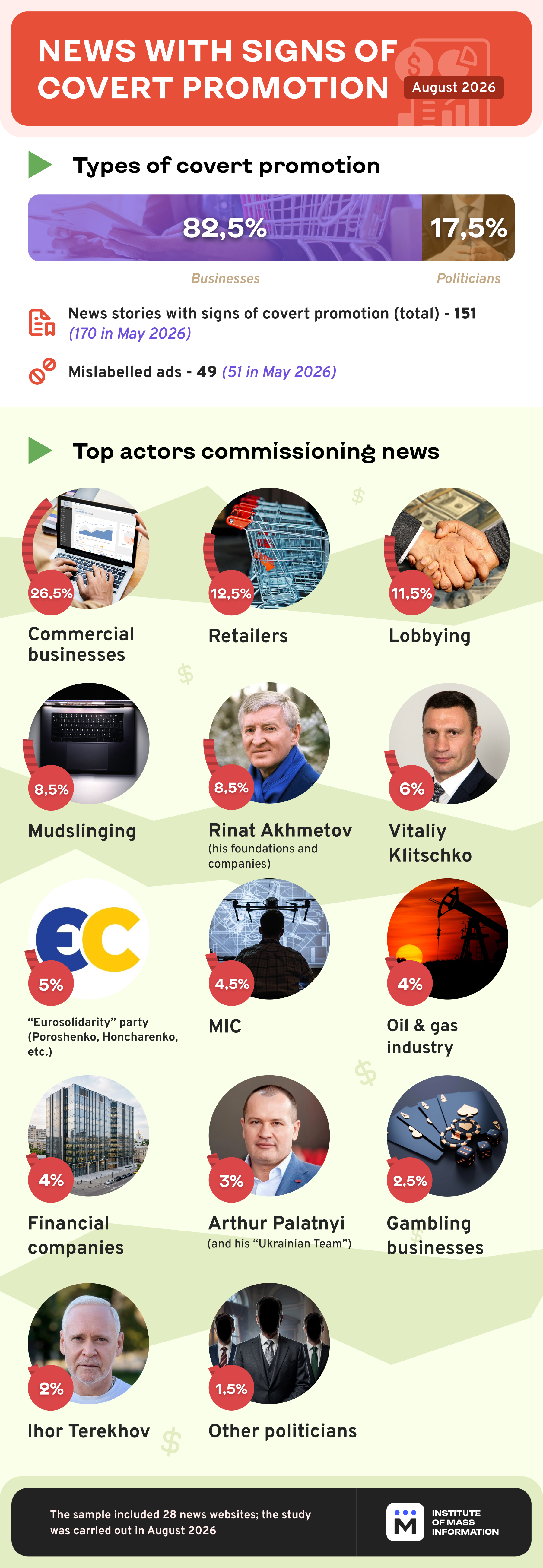
The changes in the ratio between commercial and political clients were slight. Businesses accounted for 82.5% of the identified news stories, while political clients accounted for 17.5%. Six months ago, these figures stood at 83.8% and 16.2% respectively. Commercial covert promotion continues to make up the bulk of the market, although the political share has somewhat expanded.
Mislabelled advertising
The number of mislabelled news stories barely changed: 49 compared with 51 in the first quarter of 2026. Yet, their share has grown due to the overall decline in the volume of commissioned material. This can be seen as a relative positive: improper labelling means the newsroom at least attempted to hint to the audience that a news piece has special status. Still, the audience has to decode that hint. It seems unlikely that most readers will scroll down to the website’s footer looking for a link explaining what these vague labels actually mean.
IMI regularly records a whole range of such labels: “Partnership”, “Special Project”, “Press Release”, NC, A (“Advertising”), Promoted, and “News from Companies”. For a Ukrainian audience, none of these amount to a direct, unambiguous indication that the news article is advertising. As a result, responsibility for recognising an ad as such is effectively shifted from the newsroom onto the reader.
The label “Charity” stands out in particular. It does nothing to explain that the article is an ad, and may even have the opposite effect, misleading the reader into thinking that the client is acting selflessly.
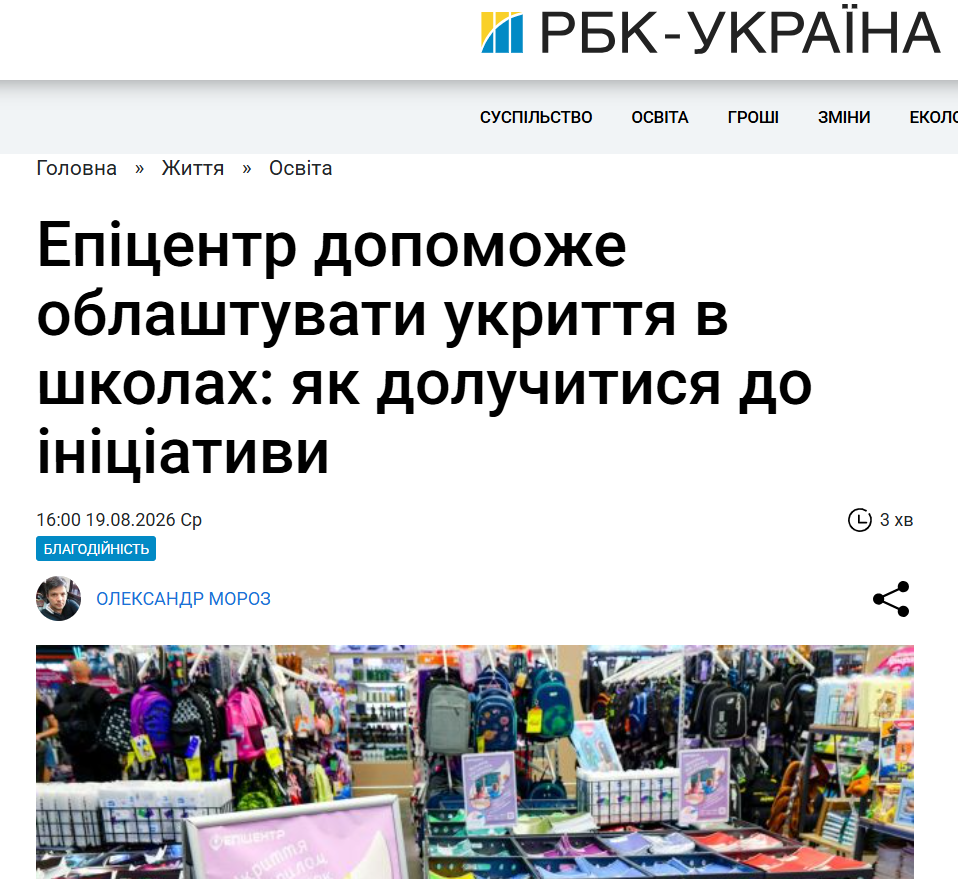
Screenshot from RBC Ukraine by IMI
As a result, the labelling itself adds a positive emotional charge to the publication and hinders the audience’s ability to consciously distinguish advertising from genuine journalistic material.
- Epicenter to help schools outfit bomb shelters: how to join the initiative (RBC Ukraine)
The monitoring found unambiguous, clear labelling of commercial posts in the news feed, in line with the law (i.e. using the words “advertising” or “posted as advertising”) on the websites Korrespondent.net and LIGA.net. Still, both websites also featured potentially commissioned material with no appropriate label.
The monitoring found no material bearing signs of covert promotion in the news feeds of Suspilne, Babel, Slovo i Dilo, Texty, Graty, Frontliner, Ukrainska Pravda, Hromadske, ZN.ua, or Ukrinform.
Mislabelled material was recorded on Hromadske Radio, Rubryka, Korrespondent.net, Novynarnia, Espreso, LB.ua, and NV.
The study found the largest amounts of content bearing signs of covert promotion on three websites: OBOZ.UA led with 46 news stories, followed by Telegraf with 22 and RBC Ukraine with 20.
The study also found material bearing signs of covert promotion on the websites LIGA.net, Focus, TSN, Gordon, Censor.NET, Channel 24, Interfax Ukraine, and UNIAN.
Overview of the top client categories
Commercial clients
Commercial clients accounted for 82.5% of the entire identified pool of potentially commissioned news stories. The share redistribution was most notable within this group: retailers and mudslinging gained a bigger presence while the shares of commercial-interest lobbying and of Rinat Akhmetov’s businesses and foundations shrank. The military-industrial complex and financial companies emerged as separate categories, having previously been lost within the “other commercial companies” list.
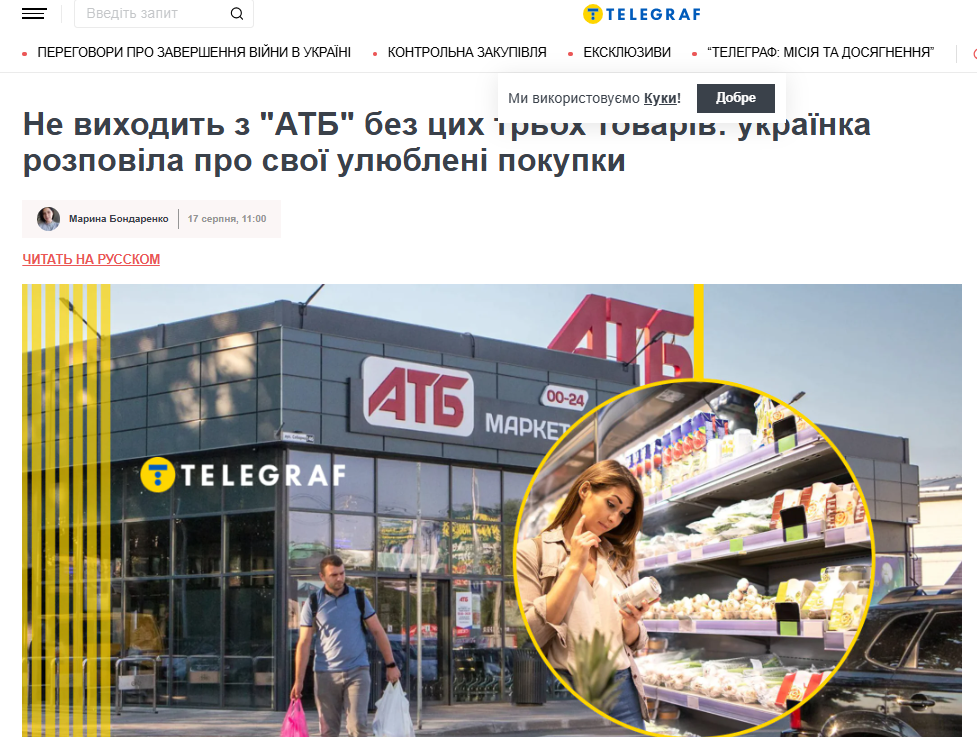
Screenshot from Telegraf by IMI
Retailers became the largest category, their share amounting to 12.5%, as opposed to 10.5% in the first quarter of 2026. So retail trade has continued to expand its presence among the returning clients commissioning covert advertising.
- Can’t leave ATB without these three groceries. Ukrainian woman talks about her favourite purchases (Telegraf)
Commercial interest lobbying ranked second with a 11.5% share. At the beginning of the year, this category accounted for 16% of potentially commissioned content, meaning its presence has shrunk considerably.
- Emissions trading should be a modernisation tool, not a financial burden for industry, says Tsyhanok (OBOZ.UA)
- Emissions trading should not become a new tax for industry, environmentalist says (RBC-Ukraine)
Mudslinging made the biggest leap among commercial clients, spiking to 8.5%. Its share was just 2.8% in the first quarter of 2026, meaning the figure has tripled over six months. This negative trend may be explained by the escalating political crisis in the country.
Material benefiting Rinat Akhmetov, his companies, and his foundations accounted for 8.5% of the pool as well. This category’s share had reached 11.6% in the first quarter of the year, so its presence in the covert promotion market has declined once again following an earlier rise.
- Rinat Akhmetov Foundation’s ‘Blogger Camp’ hosted a career guidance training for teenagers (Gordon)
The military-industrial complex emerged as a new systemic player, earning a 4.5% share. Previously, such clients used to be included in the “other commercial companies” category. Its share now warrants singling the military-industrial complex out as a separate group within the market.
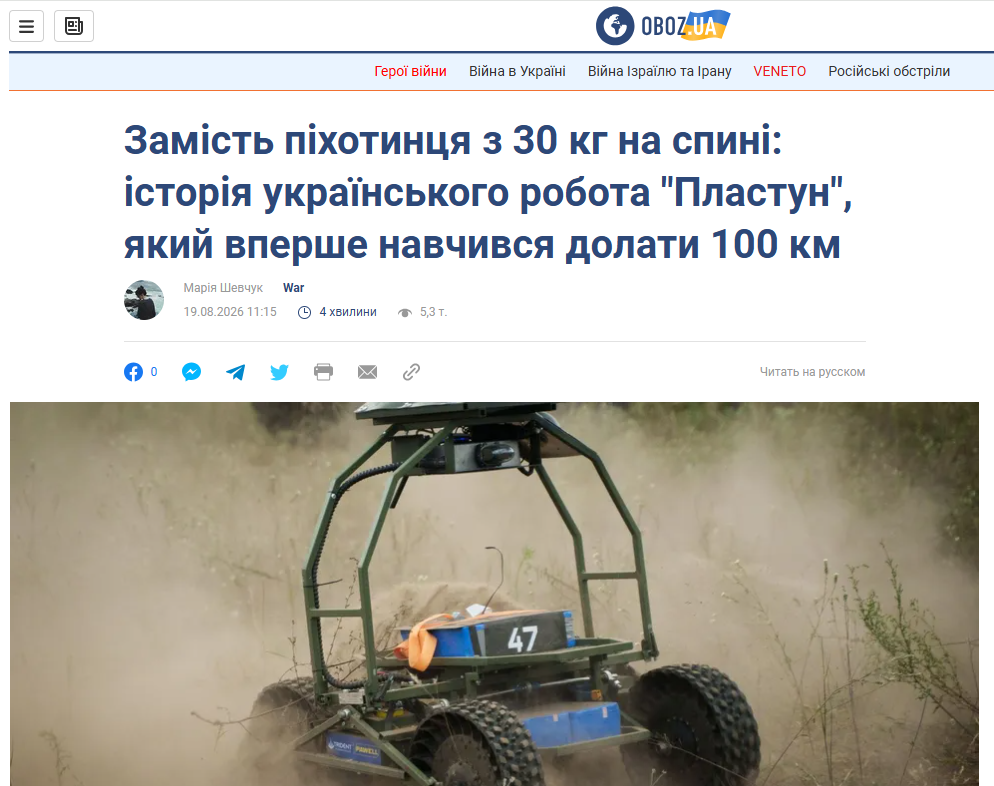
Screenshot from OBOZ by IMI
This may be evidence of the industry growing and expanding. Still, one would also expect to see growing social responsibility from such businesses, along with a more honest attitude towards the media and their audiences.
- Instead of an infantryman carrying 30 kg on his back: the story of Plastun, the Ukrainian robot who just learned to cover 100 km (OBOZ.UA)
The share of the oil & gas industry barely changed: 4% compared with 3.9% in the first quarter of 2026. Financial companies, previously included within the “other commercial companies” category, sat at the same level of 4%.
Another 2.5% went to the gambling business. Its share stood at 2.2% in the first quarter of the year, meaning this category’s presence has remained relatively stable.
“Other commercial companies” remains the largest category at 26.5%. Six months ago, it accounted for 33.2%. This category’s decline is partly linked to the redistribution of categories itself: the defence-industrial complex and financial institutions are now recorded separately.
Political clients
Covert political promotion accounted for 17.5% of the identified material bearing signs of paid publication. Its share has somewhat expanded compared with the first quarter of 2026, when the figure stood at 16.2%. Kyiv Mayor Vitaliy Klitschko remains at the top of this category, while Arthur Palatnyi’s “Ukrainian Team” and Kharkiv Mayor Ihor Terekhov showed a larger presence.
Material benefiting Vitaliy Klitschko accounted for 6% of all identified content bearing signs of covert promotion. His share stood at 6.6% in the first quarter of the year.
- Kyiv received minibuses for people with disabilities from German partners, says Klitschko (Channel 24)
The “European Solidarity” party, along with Petro Poroshenko, ranked second at 5%, as opposed to 4.4% at the beginning of 2026.
- “European Solidarity” proposes introducing a moratorium on business inspections and war-risk insurance (Interfax-Ukraine)
Another 3% of material benefitted “Ukrainian Team” and Arthur Palatnyi. They were included within the “other political clients” category in the first quarter of 2026; their presence has grown noticeably since.
- “Ukrainian Team” delivered another batch of FPV drones to the Liberty Battalion, says Arthur Palatnyi (UNIAN)
Kharkiv Mayor Ihor Terekhov accounted for 2%. He too was previously grouped among “other political clients”, but the volume of content benefiting him has grown over time.
- Demand for welfare: how Ukrainians’ post-war needs will affect Terekhovs prospects in elections (RBC Ukraine)
The remaining 1.5% was shared between “Servant of the People” MP Oleksandr Kachura and National Guard Brigadier General Andriy Biletskyi. Together, they made up the “other politicians” category.
Mudslinging and mislabelled political advertising
The monitoring recorded the largest spike in the mudslinging category. Its share has tripled, growing from 2.8% to 8.5%. This growth may be linked to the escalating political crisis in the country, which is driving up demand for discrediting one’s opponents.
IMI experts recorded 17 such news stories, ranging from attacks on NBU Governor Andriy Pyshnyi about his diploma and the story about a parking lot owned by a Recovery Agency official to smear campaigns targeting Ferrexpo/Zhevago, the Ukrainian Capital Bank, and ARMA.
This dynamic appears to be especially problematic given that media outlets barely ever label political advertising. Such material is essentially never labelled in a way that would meet legal requirements and allow the audience to understand that it was commissioned.
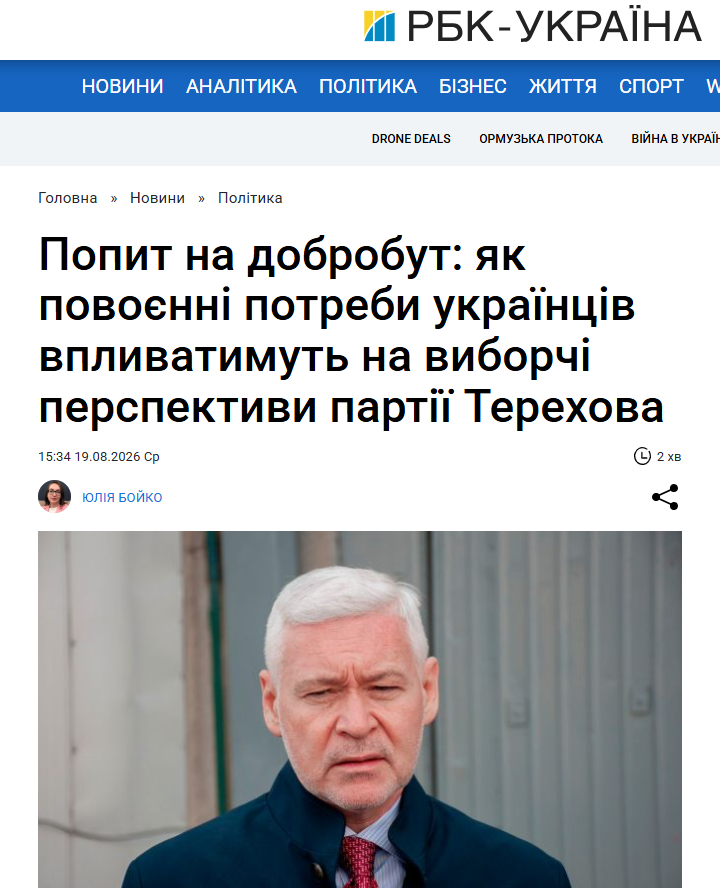
Screenshot from RBC Ukraine by IMI із сайту РБК-Україна
The drop in the overall volume of covert promotion over the summer does not mean the news feeds have become “cleaner”. The covert promotion market fluctuates, the distribution of clients within it keeps shifting, new systemic players keep emerging, but it continues its efforts to erode the media landscape.
IMI reminds readers that commissioned content can be used for various purposes: to promote one’s own goods or services (commercial promotion), to gain additional political dividends (political promotion), or to whitewash one’s reputation (image-building promotion). Such content shares a single goal: manipulating public opinion.
*The study was carried out by the Institute of Mass Information on 17, 18, and 19 August 2026 and covered 28 popular news websites: Babel, Hromadske, Suspilne, Rubryka, Slovo i Dilo, Graty, Texty, Frontliner, Hromadske Radio, Novynarnia, ZN.ua, Ukrainska Pravda, Espreso, Ukrinform, LIGA.net, NV, LB.ua, Censor.NET, Gordon, Interfax Ukraine, Korrespondent.net, RBC Ukraine, Focus, UNIAN, 24 Kanal, TSN, OBOZ.UA, and Telegraf. The sample included all news items published on these websites consecutively over the course the listed dates, and was screened for signs of commissioned material and for appropriate labelling.