

“A bird that lies,” “a crying duck,” “the ugliest shark in the world,” “the scariest spider” — Ukrainian media abound with phrases like these. Having analysed content posted by 10 Ukrainian national news websites, the Institute of Mass Information revealed that when it comes to animal-related news, the veneer of “science” often masks antropomorphisation and emotional clickbait.
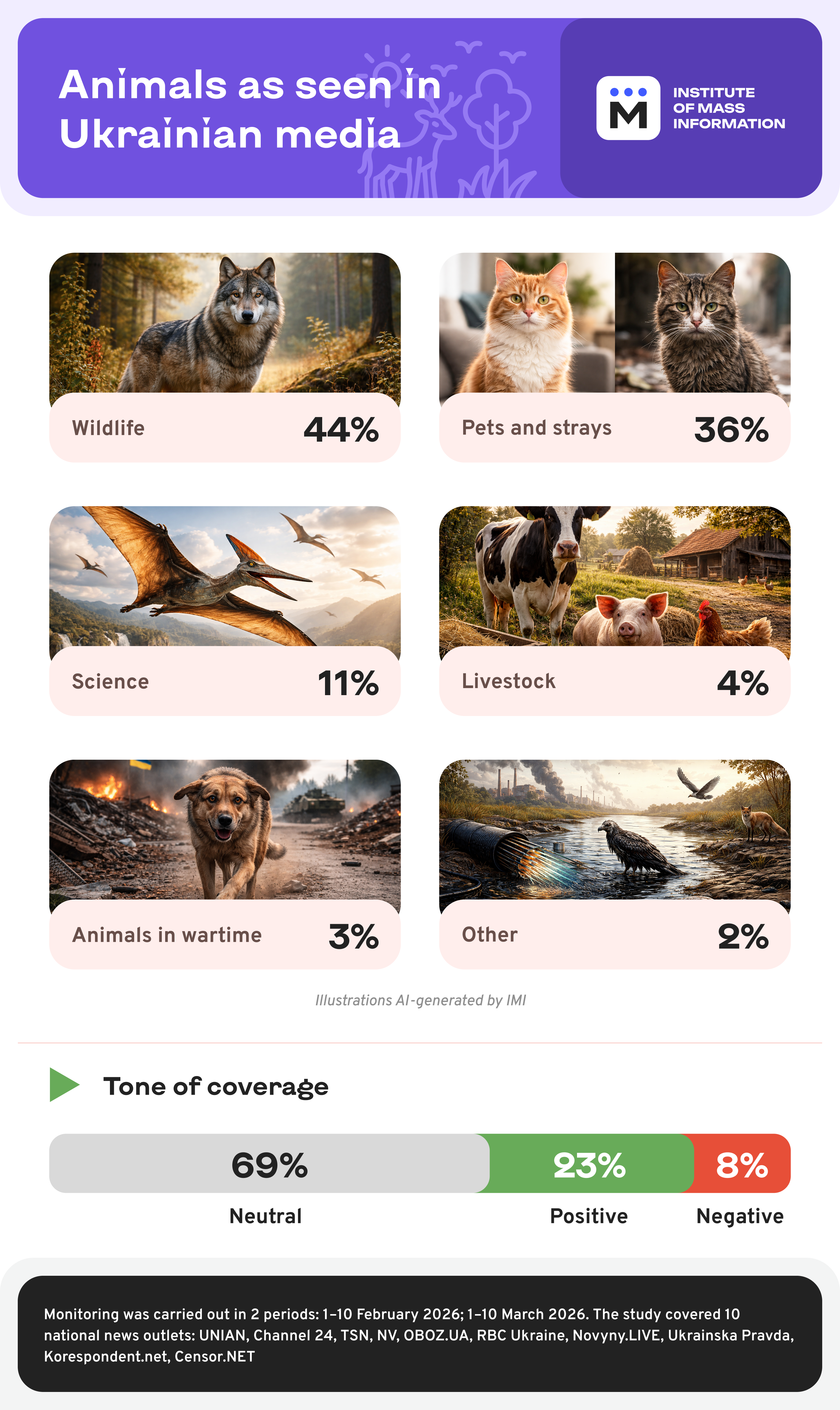
The study covered two periods: 1–10 February and 1–10 March 2026*. Wildlife was found to be the most popular topic, accounting for 44% of all news about animals. Meanwhile, as few as one-fifth of all animal-related news stories had real environmentalist messaging and social value. Most of these news were SEO content and “fun facts” such as why woodpeckers have no headaches, how loyal cockroaches are to their mates, or what the triceratops’s nose looked like.
“News outlets use triggering words or unexpected phrases that are almost never used in real life but grab your attention in a headline and prompt the reader to pause and check out the article. However, it’s important to not go overboard with this tactic. If you constantly use hyperbole to speak on serious topics, readers may start perceiving such news as exaggeration and over time lose trust in you,” comments IMI media analyst Yana Mashkova.
News stories where animals are described by real scientists (zoologists, ornithologists, environmentalists) are usually more reliable and get actively reposted by other media outlets, suggesting a demand for high-quality science content, the study showed.
According to IMI experts, news outlets still only partially meet this demand.
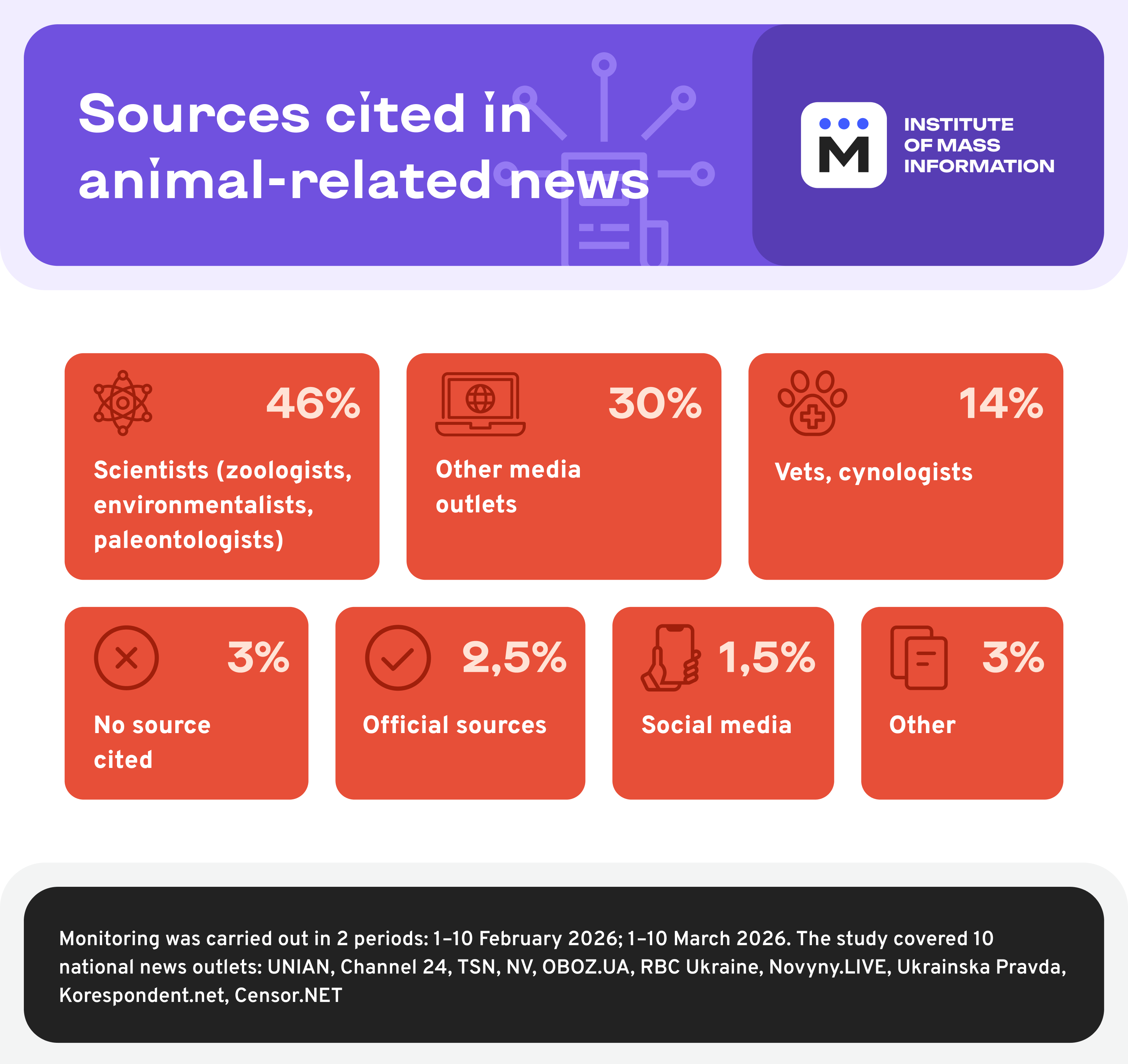
In terms of science-based news about animals, important newsmakers include Ukrainian academic institutions such as the Tuzly Lagoons National Nature Park or the Chornobyl Biosphere Reserve for Radiation and Ecology Studies, and Ukrainian polar explorers. News stories featuring experts like these help make science more poplular and raise awareness of biodiversity. During the monitoring period, such news stories were recorded on RBC Ukraine, UNIAN, NV, and UP. Life.
News about pets make up 36% of all animal-related content by Ukrainian news websites. Most of these are trivia or fun facts, pet care advice, downsides or popular superstitions.
Almost a third of the news explain animals’ behaviours, mostly those of cats: why cats “loaf”, why they stare at you at night, how they show respect, etc. News discussing real academic issues such as hormonal biomarkers for assessing the temperament of dogs or the causes of kidney failure in cats only amount to about 8% of such news. The rest is “evergreen” SEO content.
Another trend is to stigmatise certain breeds. For instance, three news outlets in the monitoring sample were found to post headlines such as “A dog expert reveals three worst-behaving dog breeds”. News like this usually rely on comments by anonymous or individual “trainers”, not supplementing them with research or analysis of the owner’s role in shaping the pet’s behavior. In some media outlets, such negative content went hand-in-hand with mystifying the animals (e.g. superstitions about black cats).
This contrasts sharply with the near complete absence of news discussing animals in the context of the war. Only 3% of all news about animals were related to the war. Despite the large-scale environmental impact of the hostilities, landmines, infrastructure destruction, displacement of people and animals, the media only address this issue sporadically. When the news outlets in the monitoring sample mentioned stray animals, it was nearly always in connection with air strikes.
“Animals as an indicator of the state of ecosystems, as subjects that are affected by the war en masse rather than occasionally – this angle remains peripheral in the Ukrainian media,” says media expert and author of the study Olena Holub.
*Monitoring was carried out in 2 periods: 1–10 February 2026; 1–10 March 2026. The study covered 10 national news outlets: UNIAN, Channel 24, TSN, NV, OBOZ.UA, RBC Ukraine, Novyny.LIVE, Ukrainska Pravda, Korespondent.net, Censor.NET