
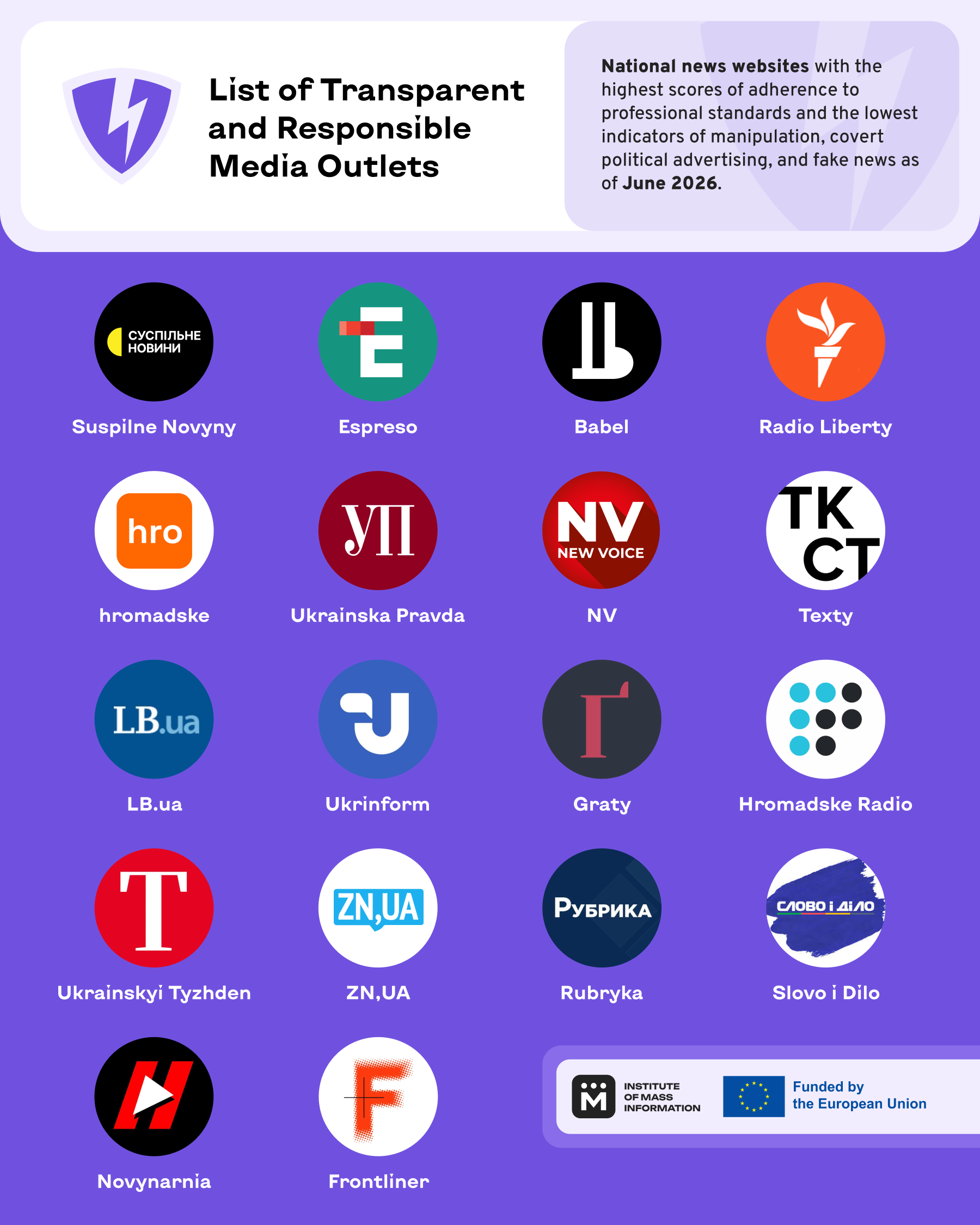
18 national news websites made it into the Institute of Mass Information’s List of Transparent and Responsible Media Outlets, also known as the High Quality List, in the first half of 2026. The list has expanded by one media oultet since the second half of 2025, being re-joined by NV, which demonstrated a stark improvement in its indicators.
The latest List includes the following news outlets:
- Suspilne Novyny
- Espreso
- Babel
- Radio Liberty
- hromadske
- Ukrainska Pravda
- NV
- Texty
- LB ua
- Ukrinform
- Graty
- Hromadske Radio
- Ukrainskyi Tyzhden
- ZN,UA
- Rubryka
- Slovo i Dilo
- Novynarnia
- Frontliner
These are the results of the two-stage in-depth monitoring of online media by the Institute of Mass Information (IMI). The assessment covers transparency, integrity, adherence to journalistic standards, and clear labeling of advertising.
The analysis showed the average level of adherence to professional standards by the news outlets included in the List to be around 96%. No covert political advertising, hate speech, sexism, or fake news were detected on these websites’ main news feeds (though there have been several inappropriately labelled news stories).
“The High Quality List is a reference point for the audience in an environment where telling high-quality reporting apart from manipulation is becoming increasingly difficult. The fact that 18 news outlets stayed above the 95% bar shows that quality journalism exists in Ukraine even four years into the full-scale war, despite the enormous challenges and exhaustion of Ukrainian newsrooms,” said IMI director Oksana Romaniuk.
What is IMI’s High Quality List?
The List of Transparent and Responsible Media Outlets, also known as the High Quality List, is a list of Ukraine’s highest quality national news websites which the Institute of Mass Information has maintained since 2019. The list includes news outlets that score the highest in IMI’s screening for adherence to professional standards of journalism. The List updates every six months.
How do media outlets get included in the List?
STEP ONE: FORMING THE SAMPLE
The top 50 national news websites, according to SimilarWeb and IMI’s previous monitoring studies, are selected for screening.
Media outlets that are not included in this sample have a separate mechanism: they need to apply for the Recommended Media Map (applications open publicly twice a year). If expert monitoring shows that a website’s level of adherence to professional standards is at least 95%, the media outlet is included in the next High Quality List monitoring.
STEP TWO: INTEGRITY CHECK
The selected media outlets are screened for harmful content, fake news, and mudslinging. This is the preliminary stage. Only the news websites that pass it make it to the next round.
STEP THREE: IN-DEPTH MONITORING
Media outlets that passed the preliminary stage are screened for the following criteria: standards of balance, reliability, distinction between facts and commentary; the presence of covert political promotion, sexism and hate speech, harmful content; as well as transparency, i.e. whether a website features a list of contacts and the editorial policy and whether the media outlet is transparent about their owners.
See the study methodology here.
INCLUSION IN THE LIST
Media outlets whose level of adherence to professional standards was at least 95% through all screening stages are included in the High Quality List.
The Institute of Mass Information (IMI) is a civil society organization specializing in the media, operating since 1996. IMI defends the rights of journalists, studies the media landscape and reports on media-related events, fights propaganda and disinformation, and provides media workers with safety equipment for trips to combat areas (since the start of the Russo–Ukrainian war in 2014).
IMI carries out the only monitoring study of freedom of speech in Ukraine, keeps a list of transparent and responsible online media outlets, and tracks Russia’s media crimes in the war on Ukraine. IMI has representatives in 20 oblasts of Ukraine and runs a network of Media Hubs that provide journalists with unfailing support. IMI’s partners include Reporters Without Borders (RSF); the organization is also a member of the International Freedom of Expression Exchange (IFEX).
This article was produced with financial support from the European Union. The Institute of Mass Information are solely responsible for its content; it does not necessarily reflect the views of the European Union.