

The General Jurisdiction Cassation Court No. 2 in Moscow (Russia) has dismissed a motion by Lutfiye Zudiyeva, a Crimea-based human rights activist and journalist with Graty, who challenged her inclusion in the Russian “foreign agents” register, Graty reports.
The hearing took place on 19 March, with Zudiyeva’s attorney precluded from attending. When the journalist’s representative arrived at the court at the appointed time, she found that the hearing had taken place earlier than planned and the decision had been “unchanged”. Lutfiye Zudiyeva and her lawyer were only able to review the decision the other day; the decision had not been shared with them before then.
The court also declined Zudiyeva’s motion to participate in the hearing via video call. The court claimed that she had not provided sufficient reasons for being unable to travel from occupied Crimea to the Russian capital, adding that the applicant’s presence at the hearing was not mandatory.
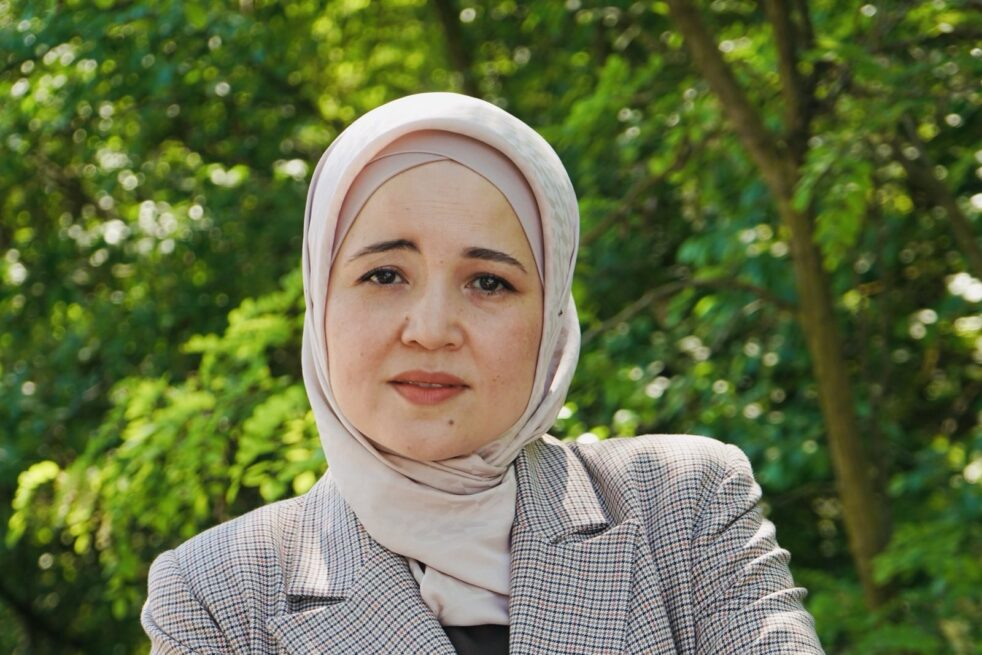
The Cassation Cassation upheld the appelate instance’s ruling, agreeing with all its arguments, namely that the Lutfiye Zudiyeva’s journalistic contributions to the independent Ukrainian publication Graty, comments to news outlets and international organisations, as well as her alleged membership in the Front Line Defenders Foundation, an international organisation assisting human rights advocates, was proof of her being under foreign influence.
Graty notes that the Front Line Defenders membership allegations are false: while the foundation has released statements recognising Zudiyeva’s activism and reporting in Crimea as peaceful and legitimate human rights work, she was never employed by the organisation.
The court also claimed that Zudiyeva had received funding from abroad, meaning the money that her husband had transferred to her from his account for household needs. He is an agricultural product supplier in Crimea, and the Russian FSB claims that he received money from three foreign citizens. Lutfiye Zudiyeva’s case mentions no other examples of “foreign funding”.
Earlier, at the appeal stage, Zudiyeva has said that the first-instance ruling had been based on false judgments (in particular, about her membership in Front Line Defenders) and misinterpretation of the facts, namely, viewing independent reporting and human rights activism as “political” and her husband selling goods to people with dual citizenship (which he could not even have known about, since he can not demand to see the buyer’s passport) as “receiving funds from foreign sources”. The court disregarded her arguments at the time and did not allow her to speak out at the latest hearing, either.
Lutfiye Zudiyeva plans to appeal the decision to the Supreme Court of Russia.
“By this point we have essentially gone through three court instances, and we are now preparing the last appeal in Russia: to the Supreme Court. The submission deadline is 19 June, that is, within six months from the appeal ruling. In our motion, we plan to point out the glaring procedural violations committed during the trial in the case, as well as the ruling itself being unfounded,” she said.
Persecution of journalist Lutfiye Zudiyeva
In May 2025, the Russian Ministry of Justice added Zudiyeva to the “foreign agents” register. In a comment to IMI, Zudiyeva said that the news had not been unexpected. She explained that when someone works to defend the people in Crimea, speaking out and writing about the searches, the arrests, the actions of the Russian law enforcers and special services that exceed their authority and reveal an alternative picture of everything that is happening in Crimea, which does not align with the picture painted by Russian propaganda, then being included in such a list of outlawed, undesirable people becomes a matter of time.
In August 2025, Lutfiye Zudiyeva received a notice from the Russian Ministry of Justice summoning her for drawing up an administrative protocol. Zudiyeva was charged with violating the law on “foreign agents” (Part 1, Article 19.34 of the Code of Administrative Offenses of the Russian Federation).
In September 2025, the Zamoskvoretsky District Court of Moscow upheld the decision by the Russian Ministry of Justice to declare Lutfiye Zudiyeva a “foreign agent.”
On 22 February 2024, officers of Russia’s Center for Combating Extremism searched Lutfiye Zudieva’s house. After the search, she was taken away to the counter-extremism center, but later released.
The police opened an administrative case against her on charges of abuse of freedom of mass information. The investigation was triggered by her Facebook post about the unlawful persecution of alleged Hizb ut-Tahrir members, as she did not mention that Hizb ut-Tahrir is considered a terrorist organization by Russia, and also cited a Radio Liberty article without noting that the media outlet is considered a “foreign agent” by Russian law.
In March 2024, the Russia-controlled Kyiv District Court in Simferopol fined Lutfiye Zudieva 2,500 rubles (UAH 1,000). Roman Filatov of the Russian Counter-Extremism Center (CEC) charged her with “abuse of freedom of mass information.”
In April 2024, a Russian court in Crimea fined Lutfiye Zudieva again, finding her guilty of “abusing the freedom of mass information.”
On 7 May 2024, Lutfiye Zudieva was handed a warning from the Russian Center for Combating Extremism.
In June 2024, he Russia-controlled Kyiv District Court of Simferopol tried Zudiyeva’s appeal and upheld the ruling to impose an administrative penalty on her.