
Russia has targeted Ukrainian media offices in air strikes at least 87 times since the beginning of the full-scale invasion, resulting in damage or complete destruction.
According to the Institute of Mass Information, some news outlets have been attacked repeatedly. The geography of these strikes covers 13 regions, suggesting that the pressure on Ukraine’s media infrastructure is a systematic effort. This data was collected by IMI’s network of regional representatives.
Kyiv city and oblast suffered the most (19 cases). At the same time, it is worth noting that a significant share of the attacks occurred in 2025–2026, when the Russian forces intensified missile and drone strikes on the capital and the oblast. Kyiv is followed by regions adjacent to the front line and those in the South: Zaporizhzhia (11 cases), Sumy and Dnipropetrovsk oblasts (10 cases each).
In Kherson and Luhansk oblasts, most media offices have been destroyed completely, which is explainable by the prolonged hostilities and Russian occupation of these territories. In Kharkiv, Sumy, and Chernihiv oblasts, the media offices affected by Russian shelling were mostly damaged.
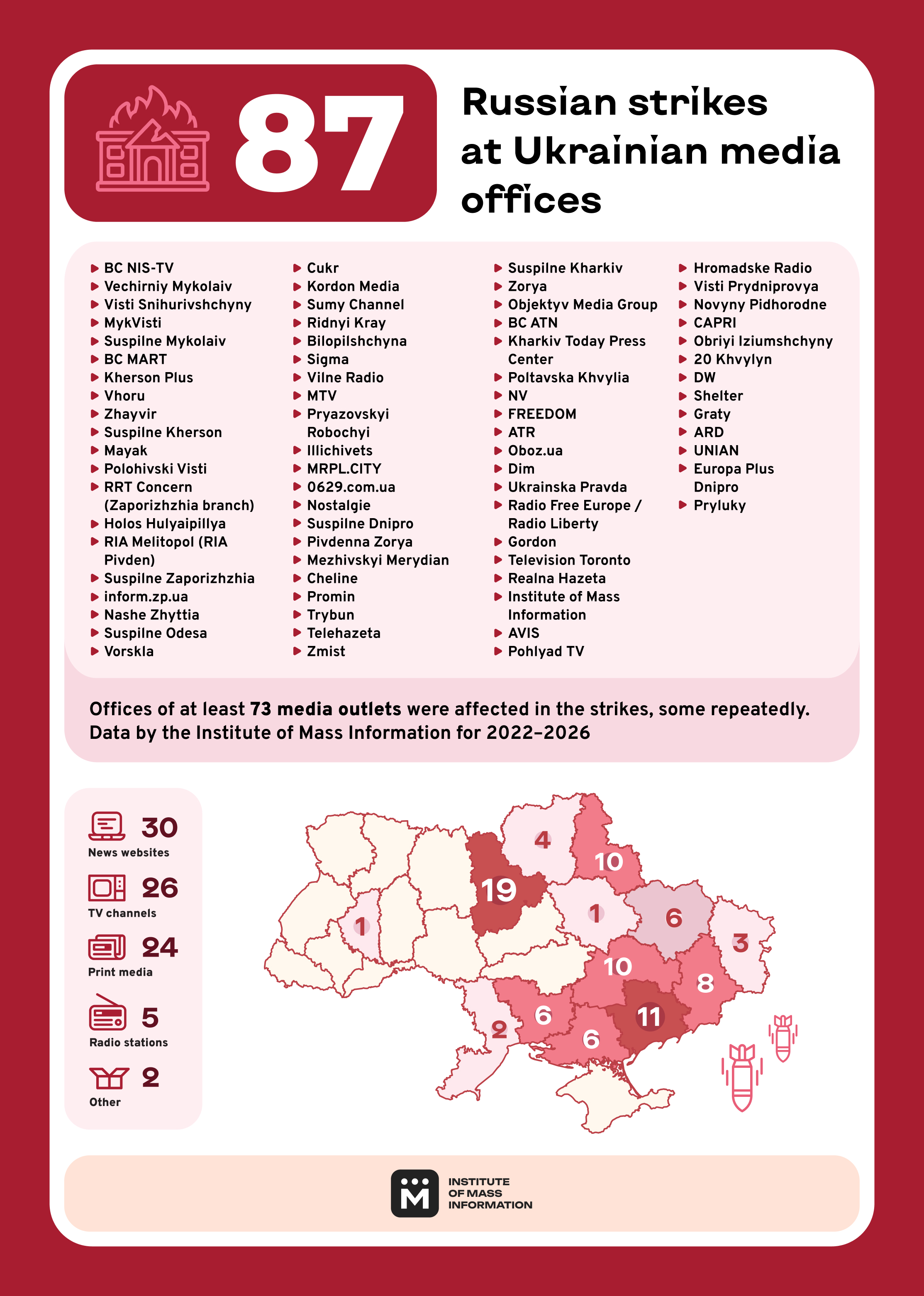
In terms of types of news outlets affected, most attacks were targeting news websites (30 cases), followed by TV channels (26 cases) and print media (24 cases). Radio stations (5) and other formats (2) were the least affected.
Overall, the data points to a deliberate strategy by Russia to undermine Ukraine’s media field indiscriminately in terms of media formats or regions. The destruction of media offices not only complicates the work of journalists, but also limits citizens’ access to verified information, especially in areas close to the frontline and the temporarily occupied regions.
Additionally, IMI recorded at least 24 reported Russian strikes on Ukrainian television towers and other TV infrastructure in 12 oblasts across Ukraine. Most such cases were recorded in Kharkiv, Sumy, and Kherson oblasts. Attacks on civilian TV infrastructure were also recorded in Dnipropetrovsk, Zaporizhzhia, Kyiv, Chernihiv, Donetsk, Luhansk, Vinnytsia, Zhytomyr, and Rivne oblasts.
The Institute of Mass Information (IMI) is a civil society organization specializing in the media, operating since 1996. IMI defends the rights of journalists, studies the media landscape and reports on media-related events, fights propaganda and disinformation, and provides media workers with safety equipment for trips to combat areas (since the start of the Russo–Ukrainian war in 2014).
IMI carries out the only monitoring study of freedom of speech in Ukraine, keeps a list of transparent and responsible online media outlets, and tracks Russia’s media crimes in the war on Ukraine. IMI has representatives in 20 oblasts of Ukraine and runs a network of Media Hubs that provide journalists with unfailing support. IMI’s partners include Reporters Without Borders (RSF); the organization is also a member of the International Freedom of Expression Exchange (IFEX).