
Updated on 12 September to include the case of obstruction faced by Ukrinform journalists while trying to film the aftermath of a Russian strike at an outdoors centre in Kanivske village, Zaporizhzhia oblast.
The Institute of Mass Information experts recorded 6 freedom of speech violations in Ukraine in August 2025, according to the IMI’s monthly monitoring study Freedom of Speech Barometer.
IMI recorded four crimes against media and journalists committed by Russia in August. These included damage to media offices and cyber crimes.
Russia’s overnight combined arms strike on Kyiv on 28 August damaged the offices of Ukrainska Pravda and Radio Free Europe / Radio Liberty, and a Russian drone strike on Dnipropetrovsk oblast affected the office of Mezhyvskyi Merydian. No casualties were reported in either case.
Detector Media sustained one of the most intense DDoS attacks in their experience, which resulted in their website running with glitches. Detector Media chief editor Hala Sklyarevska believes they were being targeted by Russian actors due to the media outlet’s work debunking Russian propaganda.
IMI recorded two freedom of speech violations unrelated to Russia’s war on Ukraine. One was a case of political pressure on blogger Olena Mandziuk by MP Oleksiy Honcharenko. The official de-facto used the state enforcement system to influence a person with opposing views by initiating a police proceedings over the blogger’s social media post.
Another one was a case of obstruction faced by Ukrinform journalists in Zaporizhzhia: photojournalist Dmytro Smolyenko and reporter Olha Zvonaryova, who were threatened by the Zaporizhzhia Forestry Department chief Hryhoriy Cherneta and barred from filming the aftermath of the Russian strike on an outdoors centre in Kanivske village, Zaporizhzhia oblast. Following the incident, the police opened a case under Part 1 of Article 171 of the Criminal Code of Ukraine (“Obstruction of legal reporting”).
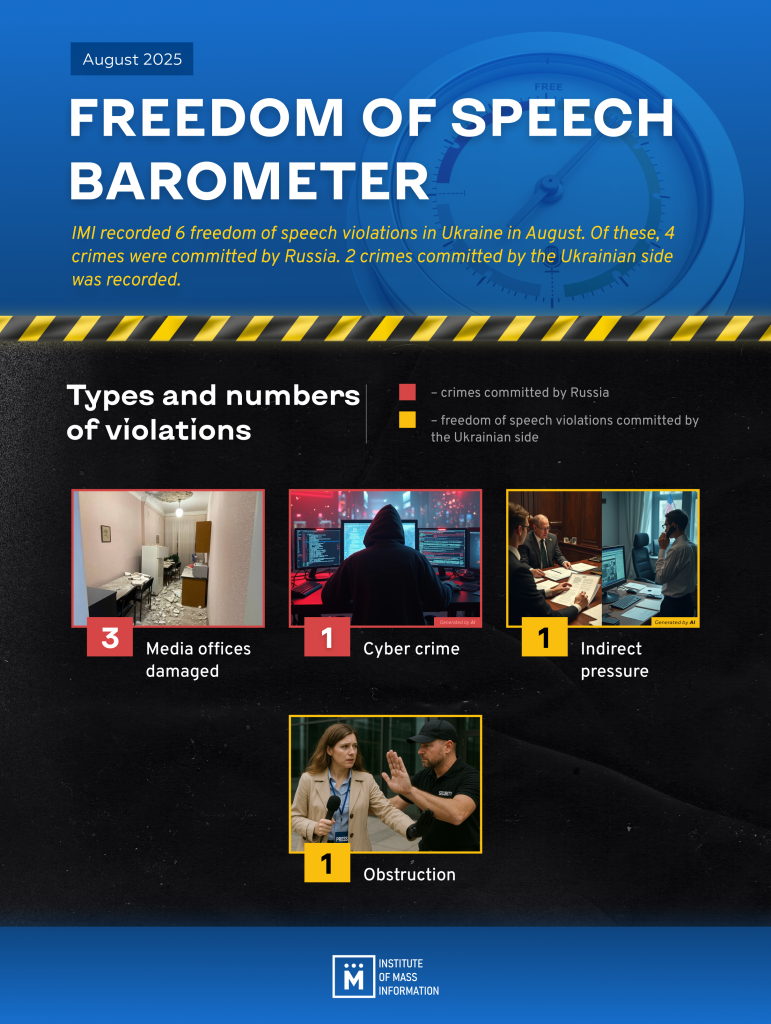
Freedom of Speech Barometer for August 2025
IMI also recorded persecution of Krym.Realii journalist Oleksina Dorohan by Russia. A Russian-controlled court in Simferopol arrested her for two months in absentia on 23 June 2025; in August, she was added to the “List of Terrorists and Extremists”. The case was filed under Article 208 of the Russian Criminal Code: “Involvement in an illegal armed group,” which may incur a penalty of up to 20 years in prison. However, the real reason was her reporting, such as her investigations into the Crimeans who fought in Ukraine as part of the Russian army and were killed in action and her work on the database GRUZ 200.
This case is another instance of Russia’s systemic pressure on independent Ukrainian journalists exposing the truth about the war and occupation.
Read the full monitoring report here.
The Institute of Mass Information (IMI) is a civil society organization specializing in the media, operating since 1996. IMI defends the rights of journalists, studies the media landscape and reports on media-related events, fights propaganda and disinformation, and provides media workers with safety equipment for trips to combat areas (since the start of the Russo–Ukrainian war in 2014).
IMI carries out the only monitoring study of freedom of speech in Ukraine, keeps a list of transparent and responsible online media outlets, and tracks Russia’s media crimes in the war on Ukraine. IMI has representatives in 20 oblasts of Ukraine and runs a network of Media Hubs that provide journalists with unfailing support. IMI’s partners include Reporters Without Borders (RSF); the organization is also a member of the International Freedom of Expression Exchange (IFEX).