

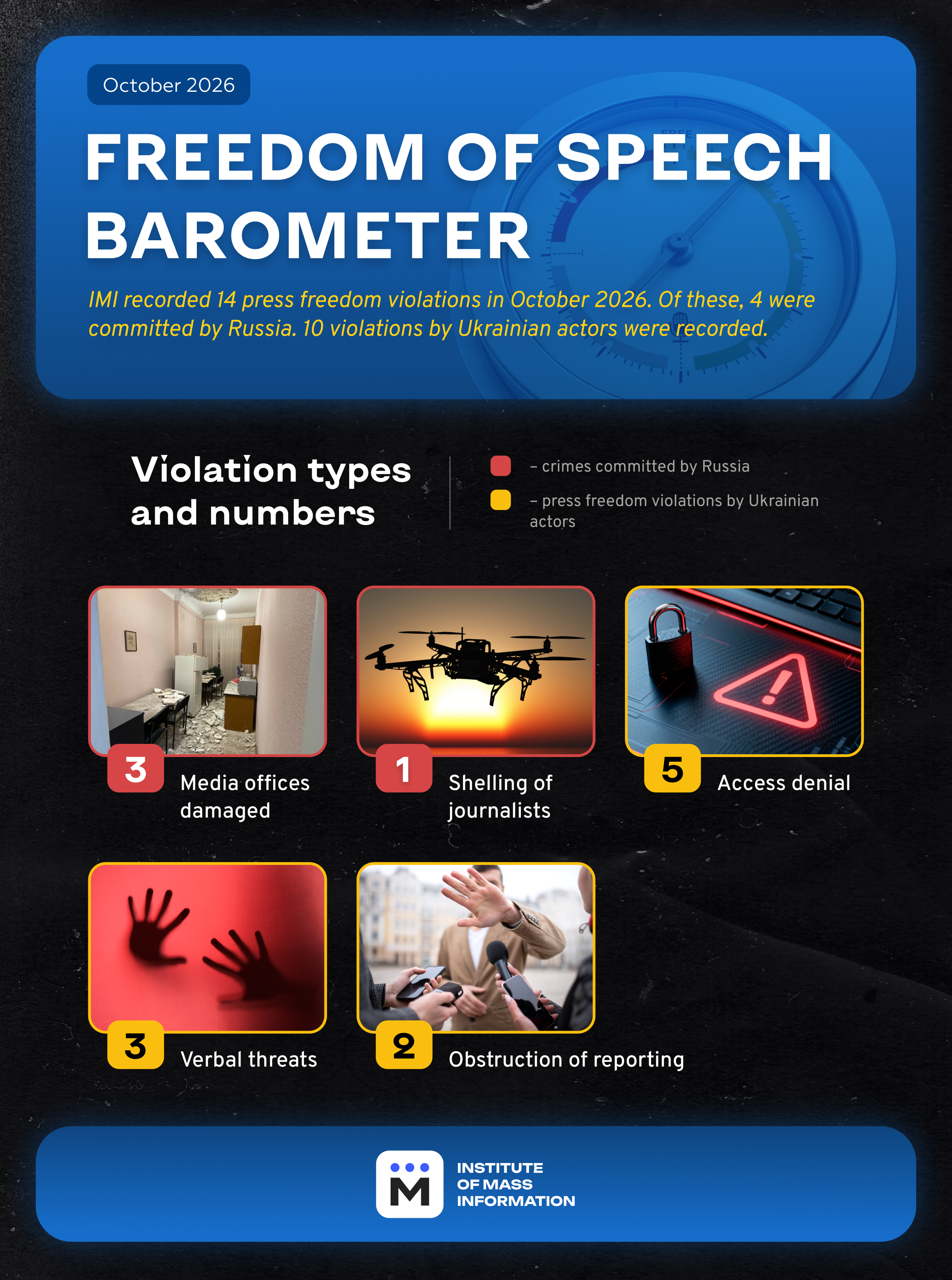
Experts at the Institute of Mass Information recorded 14 press freedom violations in Ukraine in October 2026. Four of these were related to Russia’s aggression while 10 were committed by Ukrainian nationals and institutions, as evidenced by IMI’s monthly monitoring study, the Freedom of Speech Barometer.
RUSSIA’S CRIMES
Media professionals killed
Five media professionals turned UAF servicemembers were reported dead in October. Two of them had long been considered missing in action. One is Samuil Proskuriakov, who contributed to UNN, Zaborona, Hromadske, and Babel, went missing in 2022; the second is Dmytro Khyzhniak, host at Hit FM and TV-5, had been considered missing since 2024. They were only officially declared dead in 2026.
UAF serviceman and YouTube blogger Kyrylo Soloshenko was killed in action on 15 October 2026. He rose to popularity on YouTube in 2014–2016, producing his own videos and collaborating with other bloggers who were popular at the time. Vasyl Velychko, a cameraman with the Poltava-based TV channels IRT Poltava and Misto Plus turned UAF servicemember, was killed on 16 October.
Serviceman, photographer, and cameraman Volodymyr Obertas was killed in Kherson on 27 October while accompanying a group of war correspondents and filming city streets. He died in an explosion caused by a landmine likely planted in central Kherson by Russian troops on the first day of the ceasefire. Obertas had filmed the drone video that first showed the world the scale of humanitarian disaster in occupied Oleshky.
144 media professionals have been killed by Russian forces since the start of Russia’s full-scale invasion of Ukraine, with 15 dying while reporting.
READ MORE
- More press freedom violations recorded in Ukraine in 8 months of 2026 than in entire 2025
- Obstruction of reporting spikes in Ukraine as cases rarely reach court
Air strikes on journalists
- A Suspilne Zaporizhzhia filming crew came under attack by Russian FPV drones in Kushuhum village (seven kilometres south of Zaporizhzhia city) while documenting the aftermath of earlier strikes. The journalists were unable to leave the village for over three hours, and a drone hit next to their car.
Damage to media offices
- The Suspilne Zaporizhzhia office was damaged in a Russian ballistic missile strike in Zaporizhzhia city: the shock wave blasted out windows and doors in the building. The team were unharmed, as there was no one inside at the time of the attack.
- A Russian strike on Kyiv overnight on 19 October inflicted significant damage on the office of the newspaper Zakon i Biznes. The shock wave blasted out all the windows, destroyed the interior walls, and damaged the equipment and furniture in the office. None of the newsroom’s staff were in the office at the time.
- A Russian drone targeted the office of the private broadcaster Vizyt TV in Kremenchuk, Poltava oblast, causing significant damage to the building and starting a fire. The damage to equipment and infrastructure forced the channel to temporarily stop producing news, though they remained on air. The seven employees were in shelter during the attack. No one was injured.
See the full list of Russia’s crimes against the Ukrainian media and journalists here.
Violations unrelated to Russia’s war against Ukraine
IMI recorded 10 press freedom violations committed by Ukrainian nationals and institutions and unrelated to Russo–Ukrainian war in September. Half of these cases concerned denial of access to public information, making it the largest infringement category of the month. Most violations took the form of selective accreditation, denial of admission to public events, and refusals to share documents.
Three instances of violent threats and two cases of obstruction using physical force or restriction of reporters’ movement were recorded.
The infringements were recorded in eight regions across Ukraine: Rivne, Volyn, Kyiv, Kharkiv, Sumy, Khmelnytskyi, Ternopil, and Kirovohrad oblasts, with Khmelnytskyi oblast leading in terms of the number of violations committed (two instances of denial of access to information). The violations were committed by private individuals, officials, law enforcers, and state bodies, namely oblast military administrations, the SBI, police, a state agency, and a state university.
Death threats, intimidation
- The Rivne-based outlet Chetverta Vlada reported that their chief editor Volodymyr Torbich had received death threats over his reporting from a local official’s ex-husband, who demanded Torbich not mention his children in his investigations.
- Yuriy Rychuk, owner of the media group Vechirniy Lutsk, received a text message containing death threats to him and his family over his “paid-for scribbles.”
- A woman attacked an Espreso TV film crew near Darnytsia metro station in Kyiv city, verbally threatening them and grabbing at their hands and camera. The journalists had to call the police to put an end to the conflict.
Obstruction of legal reporting
- Kharkiv police and a man claiming to be a security guard from a nearby factory forcibly dragged three photojournalists out of the grounds of a polyclinic that had been affected in a Russian air strike earlier. The security guard tried to take away their camera and the journalists were accused of helping Russian troops.
- Vladyslava Kritska, a journalist with the local online outlet Cukr, was detained for about 20 minutes by the staff of a Sumy shopping mall, where she had come to film the aftermath of a Russian strike. The staff threatened to take away her phone and blocked the exit. The journalist was only able to leave the building with the help of a police officer.
Access to information for journalists
- The Khmelnytskyi Oblast Military Administration (OMA) was selective in inviting reporters to a meeting with Verkhovna Rada Chair Ruslan Stefanchuk, which four local TV channels got to attend but no news websites did.
- Iryna Beliakova, a reporter with 20 Khvylyn, was denied accreditation to cover the meeting with Verkhovna Rada Chairman Ruslan Stefanchuk, allegedly due to missing the application deadline.
- The State Bureau of Investigation (SBI) refused to report whether persons involved in arranging, commissioning, or carrying out the stalking of Bihus.Info journalists in 2024 had been identified or when the case files would be sent to court.
- Staff of Volodymyr Vynnychenko State University of Central Ukraine (Kropyvnytskyi) barred journalists with local news outlets to cover the university’s rector election.
- A Khmelnytskyi oblast state agency declined to share documents concerning a tender consultant involved in procurement for a bomb shelter construction project with ZHAR.INFO journalist Maria Turchyna a second time after a letter by the Verkhovna Rada Commissioner for Human Rights asking them to review the journalist’s query.
See the full monitoring study here.
The Institute of Mass Information (IMI) is a Ukrainian civil society organization specializing in the media, operating since 1996. IMI defends the rights of journalists, studies the media landscape and reports on media-related events, fights propaganda and disinformation, and provides media workers with safety equipment for trips to combat areas (since the start of the Russo–Ukrainian war in 2014).
IMI carries out the only monitoring study of freedom of speech in Ukraine, keeps a list of transparent and responsible online media outlets, and tracks Russia’s media crimes in the war on Ukraine. IMI has representatives in 20 oblasts of Ukraine and runs a network of Media Hubs that provide journalists with unfailing support. IMI’s partners include Reporters Without Borders (RSF); the organization is also a member of the International Freedom of Expression Exchange (IFEX).