
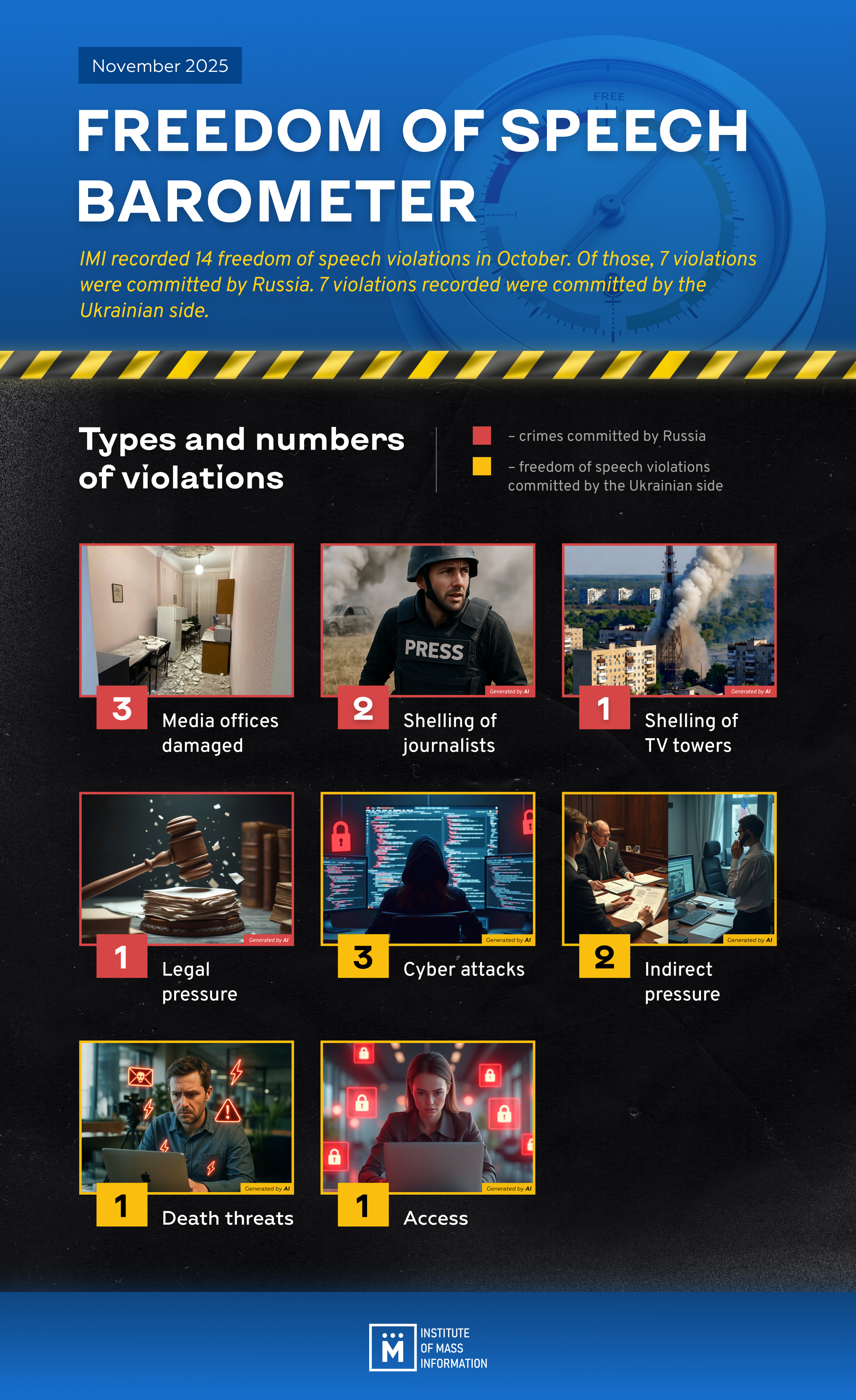
The Institute of Mass Information experts recorded 14 freedom of speech violations in Ukraine in November 2025, with 7 committed by Russia, according to the IMI’s monthly monitoring study Freedom of Speech Barometer.
Russia’s crimes against media and journalists included armed strikes at journalists, media offices, and TV towers, as well as legal pressure.
The death of two media workers turned UAF servicemen was reported in November:
- Kostyantyn Huzenko, photographer, media producer, Ukraïner team member, liaison officer at the Rear Admiral Mykhailo Ostrohradskyi Marine Brigade No. 35. Killed on 2 November 2025.
- Anton Bondarenko, UAF serviceman, Ukrainian fixer for the French TV channels TF1 and LCI. Went missing in action in Kharkiv oblast on 15 September 2025. His death was confirmed by a DNA test.
Armed strikes at journalists
- Russian troops deployed a drone to hit a Proliska Humanitarian Mission car as it was approaching Kostyantynivka (Donetsk oblast) on 8 November. There were four people in the car: two volunteers and two journalists from Spain and Austria. All four survived.
- A Russian FPV drone struck at an evacuation vehicle carrying volunteers and Radio Liberty correspondent Serhiy Horbatenko near Lyman (Donetsk oblast) on 20 November.
Damage to media offices
- The Russian drone strike in Dnipro overnight on 15 November damaged the building where the offices of the newspaper Visti Prydniprovya and the news website Novyny Pidhorodne (founded by Visti Prydniprovya) are located. The blast wave broke the windows, damaged the frames, furniture, and some office equipment.
- The Russian mass drone strike on Dnipro city late on 17 November damaged the building where the office of the regional Suspilne branch was located.
- The Zaporizhzhia office of Ukraine’s public broadcaster Suspilne was damaged in the Russian shelling strike late on 26 November. The team was unharmed: there was no one in the office at the time of the strike. The company reported damage to a part of the building’s wall and broken windows. The team is assessing the damage inflicted by the strike.
Strikes at TV towers
- A TV tower in Dnipro city was damaged in a Russian strike. Local TV channels and radio were off air.
Ukrainian media workers sentenced by Russian courts:
- Vilen Temeryanov, citizen journalist from Russian-occupied Crimea, has been sentenced to 14 years in prison. Temeryanov was detained in his home in Crimea’s Çanköy district in 2022 on false charges of terrorism.
IMI also recorded seven freedom of speech violations unrelated to Russia’s war on Ukraine. These included cyber attacks, indirect pressure, death threats, and denial of access to information.
Death threats
- Kramatorskyi Rayon journalist Andriy Hryn received violent threats from a man featured in his reporting. The police did not enter the data into the URPI at first, so the journalist sued and the court ordered the police to open an investigation. The case was opened under the death threats article.
Access
- The Komyshuvakha Town Council declined 21 information queries by SODA journalist Veronika Khorolska, sending her a non-response without the requested data. IMI’s lawyers confirmed that such a response violates the laws on access to public information.
Indirect pressure
- The suspects in the Midas corruption case were gathering intelligence on journalists, politicians, officials, and NABU detectives. The list included 10 journalists investigating corruption, such as Yuriy Nikolov and Oleksa Shalayskyi
- Slidstvo.Info received a crisis management action plan by the Ruslan Shostak Foundation, intended to neutralise the backlash expected to follow the release of the investigation into the Foundation’s efforts to evacuate children to Türkiye. The plan involved bot farms, controlled influencers, and meetings with news outlet editors. The Slidstvo.Info team expressed concerns for their sources’ safety.
Cyber attacks
- The website of the Kharkiv-based news outlet Nakypilo was targeted by hackers who attempted to crack account passwords on 14 November. The attackers operated from multiple IP addresses located mostly in Kyiv and Odesa. The website’s security system thwarted the attack.
- Unknown individuals tried to access the corporate accounts of journalists with Poltavska Khvylia and Sil Media at the same time. The mass attack resulted in Meta suspending the profile of the media outlets’ founder, which impacted the work of the pages.
- Cherkasy-based news outlet 18000 received several phishing emails mimicking Meta notifications with an offer to receive a “blue check mark” on Facebook. The emails contained a link to a suspicious Google form intended to steal data. The team recodnised it as a scam and did not interact with the suspect links.
See the full list of freedom of speech violations here.
The Institute of Mass Information (IMI) is a civil society organization specializing in the media, operating since 1996. IMI defends the rights of journalists, studies the media landscape and reports on media-related events, fights propaganda and disinformation, and provides media workers with safety equipment for trips to combat areas (since the start of the Russo–Ukrainian war in 2014).
IMI carries out the only monitoring study of freedom of speech in Ukraine, keeps a list of transparent and responsible online media outlets, and tracks Russia’s media crimes in the war on Ukraine. IMI has representatives in 20 oblasts of Ukraine and runs a network of Media Hubs that provide journalists with unfailing support. IMI’s partners include Reporters Without Borders (RSF); the organization is also a member of the International Freedom of Expression Exchange (IFEX).