

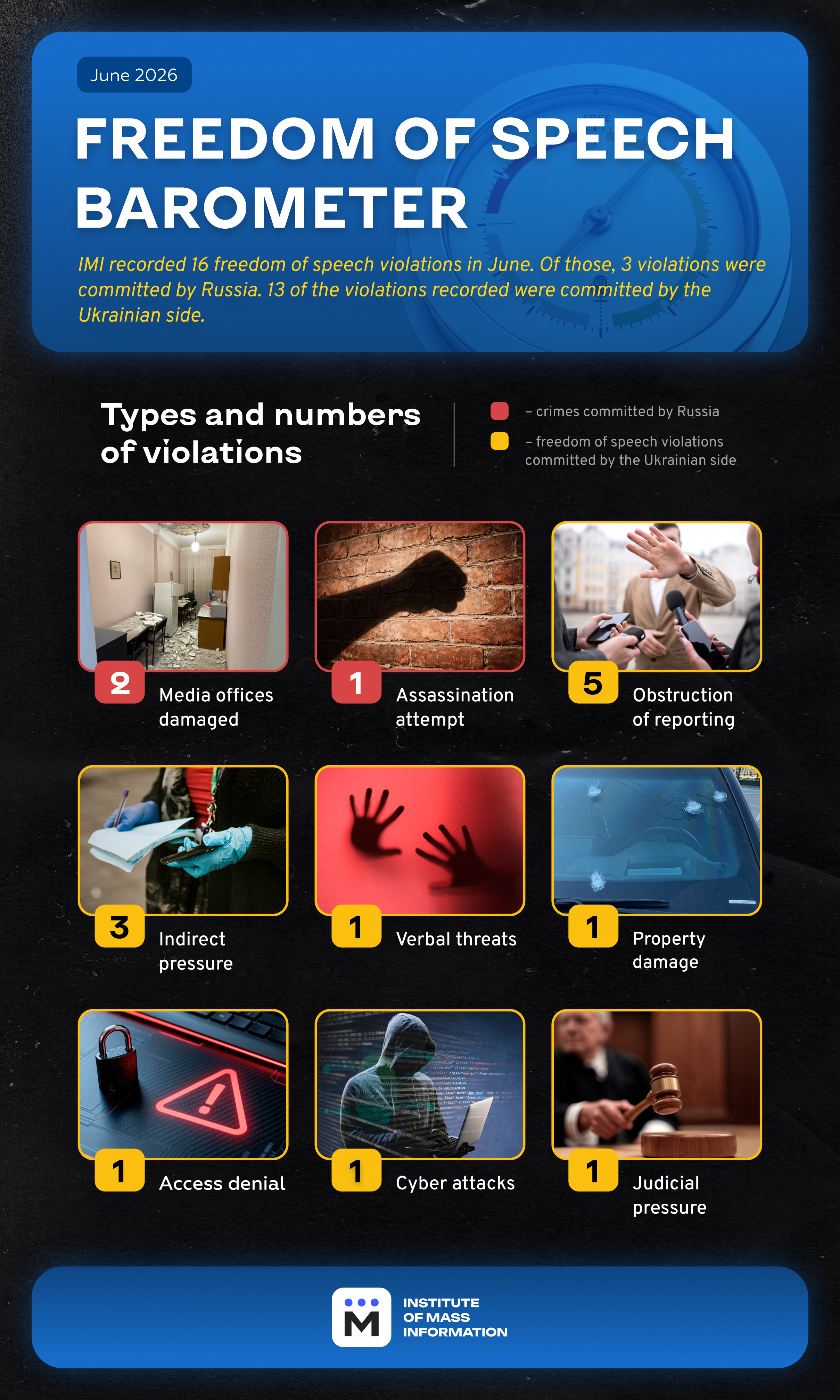
The Institute of Mass Information experts recorded 16 press freedom violations in Ukraine in June 2026. 3 were committed by Russia, as evidenced by IMI’s monthly monitoring study, the Freedom of Speech Barometer.
Russia’s crimes against the media and journalists included an assassination attempt, destruction of and damage to media offices.
The death of one media worker turned UAF servicemember was reported in June:
- Maksym Oseredchuk, former producer for the US TV channel ABC News, servicemember. Died in a Russian drone strike on 24 June 2026.
Assassination attempts
- A Russian FPV drone tried to attack a Suspilne Dnipro filming crew twice as they were interviewing a servicemember in Zaporizhzhia oblast on 23 June. No one was injured in the incident. As soon as the second drone left, the journalists got to their car and left the dangerous area.
Destruction of and damage to media outlets’ property
- The Promin office in Snovsk (Chernihiv oblast) was damaged again during a Russian strike on 3 June. The blast damaged the windows and shattered the glass in the building. No one was injured.
- A Russian drone hit the courtyard of the Suspilne Zaporizhzhia branch on 26 June. The staff were in a bomb shelter at the moment of the strike and were unharmed, though their cars were damaged. A journalist whose crew was away working on the ground was stunned by the blast wave.
IMI also recorded 13 press freedom violations unrelated to Russia’s war on Ukraine. These included violent threats, damage to journalists’ property, obstruction of reporting, denial of access to information, cyber attacks, judicial pressure, and indirect pressure.
Violations were recorded in Kyiv, Kharkiv, Rivne, and Sumy, as well as Donetsk, Mykolaiv, and Poltava oblasts. The perpetrators were officials of various ranks, servicemembers, and private individuals.
Violent threats
- On 26 June Babel reported violent threats by Mykola Kharkhan, a serviceman in the “Skelia” Assault Regiment No. 425, after the release of their news story about a series of non-combat deaths in the regiment. Kharkhan posted a video address insulting the journalists, accusing the news outlet of working “for Russian money” and saying that “everyone involved will have to puke the money up later”.
Damage to journalists’ property
- On 25 June Azad Safarov, producer with the UK TV channel Sky News, said that their crew’s armoured car had been targeted at close range by an unknown shooter as they were filming a news story about the “Skelia” Assault Regiment No. 425 in March 2025. The driver who was in the car at the moment of the attack was unharmed, but the journalists counted 12 bullet holes in the car.
Obstruction of legal reporting
- Chetverta Vlada journalist Anastasia Savliuk faced obstruction by employees of the Rivne housing and maintenance department, who took away her phone, tried to forcibly detain her in the building, and threatened her with police inspections.
- Nakypilo cameraman Ihor Leptuha was not allowed to enter the Kharkiv Art Museum to film on 14 June after the museum was damaged in a Russian strike.
- Nakypilo journalist Alisa Zhynkina reported on 15 June that security guards barred reporters from entering the Kharkiv Art Museum or filming during a press event.
- Nakypilo journalists reported facing obstruction while covering the aftermath of the Russian strike on the Kharkiv Zoo, saying that security did not allow reporters to enter the premises and the staff interfered with their work.
- Gwara Media journalist Yelyzaveta Dyachenko faced obstruction while covering the aftermath of the Kharkiv Zoo strike.
Denial of access to information
- The Mykolaiv Oblast Infrastructure Restoration and Development Service refused to share the costs of repairing the Pivdennobuzkyi (Varvarivskyi) Bridge, the scope of the repairs done, and the project’s 2026 funding with MykVisti. The agency advised the journalists to look for some of the information on the E-data portal instead.
Indirect pressure
- Babel co-founder and chief editor Kateryna Kobernyk reported pressure and smear attempts by MP Yaroslav Zhelezniak, who made a post on Telegram alleging the news outlet had “real owners” and saying he would “do some media hitmanship”.
- Vizyt journalist Daria Zgura reported facing pressure, harassment, and body shaming following the release of her news story about the treatment of stray animals in a private animal shelter in Kremenchuk.
- A man in Sumy filed police complaints against the local media outlet Cukr and its journalist Anna Shpurik, claiming that the journalist was preparing a misleading news story about him. The man has also sent a series of private messages to Shpurik, containing threats and accusations, the team said.
Cyber attacks
- The news website Babel reported that their editor Hlib Husev had been targeted in a hacker attack. He received a phishing letter containing a link to an archive with malware disguised as documents about alleged abuses in a UAF unit.
Judicial pressure
- Euromaidan Press received multiple legal claims after releasing an investigative series about the Russian oligarch Oleg Boyko and his business ties in Europe. The team received three legal letters demanding they take down their articles, publish an apology, and remove the mentions of some persons.
Read the full monitoring report here.
The Institute of Mass Information (IMI) is a civil society organization specializing in the media, operating since 1996. IMI defends the rights of journalists, studies the media landscape and reports on media-related events, fights propaganda and disinformation, and provides media workers with safety equipment for trips to combat areas (since the start of the Russo–Ukrainian war in 2014).
IMI carries out the only monitoring study of freedom of speech in Ukraine, keeps a list of transparent and responsible online media outlets, and tracks Russia’s media crimes in the war on Ukraine. IMI has representatives in 20 oblasts of Ukraine and runs a network of Media Hubs that provide journalists with unfailing support. IMI’s partners include Reporters Without Borders (RSF); the organization is also a member of the International Freedom of Expression Exchange (IFEX).