
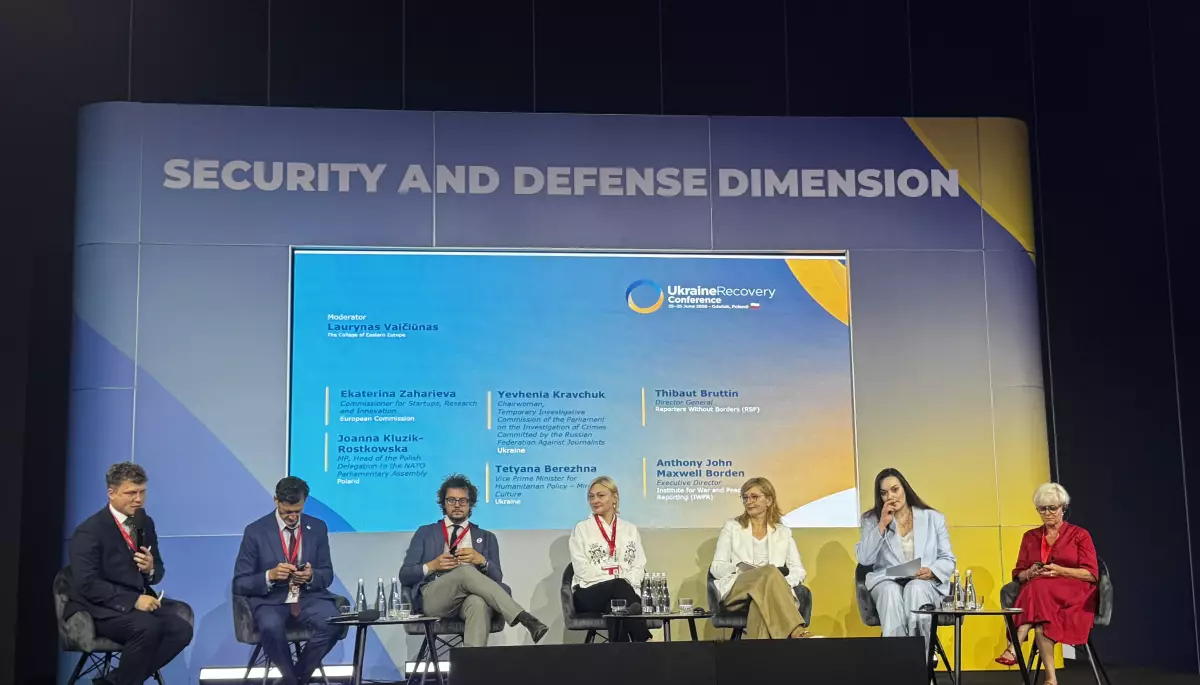
Russia has committed over 950 crimes against press freedom, killed 131 media professionals, and kidnapped 29 journalists since the start of its full-scale invasion of Ukraine, Ukraine’s Deputy Prime Minister for Humanitarian Policy and Minister of Culture Tetyana Berezhna said during her speech at the Ukraine Recovery Conference (URC 2026) in Gdańsk, Detector Media reports.
“These are not just numbers. These are the facts of Russia targeting our freedom of speech, our access to information”, she stressed.
Berezhna emphasised that informational integrity and access to information are a national security matter on a par with defense technology and weapons.
She believes that the public discourse around Russia’s aggression largely overlooks the media sphere, even though the World Bank’s RDNA reports list it among the affected industries. The total losses of Ukraine’s media sector exceed 2 billion dollars.
“When we talk about Russian aggression, about defending Ukraine, about our stability and integrity, we talk mainly about defense technology, about weapons. But not enough attention is paid to the fact that informational integrity and access to information are also national security issues,” Berezhna said.
Berezhna said that the objective of Russian attacks is to undermine trust between Ukraine and international partners by promoting narratives about corruption and the opacity of resource allocation within the country.
“Russia’s policy and all the resources it invests in the media sphere are aimed at destroying trust between Ukraine and our international partners. To convince everyone that domestic corruption is rampant here, that the resource allocation processes in Ukraine are opaque. These are the resources that are being invested in this sphere, and we need to talk about it,” she said.
Berezhna encouraged people to openly call the strength of Ukrainian media and press freedom prerequisites for national security. She also announced a discussion of the Gdańsk Confidence Package – 12 practical and scalable standards for restoring the media sector in the post-conflict and transitional period.
“We need to talk about the strength of Ukrainian media and the strength of our press freedom, because this is truly a prerequisite for national security,” she concluded.
According to the Institute of Mass Information, Russia committed 958 crimes against journalists and the media in Ukraine in the four years and four months since the start of the full-scale war. 131 media professionals were killed, 29 kidnapped, and 26 civilians working in journalism remain detained by Russia.
On 24 June, the Institute of Mass Information supported the Gdańsk Common Message, a consoldiated stance by civil society regarding Ukraine’s recovery, addressing the Ukrainian government, international partners, and all parties involved in recovery efforts. The document contains recommendations for the Ukraine Donor Platform and allows one to track if obligations are translated into concrete action.