Most Ukrainian media professionals surveyed by IMI had significant gaps in emergency preparedness. In particular, 57% of the media professionals surveyed had no fire extinguisher, and 90.2% did not know the steps to follow if trapped under rubble. When asked how they would spend an extra €3,000–5,000 to boost their own resilience, only 16.5% of those who gave a substantive answer listed physical safety among their priorities.
TThese are the findings of a study by the Institute of Mass Information focusing on Ukrainian journalists’ resilience ahead of winter 2026–2027. The survey covered 265 media professionals based in 23 oblasts of Ukraine and in Kyiv city and was carried out during the period from 21 September to 7 October 2026.
One of the study’s most alarming findings: only five of the 265 respondents (1.9%) checked out all of the basic components of general emergency preparedness. To assess this preparedness, analysts focused on access to backup power, at least two indicators of medical training, having a fire extinguisher and the skills to use it, and knowing what to do when trapped under rubble. 60.4% of respondents listed no more than one of these components.
READ MORE
- Resilience rests on people, not systems. How prepared Ukraine’s media are ahead of winter 2026–2027 — IMI study
- Only 48,3% of Ukrainian journalists are equipped for energy autonomy — IMI study
Many own tourniquets, but not everyone knows how to use them
The survey revealed significant gaps both in journalists’ first-aid supplies and in the practical skills to use them.
In particular:
- 38.9% of respondents carried at least one tourniquet on them;
- 30.9% knew how to apply a tourniquet;
- 36.6% owned a first-aid kit and knew how to use it;
- 37.7% had taken practical first-aid training within the past 12 months;
- 23.8% had never taken such training.
15.1% of the media professionals surveyed by IMI owned a tourniquet but could not apply it. Another 34.7% had neither a first-aid kit nor a tourniquet.
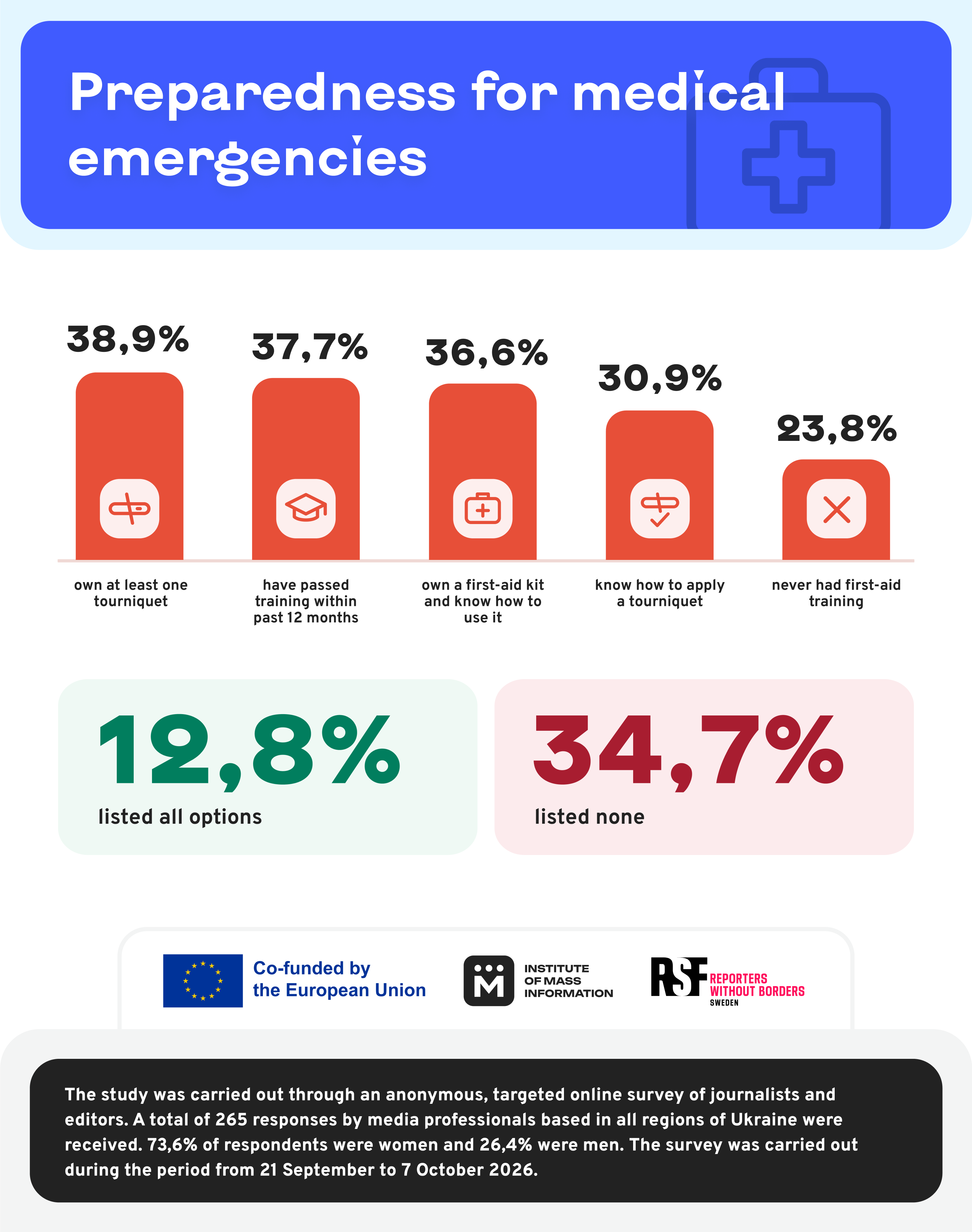
Overall, 32.8% of respondents listed none of the four indicators of medical preparedness assessed in the study: a first-aid kit and the skills to use it, a tourniquet on hand, the skill to apply it, or practical training within the past year.
Only 12.8% of respondents checked out all four.
The problem thus is not that medical equipment inaccessible, but also insufficient practical training. Owning a tourniquet does not guarantee your ability to provide help in an emergency.
Fire safety
57% of the media professionals surveyed for the study had no fire extinguisher, and another 24.5% had one but were unsure they could use it correctly.
Only 18.1% of respondents had a fire extinguisher on hand and knew how to use it.
One in four journalists keeps working during air strikes and does not go to bomb shelter
The IMI study also revealed how media professionals behaved during Russian air strikes.
The most common responses were as follows:
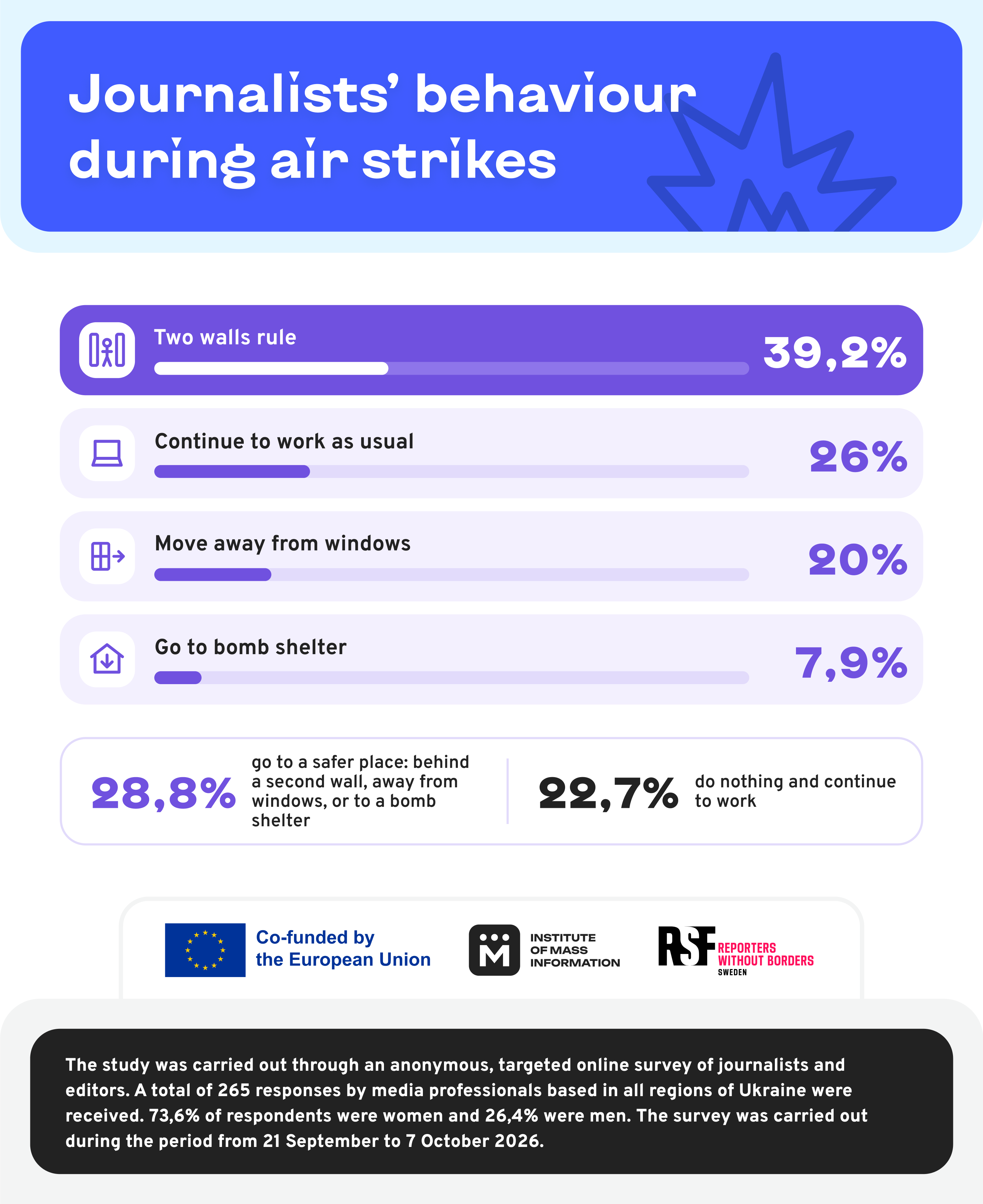
- 39.2% of the media professionals surveyed followed the “two walls rule”;
- 26% continued to work as usual;
- 20% moved away from windows;
- only 7.9% said they went to a bomb shelter.
Tellingly, the share of those who continued to work during air strikes did not vary significantly between regions close to the frontline and others: 22.7% and 28.8% respectively.
This shows that continuing to work during attacks is not a frontline-exclusive practice.
The survey did not ascertain the reasons for this behaviour. It may have to do with journalists getting desensitised to danger, needing to keep the newsroom running, a lack of accessible shelters, or other circumstances.
Journalists did report issues with access to shelters in their open-ended responses:
“The nearest shelter is at least 500 metres away.”
“I go down into the basement, but it can’t be considered a proper shelter.”
“In a sudden attack, there is often no time to get to a shelter.”
In Kyiv city and oblast, 61.8% of respondents opted for the “two walls rule”. Not a single respondent from this region reported going to a bomb shelter as something they typically did during air strikes.
These findings prompt questions not only about journalists’ personal safety skills, but also about access to bomb shelters and media professionals’ ability to interrupt their work when in danger.
Over 90% did not know the steps to follow when trapped under rubble
Another significant gap is knowing what to do if a building collapses as a result of an air strike. Only 9.8% of respondents said they knew well what to do if trapped under rubble.
Another 18.1% said they knew how to attract rescuers’ attention.
Meanwhile, 54% only had a general idea of what to do, without details, and 18.1% did not know how to act in such a situation at all.
Thus, 90.2% of respondents did not fully know the steps to follow if trapped under rubble.
This is a particularly dangerous gap given regular Russian missile and drone attacks, which threaten not only journalists working near the frontline but also media professionals based in cities in the rear.
Western oblasts show lowest medical preparedness
One of the study’s unexpected findings was regional variation in medical preparedness. Among respondents in western oblasts, 53.1% listed none of the four basic indicators of medical preparedness, compared to 28.2% of journalists in other regions.
Only 18.4% of respondents in western Ukraine had taken practical first-aid training within the past year, compared with 42.1% in other regions.
Furthermore, 40.8% of respondents in western oblasts said they continued to work during air strikes, compared with 22.7% in other regions (this finding is preliminary). The IMI study showed that safety training programmes should cover all regions of Ukraine, including those traditionally perceived as relatively safe.
Television prepared best, print press prepared worst
The study also revealed notable variation between types of media outlets. Of all respondents, journalists working in television were the best prepared for emergencies: 73.9% of them had taken practical first-aid training within the past year (34.3% for other media), 47.8% had a fire extinguisher and knew how to use it (15.3%), and 21.7% went to a shelter during air strikes (6.6%).
Journalists working in print media, by contrast, were the least likely to have basic safety skills: only 16.1% carried a tourniquet (41.9% for other media), 19.4% had taken first-aid training within the past year (40.2%), and almost half (48.4%) listed none of the medical preparedness indicators (30.8%).
Physical safety remains an underappreciated priority
Despite the gaps identified, journalists reported a need for energy equipment far more often than for physical safety-related equipment.
Asked what they would spend an extra €3,000–5,000 on to boost their resilience, only 16.5% of those who gave a substantive answer mentioned first-aid kits, tourniquets, fire extinguishers, bomb shelters, and other physical safety needs.
Energy featured in these responses almost four times as often as physical safety.
Even among respondents who checked out none of the four indicators of medical preparedness, only 21.3% of those who gave substantive answers about spending extra money mentioned physical safety needs.
Objective gaps in safety preparedness therefore do not necessarily translate into a conscious request for help.
Power outages have an immediate impact on journalists’ day-to-day work, so energy autonomy becomes an obvious priority. By contrast, the risks of fire, serious injury, or being trapped under rubble may be perceived as less pressing, despite potentially critical consequences.
The IMI study points to the need to combine material support for media with practical safety training and building a culture of care for personal safety and team safety.
In particular, first-aid training, practical drills in using tourniquets and fire extinguishers, and preparation for what to do during air strikes or under rubble should be key components of support programmes for Ukrainian media.
After all, journalists’ resilience is not only about the ability to keep working in wartime, but also about the ability to protect their own lives and the lives of their colleagues.
Note. The study is based on an anonymous targeted survey of 265 media professionals based in 23 regions of Ukraine and in Kyiv city. The survey was carried out in the period from 21 September to 7 October 2026. The maximum margin of error for the full sample is ±5.6 percentage points. The questionnaire did not measure the actual number of hours equipment can run autonomously.