

Only 48.3% of Ukrainian journalists surveyed by IMI owned a portable power station, generator or inverter that could help them work autonomously during power outages. Power supply equipment was as accessible in frontline-adjacent areas of Ukraine as in the rear regions.
These are the findings of a study by the Institute of Mass Information focusing on Ukrainian journalists’ resilience ahead of winter 2026–2027. The survey covered 265 media professionals based in 23 oblasts of Ukraine and in Kyiv city and was carried out during the period from 21 September to 7 October 2026.
More than half of the journalists surveyed (51.7%) had neither a power station, nor a generator, nor an inverter. Despite the relatively widespread use of power banks, technical preparedness for long power outages remains low.
READ MORE
Power banks, but no full autonomy
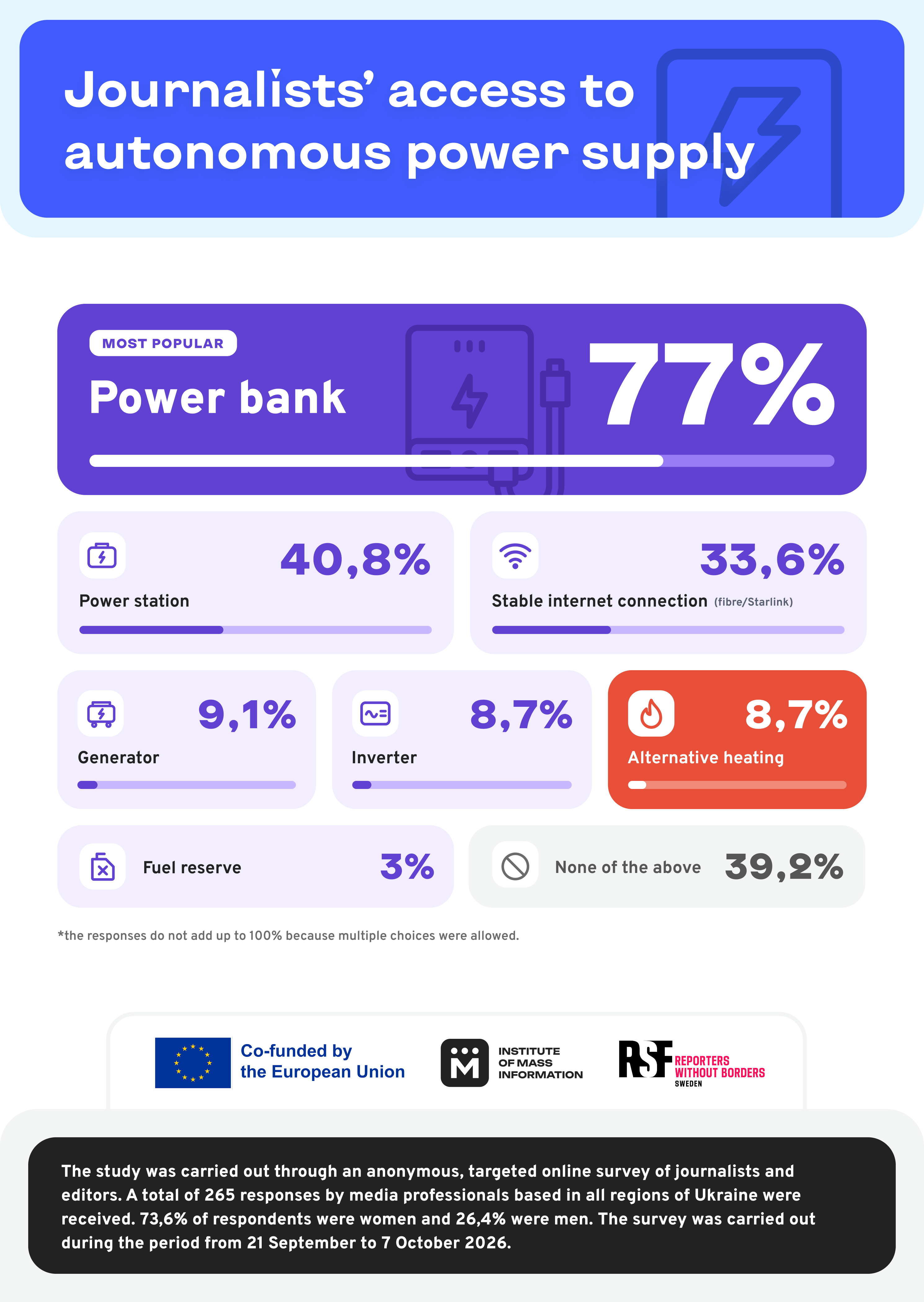
The IMI survey, showed that 77% of respondents had power banks. However, owning one does not mean being prepared for long blackouts. A power bank can keep a phone charged and connected, but does not guarantee a full day of being able to work with a laptop, internet, and other necessary equipment.
Meanwhile, 39.2% of respondents had none of the listed equipment or only a power bank.
Journalists owned the following equipment:
- power banks — 77%;
- portable power stations — 40.8%;
- stable internet (fibre or Starlink) — 33.6%;
- generators — 9.1%;
- inverters — 8.7%;
- alternative heating — 8.7%;
- fuel reserve — 3%.
These data reveal an important difference between owning devices and being able to keep a newsroom running. Even a power station does not always solve the problem, as its power and capacity may be insufficient to support long hours of work or keeping the heating running.
The 48.3% figure therefore reflects the share of journalists who have at least one basic source of backup power, but does not guarantee that they will be able to work a full day without electricity.
The lack is the same near the frontline and in the rear
One of the important findings of the study was that journalists’ access to backup power hardly depended on location or proximity to the combat zone.
Power stations, generators or inverters were available to:
- 48.7% of journalists surveyed in frontline- and border-adjacent regions;
- 47.9% of journalists in other regions of Ukraine.
The difference is not statistically significant.
A somewhat worse situation was reported by respondents in central Ukraine and Odesa oblast, where 52.4% of the journalists surveyed by IMI had none of the listed equipment or only owned a power bank; this figure is 35.1% for other regions. This difference is a preliminary finding and needs further verification.
Energy vulnerability of the media is therefore not limited to frontline areas. Journalists working far away from the line of combat may also lack the resources to keep working during blackouts.
This is an important signal for media support programmes, because going off geography alone when distributing aid does not always reflect the actual level of journalists’ access to equipment. Support for frontline media remains critical, but the needs of newsrooms based in the rear must also be assessed and taken into account.
Energy autonomy was the most reported need
The shortage of energy resources was also evidenced by responses to an open-ended question about what journalists would spend an extra €3,000–5,000 on to boost their own resilience.
Of the 230 substantive answers, 63.9% mentioned energy equipment, connectivity, or heating. This is the most frequently reported category of needs.
For 22.2% of respondents who gave a substantive answer, energy was the only spending priority listed.
Another 14.3% also mentioned a need for heating or equipment to keep themselves warm.
Tellingly, it was not only those who owned no energy equipment who said they needed more. Among journalists with only a power bank or nothing, 66.7% listed energy as a spending priority. But among the remaining respondents, the figure was 62.1%. There is no statistically significant variation between these groups.
In their open-ended answers, journalists explained exactly what they lacked:
“A bigger power station, because mine is only enough for a laptop.”
“For a gas boiler.”
“An inverter to power the whole household, not just a few devices.”
These responses suggest that the key problem is no longer just having no equipment, but the insufficient power and capacity of the equipment available and its inability to provide heating.
Support for media should be measured in hours of autonomous work, not the number of devices supplied
The IMI study showed that approaches to energy support for Ukrainian media should be rethought.
Handing over individual power banks or low-capacity power stations can solve some pressing problems, but does not always ensure journalists can work autonomously for long periods.
To assess whether such assistance is effective, it is important to consider not just the number of devices delivered, but also their capacity, power, hours of autonomous operation, and the needs of specific journalists and newsrooms for connectivity and heating.
The key finding of the IMI study: Ukrainian journalists’ energy autonomy remains insufficient regardless of region. Ahead of winter 2026–2027, support should aim not simply to provide media professionals with individual devices, but to create conditions that would enable them to work during long power outages.
Note. The study is based on an anonymous targeted survey of 265 media professionals based in 23 regions of Ukraine and in Kyiv city. The survey was carried out in the period from 21 September to 7 October 2026. The maximum margin of error for the full sample is ±5.6 percentage points. The questionnaire did not measure the actual number of hours equipment can run autonomously.