

76% of Ukraine’s top news websites (38 of 50) have their full editorial policies or individual provisions from them posted publicly, which is 12% more than in 2025. 33 outlets (66%; 50% last year) disclosed their editorial policies in full. The study covered the 50 most popular Ukrainian news websites (excluding regional outlets); experts at the Institute of Mass Information carried it out in September — November 2026.
An editorial policy is a publicly available document wherein a media outlet explains its values, standards, and operating rules: fact-checking, working with sources, correcting errors, ad labelling. The Law “On Media” only requires an editorial charter from linear media (Part 2, Article 35), but IMI considers that every responsible online outlet should have an editorial policy published.
33 (66%) of the 50 outlets had full editorial policies posted on their websites: Ukrainska Pravda, UNIAN, OBOZ.UA, Channel 24, RBC Ukraine, NV, TSN, Suspilne, Novyny.LIVE, European Pravda, ZN.UA, LIGA.net, Economic Pravda, Radio Liberty, ArmiyaInform, Ukrinform, Forbes Ukraine, Babel, Hromadske, Hlavred, Fakty ICTV, Slovo i Dilo, Espreso, Focus, Kyiv Post, Telegraf, LB.ua, Finance.ua, Today.ua, Detector Media, Ukrainski Novyny, Blik, and ITC.ua. For comparison, the figure was 50% in 2025 and 44% in 2024. Economic Pravda had no editorial policy of its own but referred to Ukrainska Pravda‘s (i.e. its publisher’s) “Principles and Work Rules”; European Pravda posted its own version of these principles.
READ MORE
- Editorial policy transparency of news websites grows by 14% in 2025 — IMI study
- Transparency of Ukraine’s news websites in 2026. IMI study
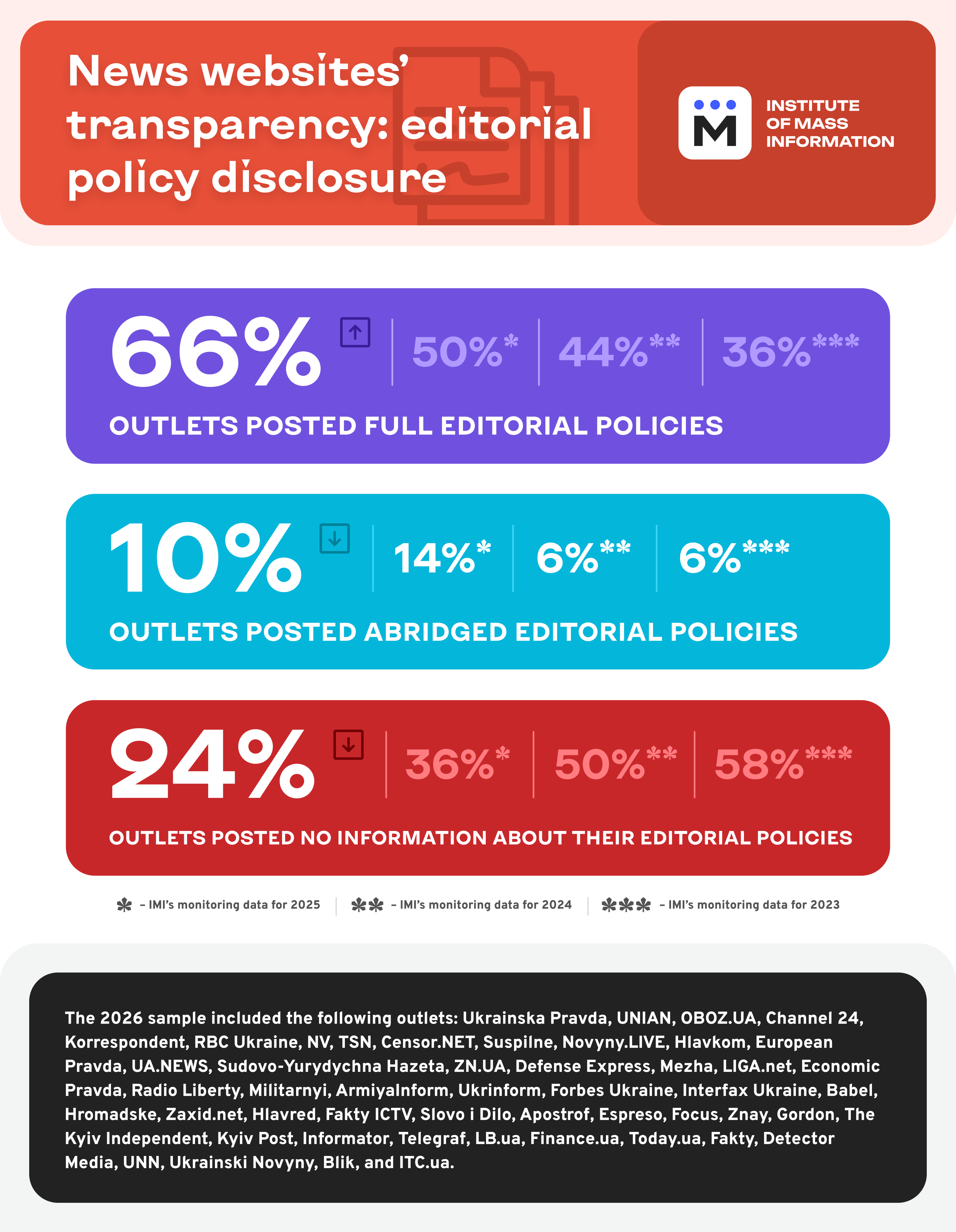
Five outlets (10% compared to last year’s 14%) have described their editorial principles in part: Censor.NET, Interfax Ukraine, Zaxid.net, Apostrof, and The Kyiv Independent. The Kyiv Independent had no dedicated editorial policy: the “About Us” page on its website only describes the principles of editorial independence and the procedure for reporting errors.
Four outlets improved their transparency by posting full editorial policies for the first time:
- TSN: an editorial policy page with rules for fact-checking and correcting errors;
- ZN.UA: a document including nine sections, such as on verification, unnamed sources, unsigned material, and the use of artificial intelligence;
- Fakty ICTV: a ten-section document covering the outlet’s mission, principles, sources, error correction, ad labelling, AI use, and inclusivity;
- Forbes Ukraine: “Editorial Rules” in nine sections, covering conflicts of interest, the line between the newsroom and the business, error correction, and AI use.
None of the outlets we assessed last year as well showed a worse situation with editorial policy. Of the 17 newcomers to the sample, nine outlets published full editorial policies: European Pravda, Economic Pravda, ArmiyaInform, Kyiv Post, Finance.ua, Today.ua, Detector Media, Blik (an editorial policy in 12 sections and a separate code of ethics), and ITC.ua. One more, The Kyiv Independent, had an incomplete policy, and seven had none.
At least 14 outlets in the sample disclosed their rules on AI use, either as part of an editorial policy or in a separate document: Ukrainska Pravda, Channel 24, RBC Ukraine, Suspilne, ZN.UA, ArmiyaInform, Forbes Ukraine, Hromadske, Hlavred, Fakty ICTV, Focus, Finance.ua, Detector Media, and Ukrainski Novyny.
Twelve outlets (24%; 36% last year) had no editorial policy available: Korrespondent, Hlavkom, UA.NEWS, Sudovo-Yurydychna Hazeta, Defense Express, Mezha, Militarnyi, Znay, Gordon, Informator, Fakty, and UNN.
The study covered 50 online media outlets: Ukrainska Pravda, UNIAN, OBOZ.UA, Channel 24, Korrespondent, RBC Ukraine, NV, TSN, Censor.NET, Suspilne, Novyny.LIVE, Hlavkom, European Pravda, UA.NEWS, Sudovo-Yurydychna Hazeta, ZN.UA, Defense Express, Mezha, LIGA.net, Economic Pravda, Radio Liberty, Militarnyi, ArmiyaInform, Ukrinform, Forbes Ukraine, Interfax Ukraine, Babel, Hromadske, Zaxid.net, Hlavred, Fakty ICTV, Slovo i Dilo, Apostrof, Espreso, Focus, Znay, Gordon, The Kyiv Independent, Kyiv Post, Informator, Telegraf, LB.ua, Finance.ua, Today.ua, Fakty, Detector Media, UNN, Ukrainski Novyny, Blik, and ITC.ua.
The study did not vet whether the outlets followed their editorial policies in practice.
IMI used its own large language model-based (LLM) AI assistants as an auxiliary tool for structuring and analysing the data set for the study, searching for and processing information, matches, and patterns. The AI output was reviewed by IMI’s analysts. The methodology, data interpretation, findings, and final editorial decisions are by the IMI research team.