
Only 16 (32%) of Ukraine’s top 50 news websites fully or partially disclosed their sources of funding in 2026. The share was the same in 2025, although a third of last year’s most financially transparent outlets did not make this year’s top by traffic.
The study was carried out by IMI experts in September – November 2026.
The methodology. The study covered the 50 most popular Ukrainian news websites (based on the Similarweb ranking for May to July 2026, excluding regional outlets).
Financial transparency was assessed based on whether a website posts their financial statements, information on their income sources (advertising, grants, donations, subscriptions), or other data that makes clear who funds the outlet. The Law “On Media” does not require media outlets to disclose their sources of funding, but this information is what allows the audience to assess who may be influencing an outlet’s editorial policy.
An outlet received 1 point (fully transparent), 0.5 (moderately transparent), or 0 (non-transparent) depending on how full the information was. Income sources listed on a separate page on the website or in the editorial policy section counted as moderate transparency. Outlets that only mentioned individual income sources in passing received 0.25 points but, as last year, were counted as non-transparent. Bank details for donations listed without reports on the money received and spent, as well as vague phrases such as “self-funded”, were not considered financial information.
READ MORE
- Financial transparency of Ukraine’s online media in 2025 — IMI study
- Transparency of Ukraine’s news websites in 2026. IMI study
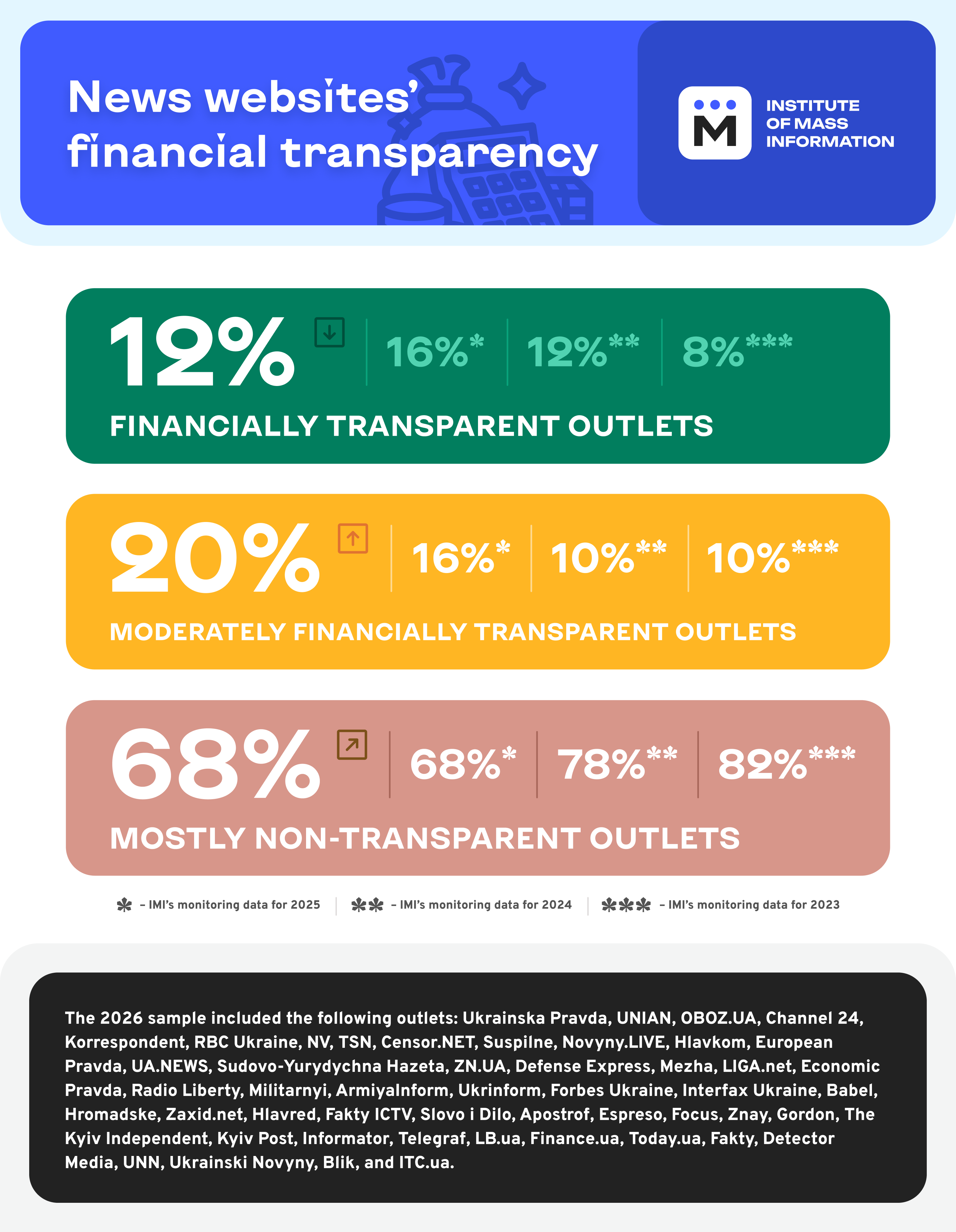
Six outlets (12%) were fully financially transparent:
- NV: the editorial policy included a dedicated section on “Ownership Structure and Financial Transparency” that featured a list of all income sources, its position on grants, and a link to the outlet’s financial statements;
- Suspilne: the issuer’s regulated reporting (for 2025 and for Q2 2026) was posted on the corporate website;
- Radio Liberty: the “About Us” page stated that Radio Free Europe / Radio Liberty was funded by the US Congress through grants from the US Agency for Global Media (USAGM);
- Ukrinform: the balance sheets, statements on financial results and cash flows for 2024–2025 and the first half of 2026 were posted in the “Tenders” section rather than “Reports”, meaning they were not easy to find;
- Hromadske: financial statements and audit opinions for 2013–2025, the financial statement for the first half of 2026, and a list of income sources (international donors, citizens’ donations, native advertising, and production) were posted on the website;
- Detector Media (featured in the sample for the first time): annual financial statements for 2022–2024 and audit opinions for earlier years were on the website of the publishing NGO.
Ten outlets (20%) were moderately transparent: European Pravda, ZN.UA, LIGA.net, Interfax Ukraine, Babel, Zaxid.net, Espreso, The Kyiv Independent, Kyiv Post, and LB.ua. European Pravda listed its donors, including the European Endowment for Democracy, the International Renaissance Foundation, and NED, and listed advertising as a source of income. ZN.UA had a dedicated section “How We Shape Our Budget” in their editorial policy, covering grants, voluntary contributions by readers, and advertising, while Interfax Ukraine had a “Funding Sources” section on their page about the agency (subscriptions to news feeds, advertising, press releases, events hosted by their press centre). Zaxid.net reported support from the European Endowment for Democracy, LIGA.net published a list of grant projects with their donors, LB.ua published information on institutional support, and Babel showed their donors’ logos, including NED and the International Renaissance Foundation. Kyiv Post wrote that most of their revenue came from advertising and events, and listed the donors of editorial projects. The Kyiv Independent reported that 70% of its 2025 revenue came from reader memberships and donations.
Espreso disclosed the structure of their revenue in a 17 August 2026 article about their business model: about 40% of their income came from producing content for partners, another 40% from advertising and monetisation of their TV, digital, and YouTube content, and up to 15% from grants. This was the second most detailed revenue breakdown among the commercial outlets in the sample after NV. We counted it as moderate financial transparency, but note that this is a news article rather than a permanent funding page, which means it could be found on the website through search.
34 outlets (68%; same percentage as last year) were non-transparent. Seven of them only mentioned some sources of income in passing: Channel 24, RBC Ukraine, Censor.NET, Forbes Ukraine, Hlavred, Today.ua, and Ukrainski Novyny. Channel 24 mentioned advertising, special projects, and native formats as their primary sources of income in their editorial policy. Today.ua explained that it was funded by advertising through automated ad networks, among other things; Ukrainski Novyny wrote they sold news subscriptions; Hlavred reported that advertising was their only source of income, while Forbes Ukraine listed the prices for a subscription and for the magazine.
The remaining 27 outlets (54%) published no financial information at all: Ukrainska Pravda, UNIAN, OBOZ.UA, Korrespondent, TSN, Novyny.LIVE, Hlavkom, UA.NEWS, Sudovo-Yurydychna Hazeta, Defense Express, Mezha, Economic Pravda, Militarnyi, ArmiyaInform, Fakty ICTV, Slovo i Dilo, Apostrof, Focus, Znay, Gordon, Informator, Telegraf, Finance.ua, Fakty, UNN, Blik, and ITC.ua.
Of the 16 outlets that were fully or moderately financially transparent last year, five did not make this year’s sample: Bukvy, Gazeta.ua, Hromadske Radio, Novynarnia, and Texty. Among the outlets assessed both in 2025 and 2026, 12 were fully or moderately transparent, which is one more outlet than last year: Espreso and ZN.UA joined the list and Hlavred dropped out. Slovo i Dilo, which published their funding information last year, has none on its website this year, only donation details.
The study did not vet whether the disclosed funding information was accurate.
The study covered 50 online media outlets: Ukrainska Pravda, UNIAN, OBOZ.UA, Channel 24, Korrespondent, RBC Ukraine, NV, TSN, Censor.NET, Suspilne, Novyny.LIVE, Hlavkom, European Pravda, UA.NEWS, Sudovo-Yurydychna Hazeta, ZN.UA, Defense Express, Mezha, LIGA.net, Economic Pravda, Radio Liberty, Militarnyi, ArmiyaInform, Ukrinform, Forbes Ukraine, Interfax Ukraine, Babel, Hromadske, Zaxid.net, Hlavred, Fakty ICTV, Slovo i Dilo, Apostrof, Espreso, Focus, Znay, Gordon, The Kyiv Independent, Kyiv Post, Informator, Telegraf, LB.ua, Finance.ua, Today.ua, Fakty, Detector Media, UNN, Ukrainski Novyny, Blik, and ITC.ua.
IMI used its own large language model-based (LLM) AI assistants as an auxiliary tool for structuring and analysing the data set for the study, searching for and processing information, matches, and patterns. The AI output was reviewed by IMI’s analysts. The methodology, data interpretation, findings, and final editorial decisions are by the IMI research team.