
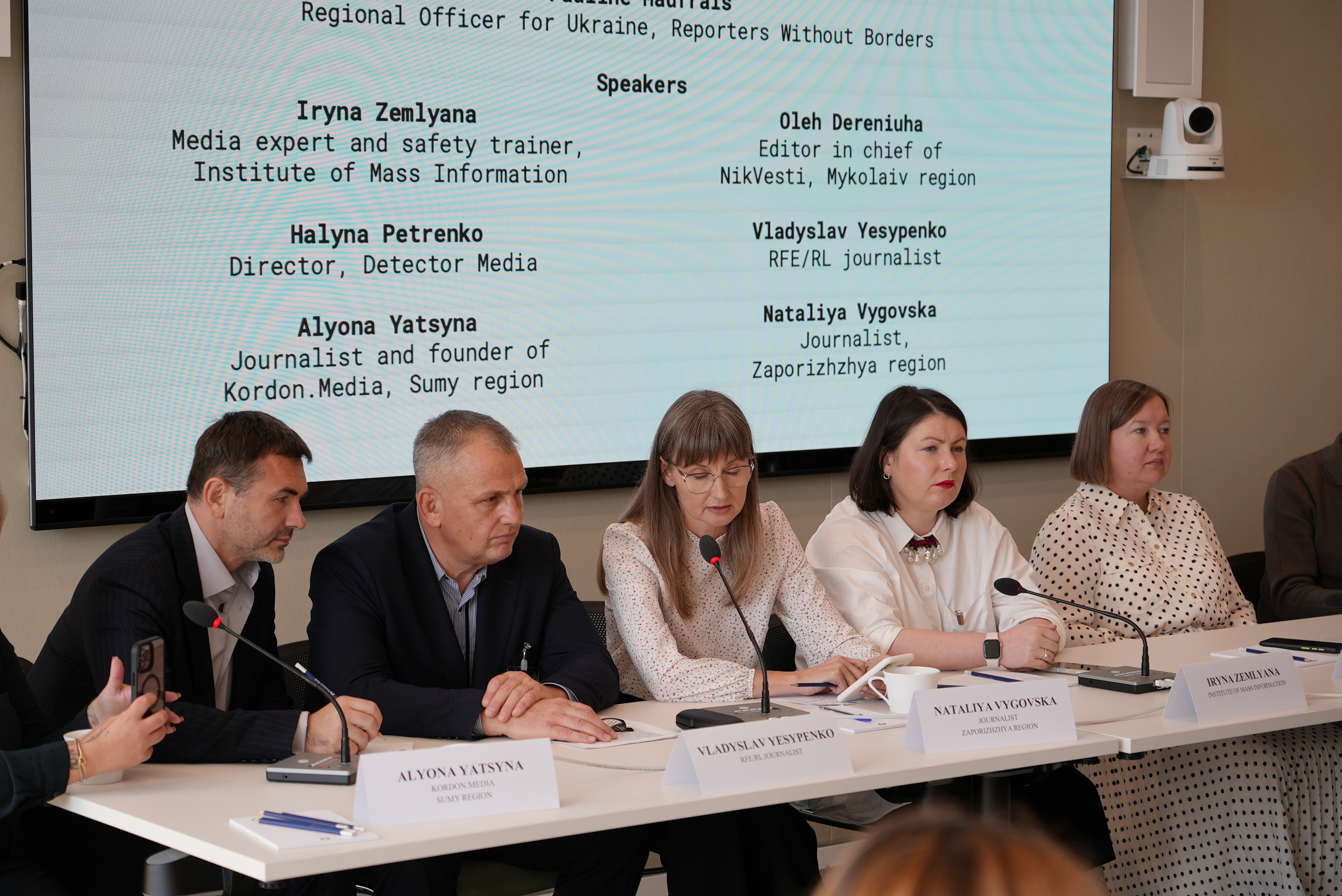
Russia is systematically destroying freedom of speech in the occupied territories of Ukraine, imprisoning and killing journalists. This was stated by the freelancer of Radio Liberty Vladyslav Yesypenko, who was released from Russian imprisonment in June, at Rebuilding Ukraine: Strong Media, Secure Investments, Transparent Recovery, an event marking the launch of the Independent Fund for the Reconstruction of Ukrainian Media (IFRUM) in London (UK) on 19 September.
Vladyslav Yesypenko used to be a freelance journalist with Radio Free Europe / Radio Liberty and made many reporting trips to Crimea after its annexation by Russia in 2014. He covered political and social events, filmed flash interviews with locals, and collaborated with with the project Krym.Realii to investigate European companies that continued to work with Russia in Crimea under occupation.
“In March 2021, I was detained by FSB officers while on a journalist assignment in Crimea. They planted a grenade in my car to smear Radio Liberty. Without any investigation or lawyers, I was taken ‘to the basement,’ where they beat and tortured me or over a day, sending electric shocks through my body to make me confess of being a spy,” Yesypenko said.
In August 2022, an court unlawfully installed by Russia in Crimea sentenced Vladyslav to five years in prison. He returned home in July 2025 “to fight and tell the whole world what the Russian government is really doing to independent journalists, people whose opinion is different from that imposed on Russian citizens by the authorities.”
“I would like to say that the media’s most important role is to inform, as they provide people with up-to-date data on events and processes in society. And I would like to draw your attention to the occupied Crimea, the Donbas, Zaporizhzhia, Kherson oblasts. Wherever Russia came to our land, freedom of speech has been completely destroyed. Ordinary people who speak out against the Russian war on social media are given real prison terms,” said Vladyslav Yesypenko.
He added that the Russians are kidnapping, torturing, and sometimes killing Ukrainian journalists. In particular, he mentioned Viktoria Roshchyna, who died in Russian custody in 2024.
“The Radio Liberty project was the last major source of information where people in the occupied territories could learn what was really happening there. But with President Donald Trump assuming office, everything changed. Large corporations such as Radio Liberty and Voice of America are forced to downsize their teams, downscale their projects, and live with uncertain prospects for the future. We all remember that it was not tanks but microphones that brought about victory in the Cold War. Where the totalitarian states of the Soviet Union and then Russia failed — in destroying independent media — Trump succeeds with one stroke of the pen,” Yesypenko said.
He added that Ukrainian journalists were counting on European partners and hoped that the latter share a vision of how to resist Russian aggression on the battlefield and in the media space.
As reported earlier, Rebuilding Ukraine: Strong Media, Secure Investments, Transparent Recovery, an event marking the launch of the Independent Fund for the Reconstruction of Ukrainian Media (IFRUM), took place in London on 19 September, hosted by the European Bank for Reconstruction and Development (EBRD) alongside the EU delegation in the United Kingdom.
A photo exhibition about the work of Ukrainian journalists in wartime was also presented at the European Bank for Reconstruction and Development (EBRD) HQ.
The Independent Fund for the Reconstruction of Ukrainian Media (IFRUM) was launched by the international watchdog Reporters Without Borders and Ukrainian organisations: Institute of Mass Information, Lviv Media Forum, Detector Media, DII-Ukraine, Recovery Window, Media Development Foundation. The Fund has already received support from the European Union.