

A newspaper called Ostdeutsche Allgemeine Zeitung (OAZ, “East German General Newspaper”) has started operations in Germany. The newspaper claims to be the voice of East Germany and an alternative to West German media. Its team features former columnists for Russia Today and RT DE, Roman Honcharenko reports for DW.
Honcharenko says it is rare that a new newspaper emerges in East Germany. The last time this happened was over 30 years ago, which is why the launch was met with enthusiasm, all the more so as the media market is transforming: circulation numbers are dropping, some news outlets are moving online wholesale, but in the East, digital subscription revenues are rarely large enough to compensate for losses.
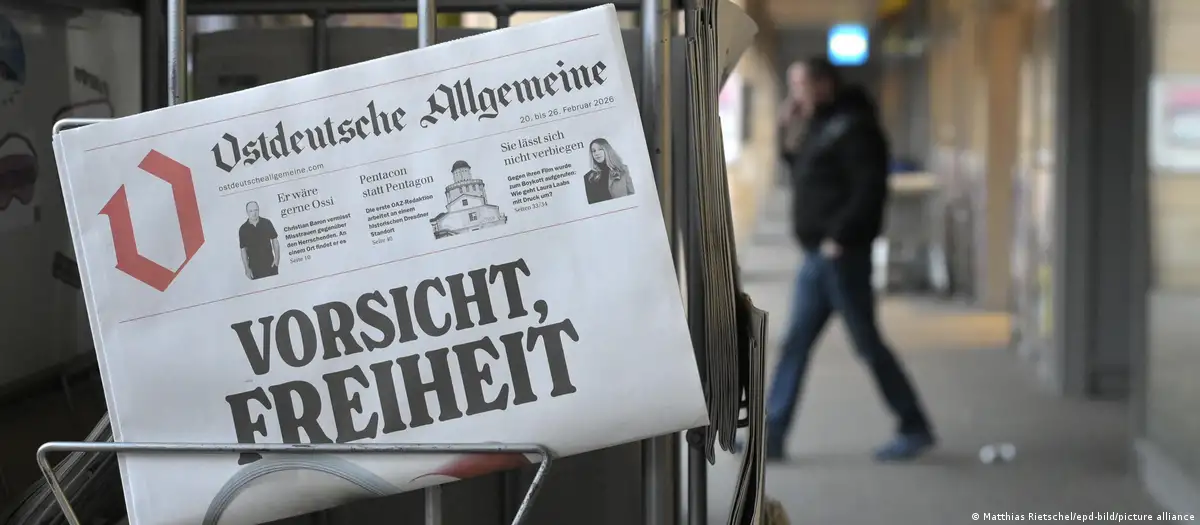
Photo by Matthias Rietschel/epd-bild/picture alliance
The first issue of OAZ came out on 19 February, with a declared circulation of 43,000 print copies and a digital version available online. The newspaper is based in Dresden, the capital of Saxony. “The very fact that they have a print version is indicative of who the publishers are targeting – the 60+ generation, that is, those who still buy their newspapers at newsstands. There are more of them in Eastern Germany than in the West,” DW writes.
The new media outlet claims to be the voice of eastern Germany, the six federal states of the former German Democratic Republic (GDR), which among other things means they promote a less critical view of Russia and its war against Ukraine.
Honcharenko points out that the newspaper’s title and its main page read as a challenge to the popular West German media. There is a large Essen-based regional news outlet called the Westdeutsche Allgemeine Zeitung (WAZ), and the Gothic font OAZ uses for their logo is reminiscent of a German press flagship, the Frankfurter Allgemeine Zeitung (FAZ).
“The new newspaper is full of nostalgia for the German Democratic Republic (GDR) and bitterness against West Germans for what many have perceived as moralising. The author of one article, a West German, writes that he would have preferred to be an ‘Ossi’, as East Germans are called in Germany. The overarching theme is that ‘things were not that bad in the GDR.’ Some journalists see the newspaper as an attempt at revanchism,” the article reads.
The new newspaper is published by Silke and Holger Friedrichs, a German entrepreneur couple. Holger Friedrich, 60, was born in East Berlin and is the most prominent voice of the GDR in the German media market.
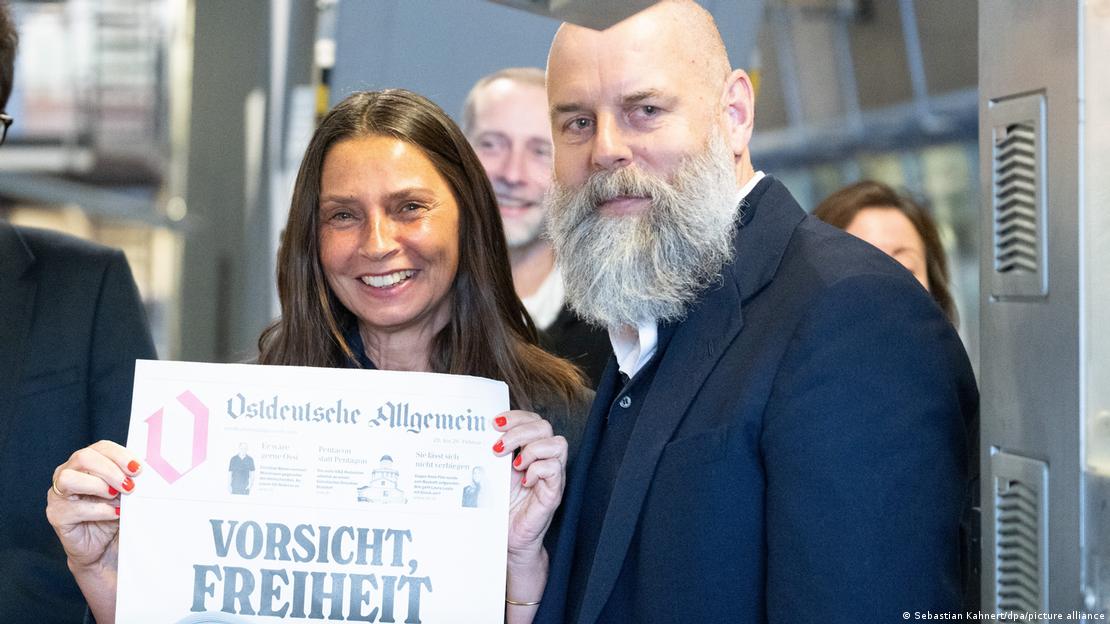
Friedrich has said in a recent interview with Welt am Sonntag (WamS) that he travels to Russia every now and then. He visited Moscow shortly before the launch of the new newspaper and saw a show at Bolshoi Theater.
In his interviews, the publisher advocates for ending the war and resuming relations with Russia. Honcharenko notes that one statement from Friedrich’s WamS interview, where he was asked why Russian President Vladimir Putin would wage a war “where all sides could only lose,” and replied, “Why would I found the Ostdeutsche Allgemeine Zeitung? It’s about self-assertion,” sparked controversy.
Honcharenko writes that one Thomas Fasbender, who used to work at the Berliner Zeitung and earlier at RT DE, the German-based project of the Russian international broadcaster RT (formerly known as Russia Today) that closed in 2022, now writes for the Ostdeutsche Allgemeine Zeitung. Florian Warweg, Fasbender’s former colleague at RT DE, has been assigned OAZ parliamentary correspondent.
Searching the keyword “Russia” on the Ostdeutsche Allgemeine Zeitung website yields 44 links. One is an interview with the Prime Minister of Saxony, a member of the ruling conservative CDU party, Michael Kretschmer, with the quote “Russia cannot be defeated on the battlefield” as the headline.
“Judging by the top articles, the team of the new East German newspaper is not engaged in what could be called overt pro-Russian propaganda,” Honcharenko notes.
He adds that there is no clear answer as to why the OAZ would open in early 2026 specifically. Observers have pointed out that the new media outlet emerged at a time when the former German Democratic Republic (GDR) is expected to face a political upheaval with nationwide implications. The far-right party Alternative for Germany (AfD) may win the September election in the federal state of Saxony–Anhalt. It’s ranking in the polls is about 40%, so this political force may for the first time form a government.
The AfD is criticized for its pro-Russian stance, among other things. For example, on 25 February, it submitted a draft resolution to the Bundestag proposing to put an end to Russia’s war on Ukraine through negotiations, curtailing military support for Ukraine, lifting sanctions against Russia, and “unfreezing” Russian assets in the EU. The proposal was not supported. In its first issue, the OAZ painted a portrait of AfD co-chair Tino Chrupalla which many news outlets have described as “friendly.”