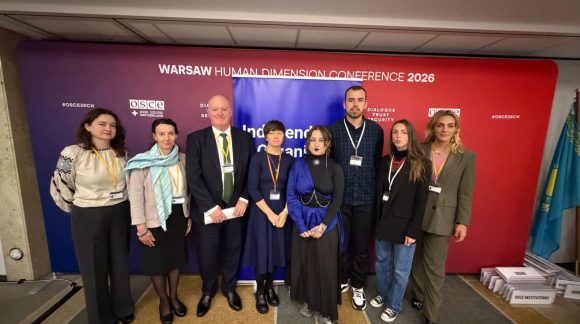
Civil society organisations are calling on the Ukrainian government to swiftly adopt the Information Security Strategy 2030. The statement was published on the website of the Centre for Democracy and Rule of Law and endorsed by the Institute of Mass Information.
The statement stresses that the previous Strategy expired in 2026, leaving Ukraine without an up-to-date strategic document in the field of media security for more than six months.
In the meantime, Russia continued to target Ukraine in large-scale information operations and disinformation campaigns, aiming to undermine society’s resilience, discredit state institutions, and deepen internal rifts.
Representatives of civil society note that the information environment has changed significantly due to the development of digital platforms, artificial intelligence, and new tools for spreading content.
READ MORE:
“This creates new challenges for the state and society, which require a systemic, coordinated, and long-term response. This situation calls for comprehensive counterefforts on the part of the state. High-quality awareness campaigns, explanation work, media support for reforms, and media literacy training — this process requires long-term, consistent work by the state,” the statement reads.
The statement’s signatories are calling on the government to swiftly adopt the Strategy, developed by the according ministry, and to ensure it is implemented.
The draft Strategy’s key objectives include developing the state’s strategic communications system, fighting disinformation, hybrid threats, and foreign information manipulation, and promoting culture.
Furthermore, the Strategy covers reintegration campaigns for Ukrainian citizens living in territories temporarily occupied by Russia, international cooperation to ensure Ukraine’s information security, efforts to ensure unity in Ukraine’s media and boosit the national and civic identity of Ukrainians abroad.
“We are convinced that underestimating cognitive warfare poses a serious threat to the country’s defence capabilities. One can win a battle yet lose the war, because the population becomes poisoned by narratives that the enemy is persistently instilling in Ukrainian society,” the statement reads.
The signatories believe the Strategy should form the basis for coordinated efforts by the state, civil society, and international partners to protect Ukraine’s media landscape, preserve social cohesion, and support Ukraine’s capacity to withstand prolonged aggression.
“That is why we, as representatives of civil society, urge the state to adopt the Information Security Strategy as an important tool for resilience during the full-scale war. The swiftest possible adoption of the Media Security Strategy 2030, and efforts to ensure its implementation, is a crucial condition for building the nation’s resilience,” the statement reads.
The statement was signed by: NGO Centre for Democracy and Rule of Law, Souspilnist Foundation, Centre for Strategic Communications, NGO Institute of Mass Information, NGO Detector Media, the Pylyp Orlyk Institute for Democracy, NGO Lakmus Information Analysis Centre, NGO Ukrainian Institute of Media and Communication, NGO Human Rights Platform, NGO Digital Security Lab, media hygiene initiative How Not to Turn Braindead, and NGO Women in Media.