

Updated on 7 October to include the case of Channel 5 journalists who hit a magnet mine near Pokrovsk (Donetsk oblast), which detonated under their car, resulting in concussions. The total number of cases is 848.
In the three years and seven months since the start of the full-scale invasion, Russia has committed 847 crimes against journalists and the media in Ukraine, as evidenced by the Monitoring Study of Russia’s Crimes Against Journalists and the Media, which the Institute of Mass Information has been carrying out since the first day of Russia’s invasion of Ukraine.
IMI recorded six crimes against media and journalists committed by Russia in August – September 2025. These included injuries to journalists, damage to media offices, legal pressure.
Three media workers defending Ukraine in the ranks of the UAF were reported dead in September. One of them had been considered missing in action since October 2024.
- Oleksandr Holyachenko, former Kyiv FM and Nash Kyiv journalist turned servicemember. Killed in action in Zaporizhzhia oblast on 3 September 2025.
- Denys Ponomarenko, Starlight Media director of photography turned serviceman. Died on 7 September 2025 while performing a combat mission in Kharkiv oblast. Denys was a cameraman and director of photography for many projects including Psychic Challenge, X Factor, Ukraine Got Talent, Everybody Dance, Phenomenon, CUBE, Lie Detector, Hearts of Three, Mole, Psychics On The Case until 2021.
- Yaroslav Levytskyi, former cameraman with Channel 5 and the media agency ACC turned serviceman. Had been considered missing since October 2024. Reported dead on 9 September 2025. Assigned to a military unit fighting near Pokrovsk (Donetsk oblast) in late October 2024. Yaroslav went missing a few days after joining the unit.
111 media personnel have been killed since the start of Russia’s full-scale invasion of Ukraine, with 12 dying while reporting.
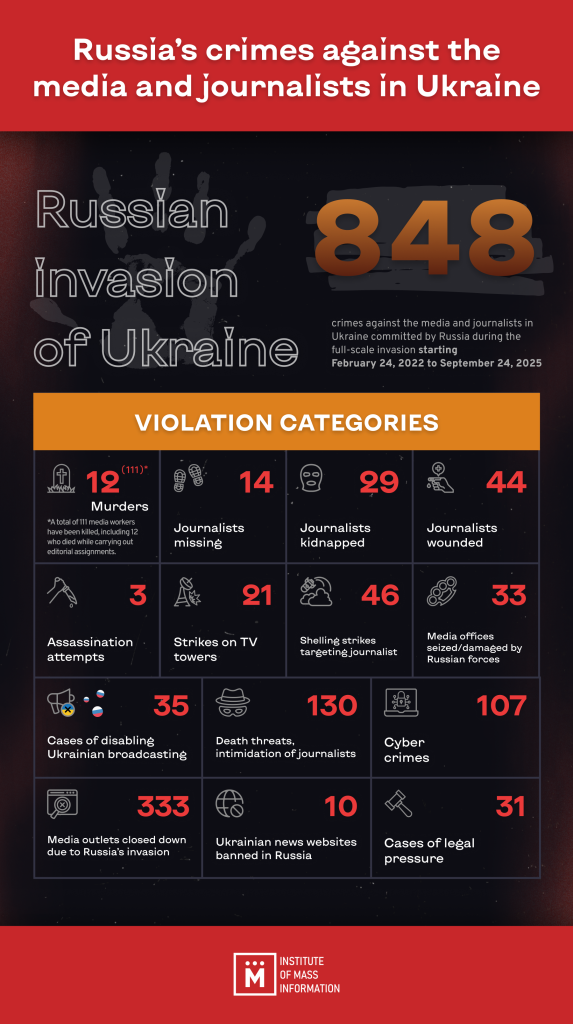
Russia commits 848 crimes against journalists and media in Ukraine in 3 years, 7 months of the full-scale war
Damage to media offices. Russia’s overnight combined arms strike on Kyiv on 28 August damaged the offices of Ukrainska Pravda and Radio Free Europe / Radio Liberty, and a Russian drone strike on Dnipropetrovsk oblast affected the office of Mezhyvskyi Merydian. No casualties were reported in either case.
Media workers injured. A crew including Channel 5 correspondent Olha Kalynovska hit a magnetic mine, which detonated under their car, during a trip near Pokrovsk (Donetsk oblast) on 19 September. All four crew members suffered concussions and one was injured in the leg (in addition to a large bruise, his upper leg bones were broken). The car was severely damaged.
Vadym Khomenko, chief engineer at Suspilne Kherson, was injured in a Russian “petal mine” explosion in downtown Kherson on 22 September. He suffered severe injuries to his leg but was quickly hospitalised and had surgery thanks to his colleagues’ prompt action; his condition is now stable. It was later reported that the explosion happened on Suspilne Kherson premises, which employees (who mostly work remotely) visit every now and then as the equipment remains in the office.
The Russian troops plant mines on the Suspilne Kherson premises by dropping anti-personnel mines such as “petals” from drones. This was reported following a SES inspection, which revealed several more mines on the broadcaster’s premises. Even though the office was cleared of mines after the de-occupation, new mines suggest a deliberate attack on media infrastructure. The office was temporarily shut down in response for safety reasons and Suspilne stepped up the protection of their staff in the regions near the front line.
Ukrainian media workers sentenced by Russian courts. In September, Russian-installed courts in the occupied part of Zaporizhzhia oblast sentenced two Ukrainian media workers, Heorhiy Levchenko and Vladyslav Hershon, to 16 and 15 years in prison respectively. Both were admins for the Ukrainian Telegram channels RIA Melitopol and Melitopol Is Ukraine, which continued to work following the occupation of the city. The two men were detained back in 2023, kept in undisclosed locations, and then charged with “high treason,” “espionage,” and “terrorism.” The trials were held in camera and the rulings were based on charges that Russia only applies to Russian citizens. According to Mass Information, 26 Ukrainian media workers remain Russia’s political prisoners today. The imprisoned journalists face pressure, inhumane detention conditions, and have little to no access to legal defense.
Russia consistently persecutes Ukrainian journalists in the occupied territories with kidnappings, false charges, non-transparent trials and severe sentences. The journalists reporting on the life in the temporarily occupied regions or criticising Russia’s aggression end up on the list of “extremists” or “spies.”
See the full list of Russia’s crimes against media and journalists in Ukraine.
The Institute of Mass Information (IMI) is a civil society organization specializing in the media, operating since 1996. IMI defends the rights of journalists, studies the media landscape and reports on media-related events, fights propaganda and disinformation, and provides media workers with safety equipment for trips to combat areas (since the start of the Russo–Ukrainian war in 2014). IMI carries out the only monitoring study of freedom of speech in Ukraine, keeps a list of transparent and responsible online media outlets, and tracks Russia’s media crimes in the war on Ukraine. IMI has representatives in 20 oblasts of Ukraine and runs a network of Media Hubs that provide journalists with unfailing support. IMI’s partners include Reporters Without Borders (RSF); the organization is also a member of the International Freedom of Expression Exchange (IFEX).