

Dnipro-based Channel 11 fired journalist and host Tetyana Zayets after the release of her news story about the state of bomb shelters in Kryvyi Rih which prompted the Kryvyi Rih City Council’s capital construction department to sue the media outlet, reports Kateryna Lysiuk, the Institute of Mass Information representative in Dnipropetrovsk oblast, who spoke with the TV channel’s management and the journalist.
The news story in question is “Scandal in Kryvyi Rih: Bomb Shelters Have Cracks!”, and episode of the program About Kryvyi Rih, uploaded to YouTube on 5 November 2025. The report covers the new radiation shelters in several Kryvyi Rih schools. The shelters were officially opened in September 2025, but a month later a downpour caused the reinforced concrete of the running tracks and the stadium bowl located above the shelters to crack.
Tetyana Zayets says she was on vacation when she received a call from work. The editor and presumably a lawyer asked her a few questions about the project over the speaker and ended the conversation. Coming back from vacation on 10 December, the journalist was summoned to meet the media outlet’s director.
“I expected that we would all sit down and figure out what I said wrong and how we should retract it. I was ready for a constructive conversation. But that didn’t happen! I was told three times right off the bet, ‘You are fired!’ They were showing me the draft material for the story and discussing that, not the story itself. No one mentioned future retractions, they were simply destroying me morally and trumpling all my work,” Tetyana said.
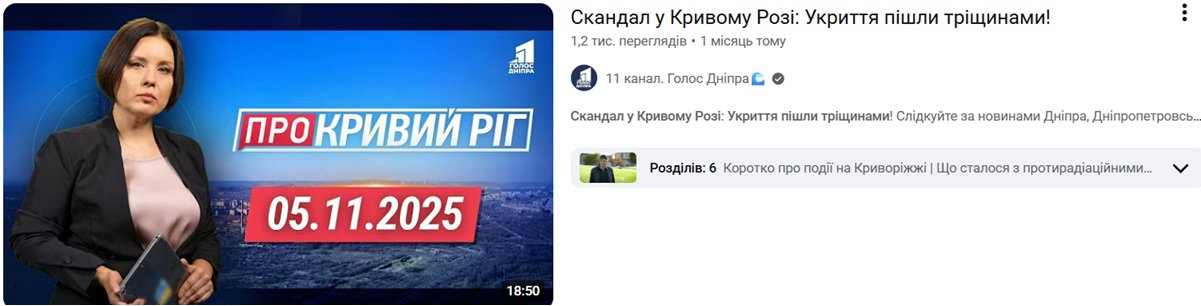
The thumbnail for the About Kryvyi Rih episode which led to the journalist’s dismissal. Screenshot of Channel 11 on YouTube
After the meeting, Tetyana Zayets wrote a resignation letter, saying she saw no further opportunity for constructive and professional cooperation. On the same day, 10 December, she was dismissed without a notice period.
After being fired, the journalist wrote a post on her personal Facebook page, which was actively shared on the platform (shared by over 680 users, with nearly 300 comments from the journalist’s colleagues and followers).
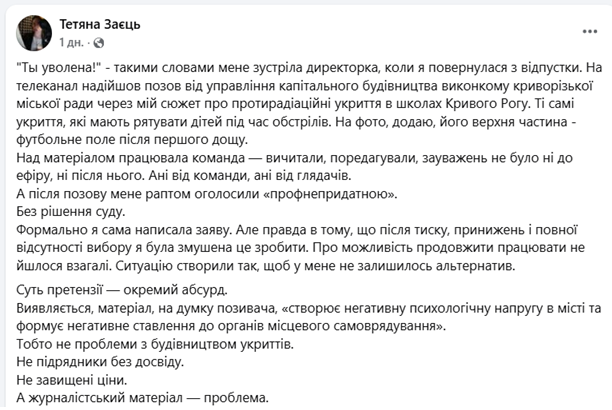
An excerpt from Tetyana Zayets’s personal Facebook post. Screenshot by IMI
In the comments, colleagues and followers expressed their support for Tetyana Zayets, urging her to sue the channel.
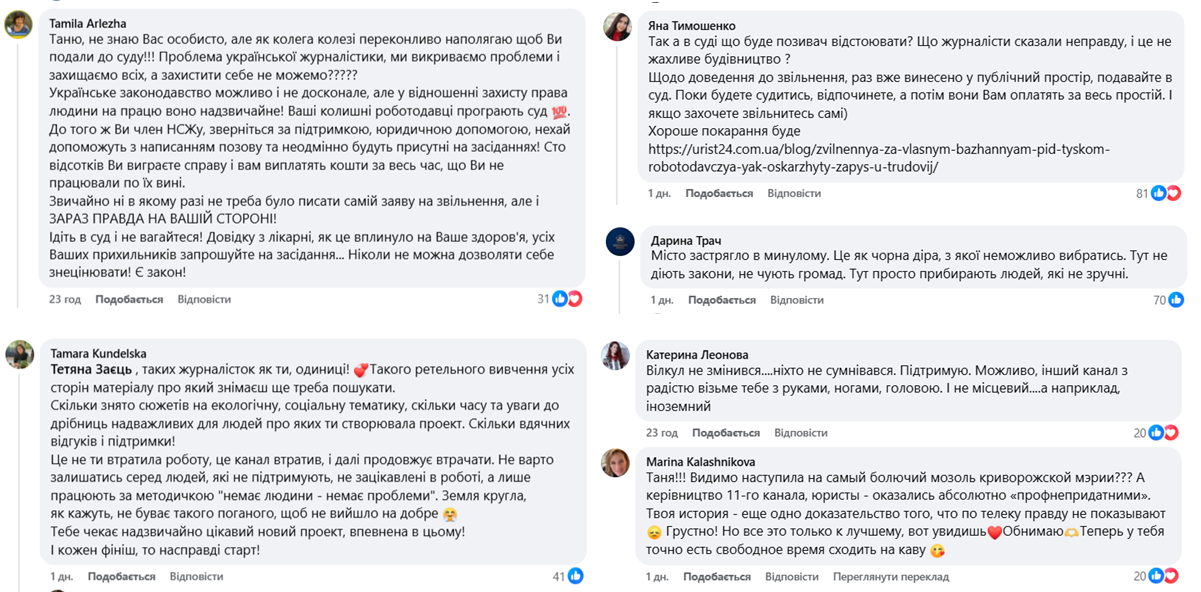
Some of the comments under Tetyana Zayets’s Facebook post. Screenshot from Tetyana Zayets’s Facebook page
The journalist admits there might have been an error in the news story, but insists that it did not raise any questions at the production stage. She adds that she has confirmation of the issues with the shelters and was acting in the community’s interests.
“I was grilled over the draft material, which yes, might have had an error. But I received no support, not a single kind word whatsoever, I was blamed simply for everything! I found myself fighting a large system, a corporation, on my own, and sure enough they will win now, they can say whatever they want about me. Yes, I might have made a mistake, but the fact that the bomb shelter there is damaged is certain! I am still hearing from people, receiving information (I cannot disclose the sources) that confirms I was not mistaken. And, most importantly, I was acting in the interests of this community,” says Tetyana Zayets.
Channel 11 director Svitlana Manko said in a comment to the IMI representative that Tetyana Zayets had resigned of her own free will after a conversation with the channel’s management regarding the objectivitiy and quality of the news story.
Svitlana Manko says that the journalist’s report about the cracks in the concrete was misleading, as, according to the channel, the cracks were only observed in the elements of the stadium and not in the shelters.
“Tetyana Zayets told the viewer that there were cracks in the reinforced concrete of newly built radiation shelters in schools, which are located about 1.5 meters deep under the school’s stadiums. She conveyed similar information to an expert, prompting him to make incorrect public comments. All while the journalist had absolutely accurate information about the integrity of the shelters themselves and was aware that the cracks were only recorded in the running tracks and the stadium bowl and were a result of the soil underneath subsiding,” the channel’s director said.
Svitlana Manko added that this fact was confirmed by the draft material for the news story, which the channel’s team studied during the internal investigation and was ready to share upon request, “in order to avoid manipulation of the professional community’s opinion around this situation.”
“Our last conversation with the journalist involved a detailed analysis of the incident, and a decision was made later to terminate our cooperation. We do not consider it ethical or appropriate to discuss the Tetyana Zayats’s motivation or her professionalism when working on the news story, the project in general, discussing this specific situation, or after her dismissal,” said the director.
Svitlana Manko confirmed that the head of the Kryvyi Rih City Council executive committee’s capital construction department had filed a lawsuit against them, adding that the channel was reviewing it as usual.
The news outlet does not plan to cancel the project About Kryvyi Rih and promises to resume the program in the near future, she added.
The Institute of Mass Information’s lawyer Volodymyr Zelenchuk notes that a statement of resignation, be it at one’s own request or by agreement of the parties, cannot be written under pressure from the employer. He adds that if such a decision is proven to be made under duress, the court may declare the dismissal unlawful and order the employer to compensate for the damage caused.
“Even if it is not mobbing, as in systematic harassment of an employee, it confirming that resignation was coerced is enough to declare such dismissal unlawful in court and make the employer pay for the ensuing damage. Of course, the employee must ensure they have proof that the pressure really occurred. Such a legal process is long, requires a lot of resources and a considerable body of evidence. Moreover, if the lawsuit is to succeed, the sum paid by the employer is always enough to compensate for their attitude towards the employee who has been reinstated in their position by a court ruling, or even the effort and time spent to resolve a labor conflict with the employer through court,” Volodymyr Zelenchuk said.